P&O’s
S.S. Iberia 1954 to 1972
Please Note: Firefox and some other Search Engines may not be suitable
Use Google Chrome for this Web Page to load perfectly!

Please Note:
All ssMaritime and other related maritime sites are
100% non-commercial and privately owned, thus ssmaritime
is NOT associated with any shipping company or any other organisation! Although
the author has worked and been involved in the passenger shipping industry for
well over 60 years, but due to his old age and poor health, he was forced to
retire. Yet, he has completed well over 1,550 Classic Liners, Passenger-Cargo
Liners as well as humble converted C3 converted Migrant Liners, which has
transported countless thousands of folk to the new world, as well on
vacations’. Amazingly, ssmaritime.com has received 573.4 million visitors
to date I trust the features online will continue to provide Classic Liner and
Ship enthusiasts both the information they are seeking, but more so provide a
great deal of pleasure and relive many happy memories!
Please Note: Postcards, photographs & other images are either
from the author’s private collection or from my supporters.
Thus thank you to my ssmaritime supporters for sending me their
wonderful photographs & images.
I am
sorry if some of the images shown may not be of the highest quality, but they
are the best that were available
P&O Lines
“Peninsular & Oriental Steam
Navigation Company”
S.S. Iberia
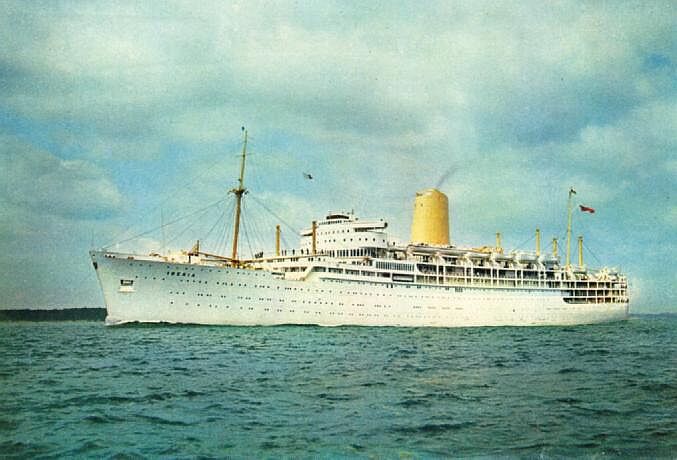
This
is one of the early P&O postcards of the Iberia
Please Note: All photographs & images are from the author’s private
collection, unless otherwise stated
Introduction:
After WWII P&O decided to upgrade their
fleet for the Australian service considering P&O had lost six of their
passenger ships. Four of these had been sunk during jus one of WW 2’s
operations, “Operation Torch,” being the Allied landing in North Africa. Included were the
magnificent Viceroy of India which was only 12 years old, and the
company’s newest ship, the four-year-old Strathallan,
Obviously, even the ships that survived WWII
needed considerable refitting at great cost. Thus P&O commenced a plan to
build a series of new ships that would be economically more viable and have a
sustainable future, for the much loved black hulled Mooltan and Maloja which
had entered service in 1923 and 1924 respectively were almost 27 years old.
They were noted for having been the first P&O ships to exceed 20,000 GRT,
but the time had come to consider replacing them with more effective and more
modern units. Other problems had arisen, such as who were going to build these
ships, due to steel shortages, rising inflation and industrial problems as well
as competition from abroad. However once the details were worked out, British
shipbuilders were decided on, as at the time they were considered to be
“the best in the world.”
In order to recommence the rebuilding plan, in
1946 P&O placed an order for the first ship to be built, the 28,000 GRT SS
Himalaya, which was followed up four months later by an order for smaller
version of the Himalaya, the 24,000 GRT SS Chusan.
S.S. Iberia:
Then the next two ships to be built, although
similar to the Himalaya,
they would be updated versions of her. Externally this would be most obvious be
most obvious by their modern stylized funnels.
The order was placed for the first ship, SS
Arcadia to be built at Clydebank in autumn 1951, whilst the Iberia’s
order was placed in the winter of 1951. The Arcadia was the first to be
completed and she departed on her maiden voyage for Sydney
on February 22, 1954. She could always be distinguished from the Iberia
as her funnel was toped with a black smoke deflector.
SS Iberia was built by the famed shipyards of
Harland & Wolff Ltd, Yard 1476, in Belfast,
Ireland.
Her keel was laid down February 8, 1952.
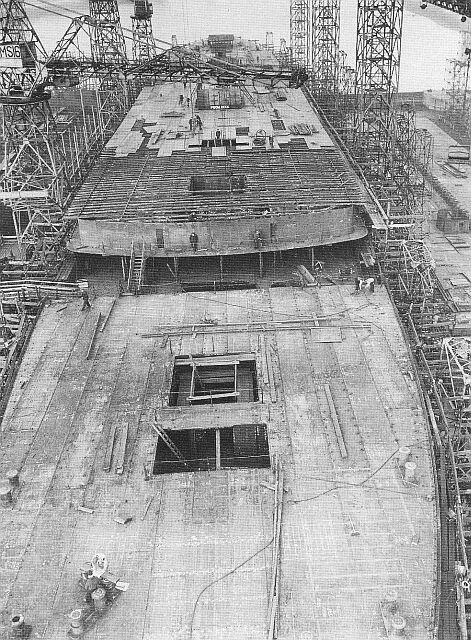
The
hull of Iberia
has taken shape and is now her superstructure is starting to take shape
Seen
at the Harland & Wolff shipyards during the building process
From
the Harland & Wolff Collection
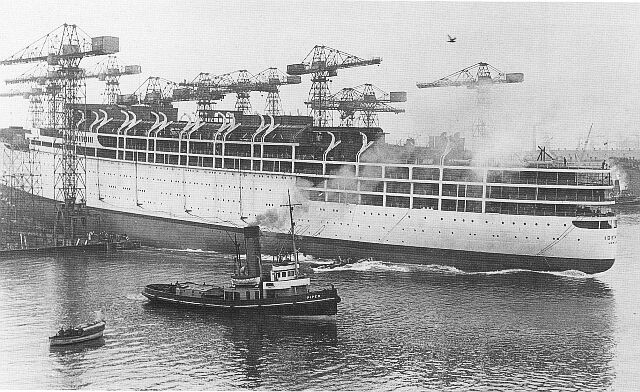
Iberia
finally reaches the water having been launched on January 21, 1954
From
the Harland & Wolff Collection
She was launched on
January 21, 1954 by Lady McGrigor the wife of the
“First Sea Lord” - Admiral Rhoderick McGrigor. After launching she went to her fitting out
wharf. For
interest, her interior design was entrusted to “A. McInnes,
Gardner & Partners” of Glasgow, who followed a well trusted standard
set by her earlier sisters, but also made some new innovations!
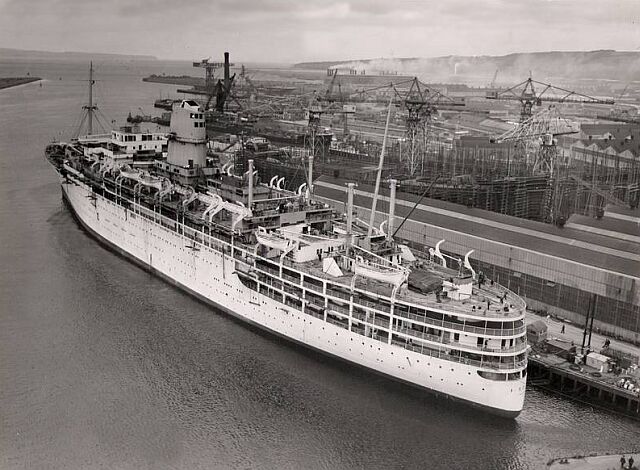
Iberia
almost completed - seen in June 1954 at Victoria
Wharf
fitting out basin
When completed, she underwent sea her trials
during September 1954 where she achieved a respectable 24.9 knots. She was
delivered to P&O on September 10, 1954. It was decided to name her Iberia
after the 1836 namesake SS Iberia (I), which was named after the Iberian
peninsular where Spain
and Portugal
are located and which had a strong connection to the formation of P&O and
the company's early years.
*There was another ship that carried the name
“Iberia,”
but it was not related to P&O, yet for some reason P&O still considered
this to be the third Iberia.
It is obvious to all followers of the Orient
Line and P&O story that 1. These two ships were contemporaries of Orient
Line’s Oronsay and Orsova respectively. In addition: 2. That the
Himalaya, Arcadia
and Iberia of P&O had been paralleled by Orient Line's Orcades, Oronsay and
Orsova. These ships marked a coming together of new liners of the two
companies. Indeed the six ships worked closely together on their Australian
service with their sailing schedules organised so that sailings alternated
between P&O and Orient. Thus they formed a Southern Dominions "Big
Six" fleet.
The 29,614 GRT Iberia departed on her maiden
voyage on September 28, 1954 from London
(Tilbury) for Sydney,
Australia,
sailing via the Suez Canal.
She arrived in Fremantle on October 22, then sailing via Adelaide and Melbourne, arriving in Sydney
on November 1. Iberia
had a cargo capacity similar to that of his sisters, of around 239,800 cu ft.
In June 1955 Iberia
commenced her first summer season of Mediterranean cruises out of the UK.
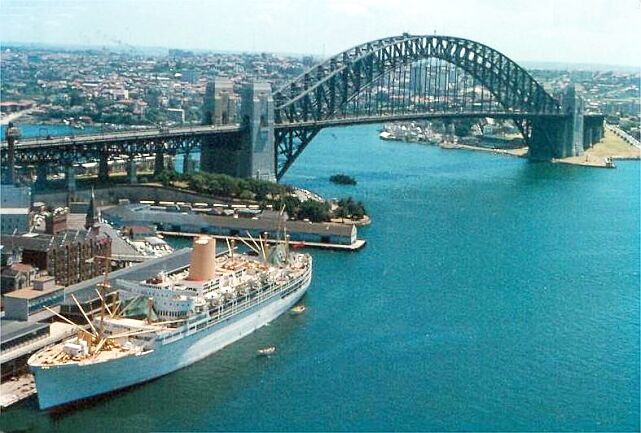
Iberia
seen at the Sydney
“International Passenger Terminal” Circular Quay
Interior & Exterior Photo Album:
1. First Class
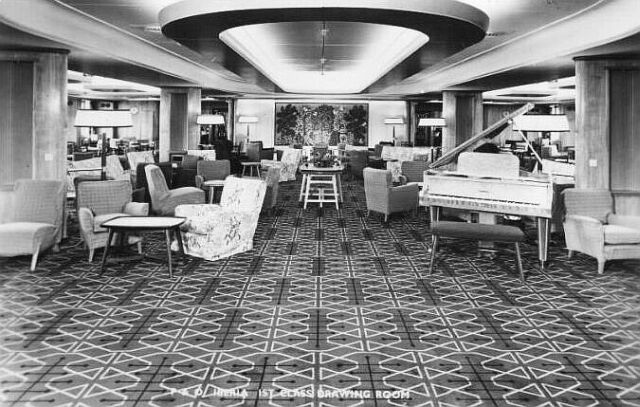
The
Main Lounge which was certainly built for comfort and having a
simple elegance
This Iberia
postcard collection is from the author’s private collection
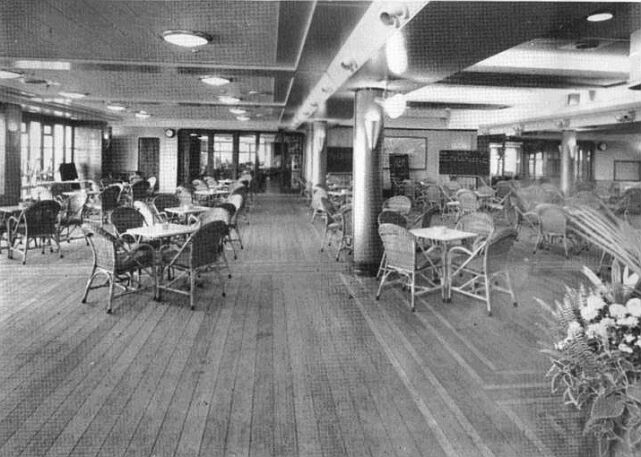
The
ever-popular dance arena was semi indoors, but out on deck with sliding glass
doors
that could be open or shut pending
weather conditions – cane furnishings was the popular mode
here
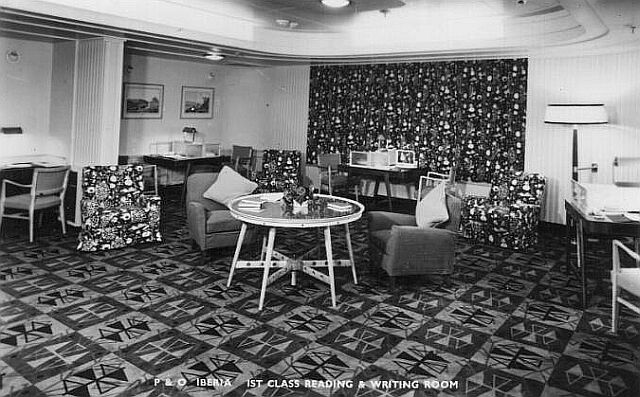
The
floral and heavy patterned Writing and Reading Room
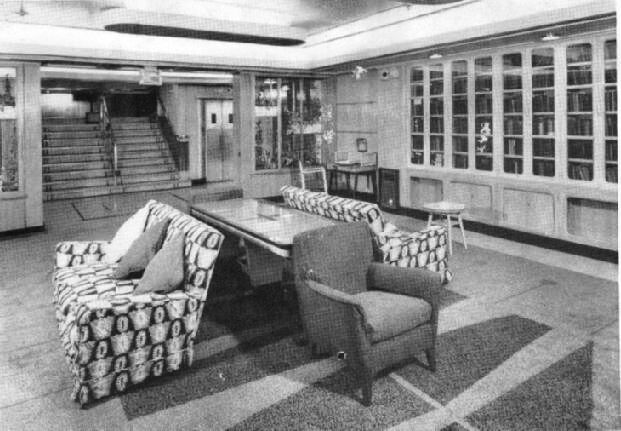
The
ever-popular Library and reading area
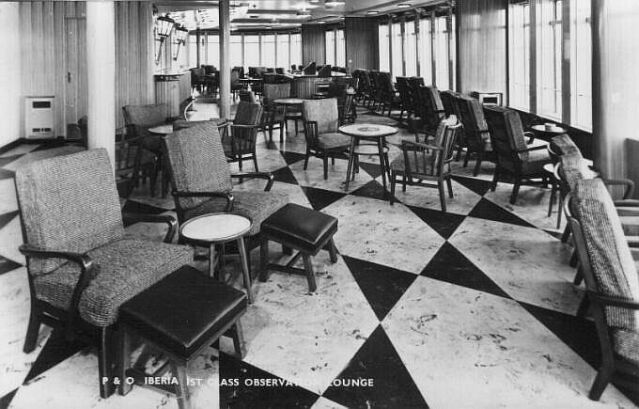
The
Observation Lounge, the forerunner of greatly extended “Crows Nest”
on the modern P&O ships
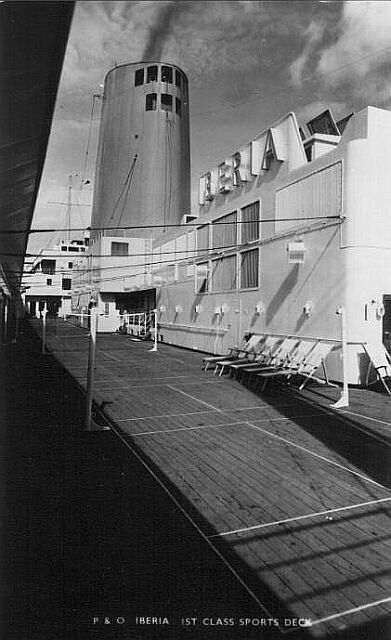
The
expansive spaces of the Sports Deck
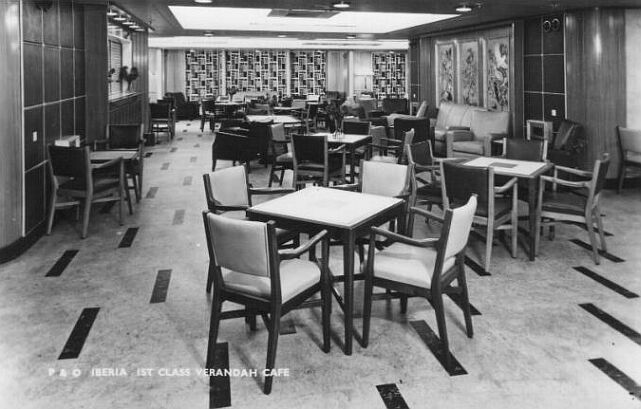
Far
aft is the popular Verandah Café overlooking the stern
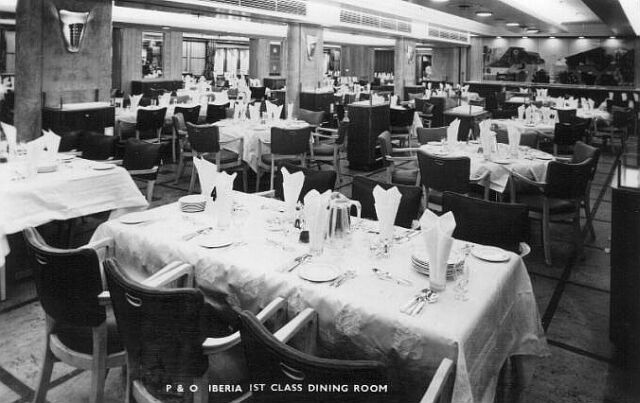
The
Dining Room was adorned with fine timbers and murals and wall
lighting and had an elegant feel!
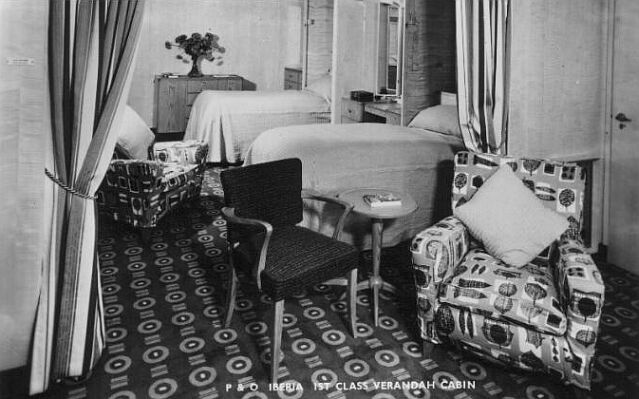
The
superb Verandah Cabin with comfortable lounge chairs
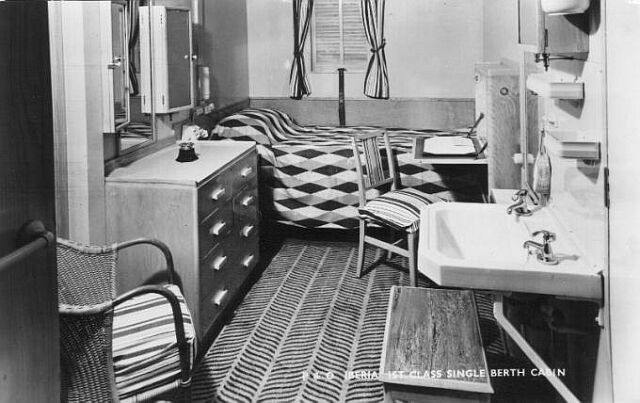
A
Single Cabin
Tourist
Class
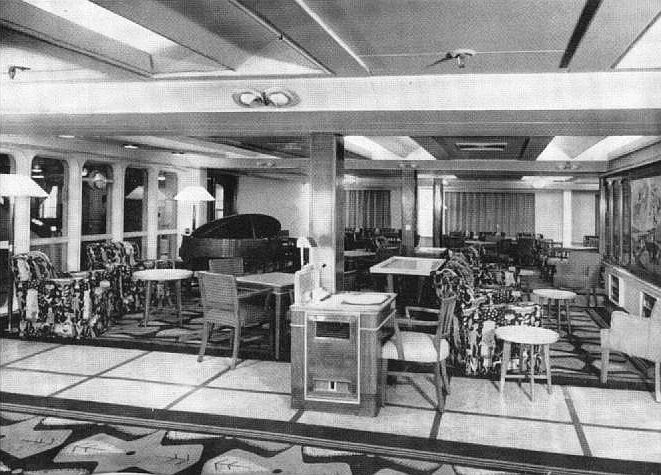
The
Main Lounge was a beautiful room with a fine mural and a Grand
piano
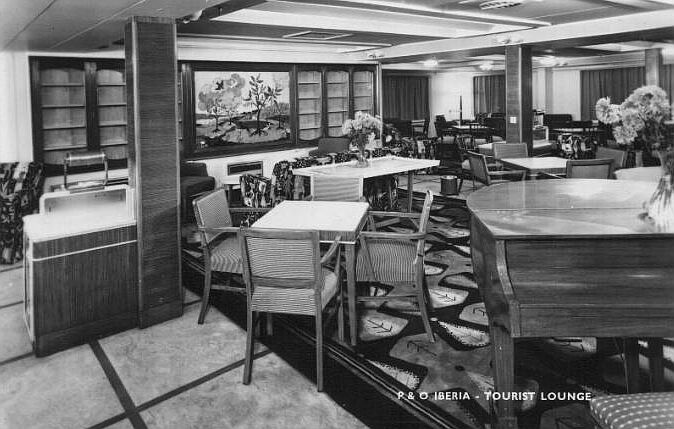
Another
view of the Main Lounge
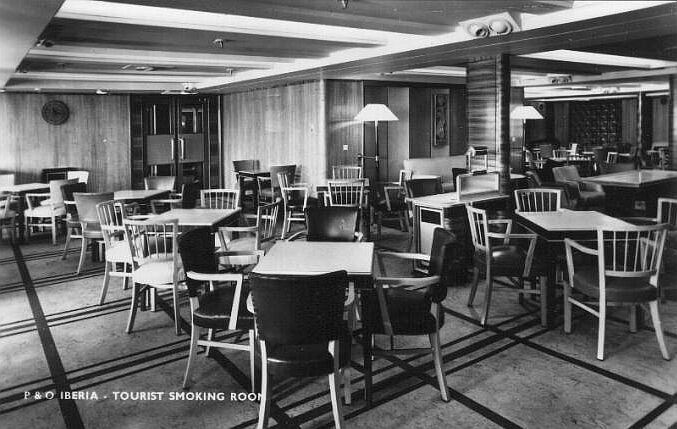
The
Smoking Room also had writing desks and was a popular venue for
games
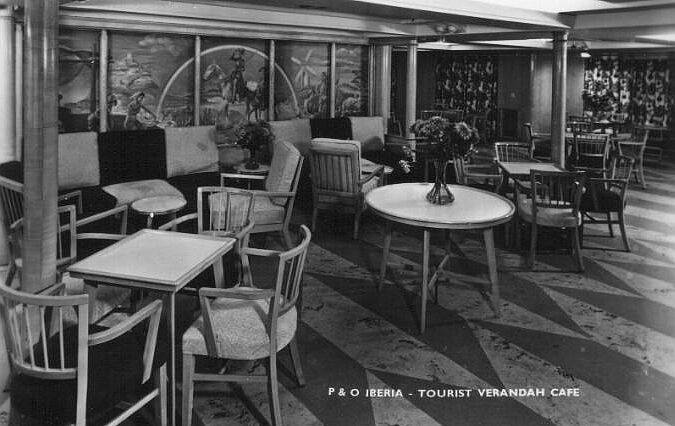
Verandah
Café was a beautiful room with a fine mural
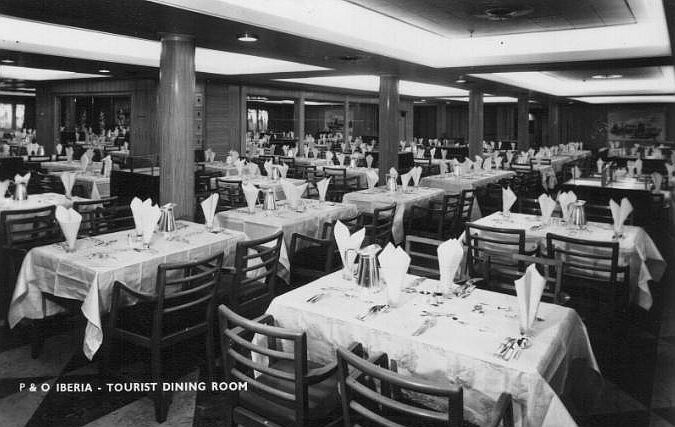
I
was impressed that the Tourist Class Dining Room has so many
tables for four
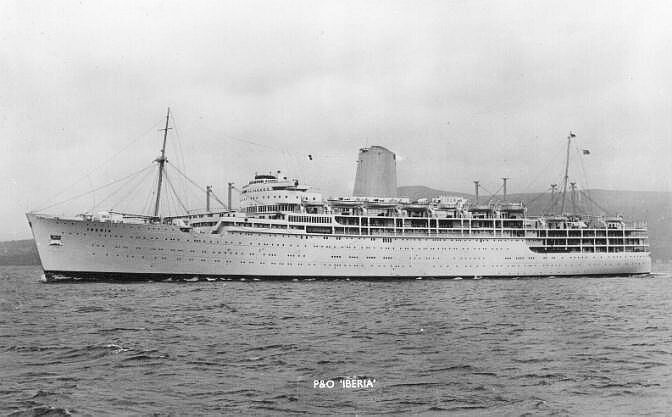
This
postcard of SS Iberia was part of the above Iberia
postcard collection – note the aft (tall) mainmast
Iberia’s General History – 1956 to 1973:
Sadly,
Iberia
eventually became known as a much “troubled ship” due to accidents
and constant breakdowns as the following overview will disclose. It is not that
the author dislikes this ship, far from it, she was simply superb and I not
only sailed on her, but I also visited her many times and dined on her often as
a P&O guest. She and the Himalaya were my two favourites of the P&O
ships of the time, Arcadia
was OK, but somehow she lacked something for me. Thus, although the following
will seem rather negative, I am simply presenting the facts and it saddens me
for she was a fine ship and her passengers greatly loved her!
Below is a list of both good and the bad incidents
of her ongoing troubled career.
On March 14, 1956 Iberia
departed Tilbury bound for Australia
via the Suez Canal.
However, on March 27 at approximately 0130 Iberia
was rammed broadside (amidships - portside) by the Esso
tanker “Stanvec Pretoria” whilst sailing
in heavy seas about 275 km (170 miles) off Colombo.
Iberia
received extensive damage to her portside Promenade, Boat and Sports Decks.
Temporary repairs were made at Colombo.
One of the things that had to be done was vertical irons bars had to be welded
to the side of the ships upper decks to support boat deck. As soon as the work
there was completed, Iberia
continued to Sydney,
and entered into the Sydney’s
Cockatoo Shipyards on April 16 for extensive repairs. After seventeen days of
extensive work, both at the shipyard and whilst docked at Pyrmont
wharf, she was returned to her regular duties.
Collision Photo Album:
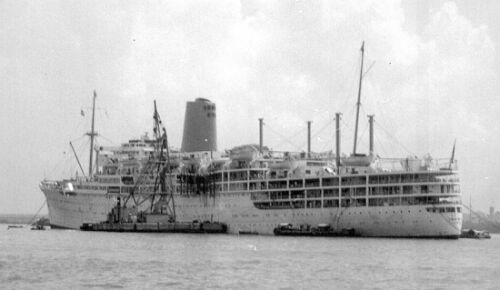
SS
Iberia is seen at Colombo
during her temporary repairs
Just aft of the
funnel and below, you will see some vertical iron
bars that were railway irons
that held the decks together, in order they would not collapse during
the voyage to Australia
Photograph
by & © Terry H. Connell Iberia’s
3rd.Officer
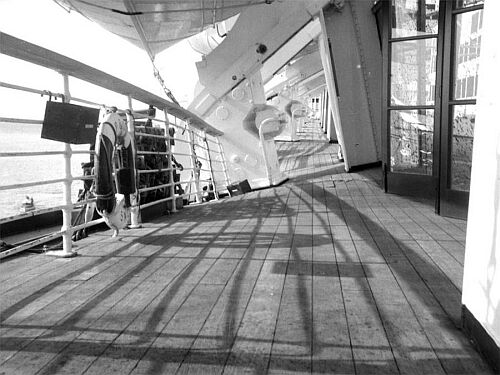
Here
we see some of the extensive damage up on Boat deck
Photograph
by Iberia’s
then 3rd.Officer Terry H. Connell ©
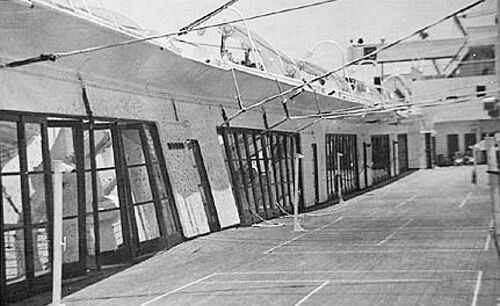
It
even extended as high as Sports Deck
Photograph by Iberia’s
then 3rd.Officer Terry H. Connell ©
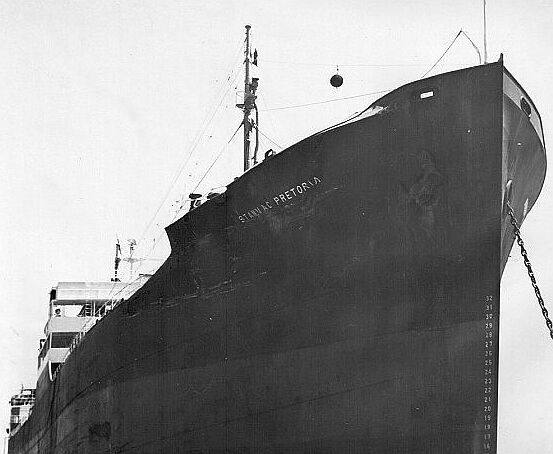
The Stanvec Pretoria had damage on its lower hull see lower
left, as well as the upper bow
Just aft of her name where the plates have
buckled extensively. However Iberia
came off the worse of the two
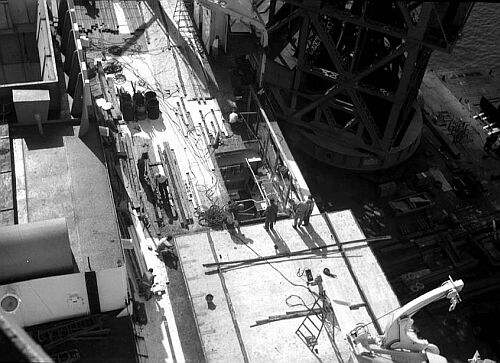
Iberia
is seen here in Sydney
during her final repairs
Photograph by Iberia’s
then 3rd.Officer Terry H. Connell ©
In April 1957 she called
at St Paul
Island
in the Indian Ocean
and this marked the first call there by a P&O ship since the Malacca
rescued the crew of the HMS Megaera which had run
around there in 1871.
On February 15, 1959 Iberia
ran aground whilst sailing the Suez
Canal northbound.
In January 1958 P&O and Orient services to
Australia
were extended across the Pacific in a joint service marketed as Orient &
Pacific Line. The Iberia
thus started operation in March 1960 on her first trans-pacific services and
sailings continued from Sydney
to Auckland,
Suva, Honolulu, Vancouver and San Francisco.
In May 1960 her management and operation was
transferred to P&O-Orient Lines.
In 1961 from January to March she was refitted
by J.I. Thornycroft Ltd, Southampton. During the work
she was modernised and finally fitted with air-Conditioning and
stabilizers.
On October 17, 1961 she suffered a complete
electrical failure having just departed Auckland New Zealand. She required five days
of repairs.
On August 12, 1962 she struck a sandbank near
Port Tewfik and damaged a blade of her portside
propeller.
A Christening in the Ships Bell:
Teresa Swan’s journey began in England
where she was born in Kent
on November 8, 1962. She and her parents Mr. and Mrs. G.L. Swan departed London England
on the SS Iberia on January 8, 1963 bound for Australia.
Special arrangements had been made to have
baby Teresa Baptized on Sunday January 20 directly after Holy Mass in the Port
Writing Room forward on Promenade Deck. For this special occasion, it had been
decided that they would use the ships bell as the Baptismal
Basin.
The Captain and the Ships Company gave Teresa
and the family two boxes of silver gifts containing eggcups and napkin rind as
well as a special Egyptian teaspoon as the ship was in the area.
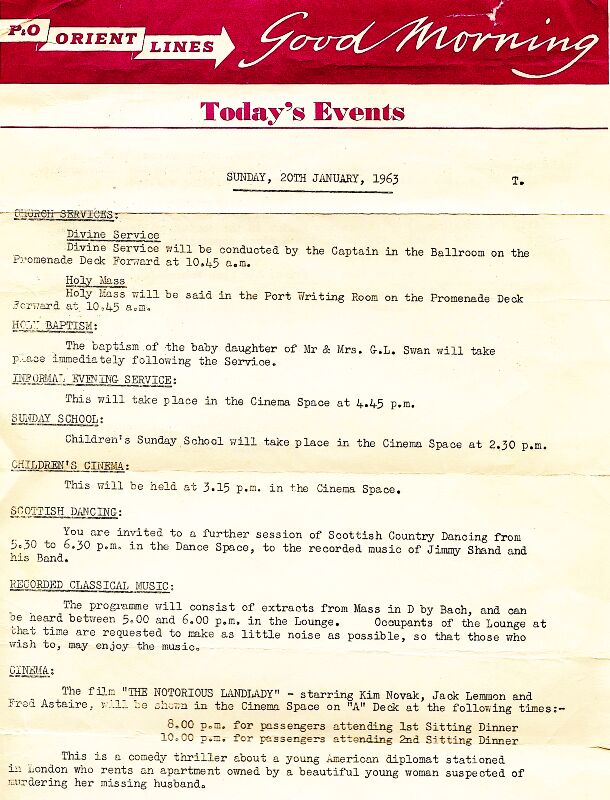
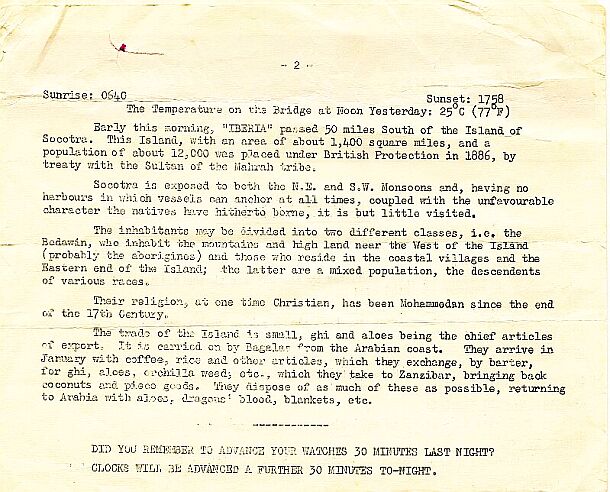
Above
SS Iberia’s daily Events & News paper for January 20, 1963
All images related
to this story were provided by Teresa Shaw
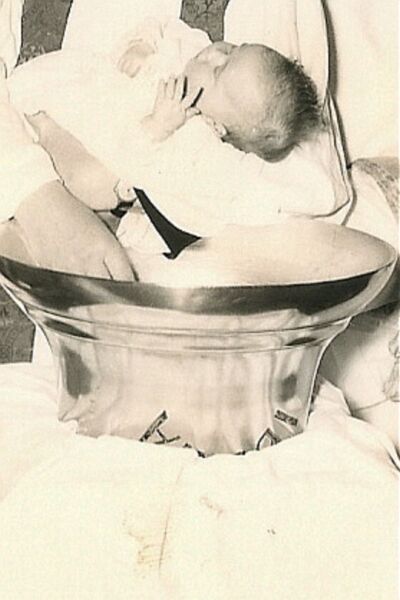
Iberia’s
Bell
is seen being used as Teresa’s Baptismal
Basin
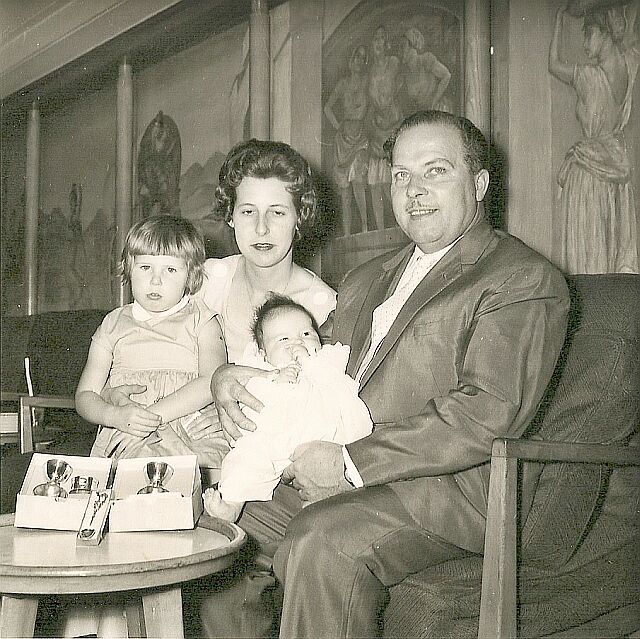
With
the event over, a happy family gets together
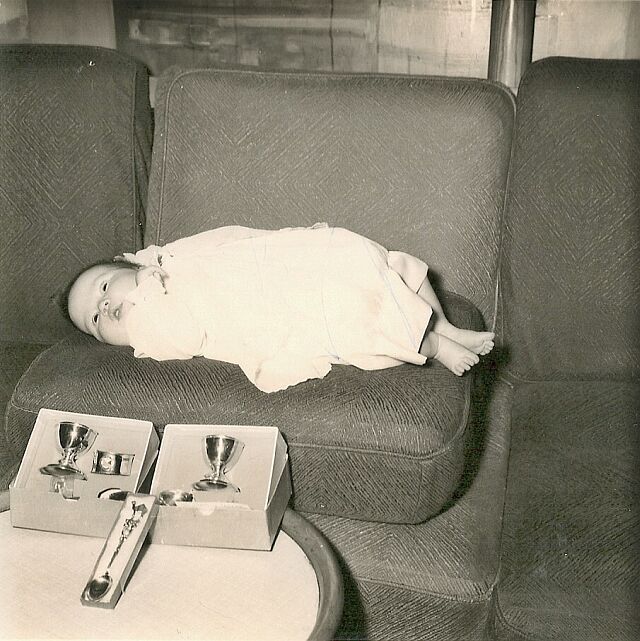
A
beautiful BUB and the gifts given by P&O
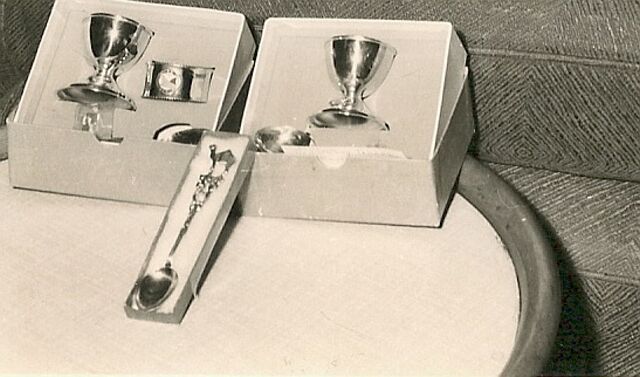
Two
silver egg cups and napkin rings and note the delightful Egyptian teaspoon
The Paul Soper Story:
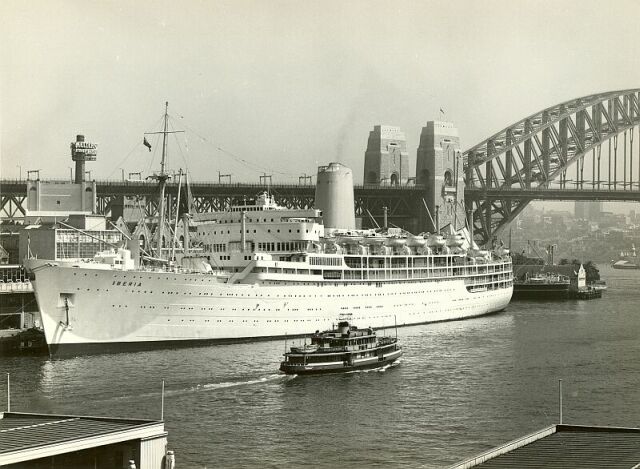
Iberia
is seen here at the International Passenger Terminal in Sydney
in 1964
Photograph
by & © Iberia’s Radio Officer Paul Soper
I received the following
interesting story from ex P&O Radio Officer Paul Soper
and decided to add it to the page as well as his photo above of the Iberia.
I have slightly edited his story, but not changed any of its content in any way
whatsoever.
The Iberia
was my first passenger liner where I served full time as a Radio Officer in
1964, although the first ship I worked on was the Canberra earlier in the year when
we went to the New York's
World Fair. I had a wonderful time on this fine ship but the highlight of my
time on the Iberia
was probably going to the Olympic Games in Tokyo
in 1964 and we had an absolutely wonderful time even if I did not get to see
any of the games - enough said!
However, during my time on her I can recall at
least two other unfortunate incidents occurring either in 1964 or
1965. The first was when we were in a long beam sea and the stabilizers
became stuck in position. The ship started to roll to port, and continued
rolling and then rolled more and more until the radio transmitters were hanging
off the bulkhead, then the typewriter smashed to the floor and the whole ship
resounded to the sound of breaking crockery. She did eventually come to a
halt, but not before a great deal of damage had been done and I suddenly
realised how many prayers I knew. But all ended well and there were no real
injuries except for a little one related to pride.
The second incident occurred when we were
anchored off Malta
and we were taking passengers ashore in the ship's tenders (lifeboats) for a
run ashore. During the afternoon the sea got a little rough and the crash
boat (which should have been fitted with the optional spray cover over the fore
deck, but was not) ploughed into a big sea and was immediately swamped, and
somehow some of the passengers and crew were flung into the water. Fortunately
they were all picked up by one of the other ship’s lifeboats and there
were no serious casualties, but it could have been quite a serious incident and
in the Radio Room we spent the rest of the day fielding queries from the press
and anxious relatives.
Paul Soper (P&O Radio Officer 1964-1971).
Iberia’s General History - 1956 to 1973 – continued:
In 1966 her passenger capacity was revised to
651 First Class and 733 Tourist. In addition her management and operation was
transferred to “P&O Lines.”
On June 10, 1966 on her way to Yokohama from Kobe,
she had to return for repairs to a turbine coupling. This delayed her voyage by
four days.
On January 19, 1967 Iberia
collided with wharf in Funchal, Madeira
and damaged her bow plates 2.5 metres above the waterline.
On February 2, 1968 she was delayed in Funchal
by two days with a power system breakdown.
On November 16, 1968 her number 2 boiler room
forced draught fan failed. Repairs were made in Dakar
and delayed the voyage by 24 hours.
On June 12, 1969 she sailed on her final
voyage from London
(Tilbury) bound for Australia
before P&O's terminus moved to Southampton.
On December 8, 1969 she finally arrived in
Southampton from Australia
after a much-troubled voyage. Whilst in Pago Pago
her funnel caught fire. Then she suffered an electrical failure in Honolulu.
But her problems did not end there, for her the starboard engine failed by the
time she arrived at Acapulco and whilst bunkering in Curacao it was discovered
that some of the fuel has escaped into one of the first class baggage rooms,
which had been flooded with fuel oil.
On December 9, 1969, the day after she
returned to Southampton,
she underwent a major two-week overhaul in dry dock. This included the removal
of her (aft) Mainmast.
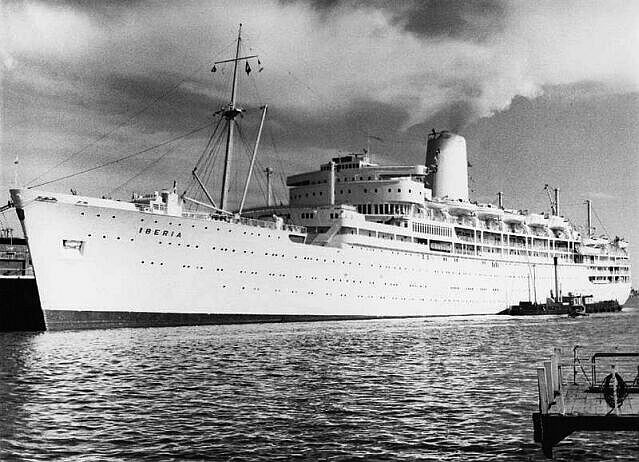
Iberia
is seen here without her aft Mainmast
On December 26, 1969, after all the work done
at the major overhaul, guess what? She suffered yet another major a stabilizer
failure.
In October 1971 her management and operation
was transferred to the “P&O Passenger Division.”
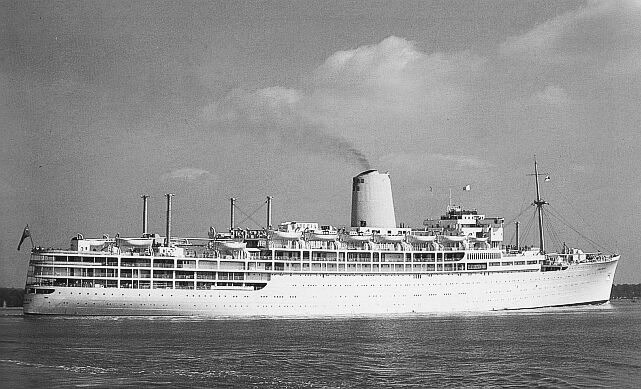
Iberia
seen on a cruise around 1971
On November 6, 1971 she sailed from
Southampton on her final voyage from the UK
bound for Cherbourg,
Panama,
the USA,
Canada
and Sydney.
But then in February 1972 it was announced that the Iberia
would be retired from service. Iberia would be the first of P&O's post war
liners to be retired from service as the line voyage loading were less and
less, and Iberia was not as popular as Arcadia as a cruise ship. In addition,
she took precedence over her sisters due to her poor mechanical performance
over the years having been a much-troubled ship, whilst her sister had a good
run.
Iberia
was withdrawn from service in 1972 arriving at Southampton for the last time
on Wednesday 19th April 1972 with an 18ft paying off pennant flying from her
mast. Captain Trenfield rang “finished with
engines.” At the end of April, Iberia
was laid up at berth 101, awaiting a buyer, which was soon found for P&O by
Mitsui & Co. Taiwanese breakers, Tong Cheng Steel
Manufacturing Co. Ltd, purchased the Iberia
to be broken up.
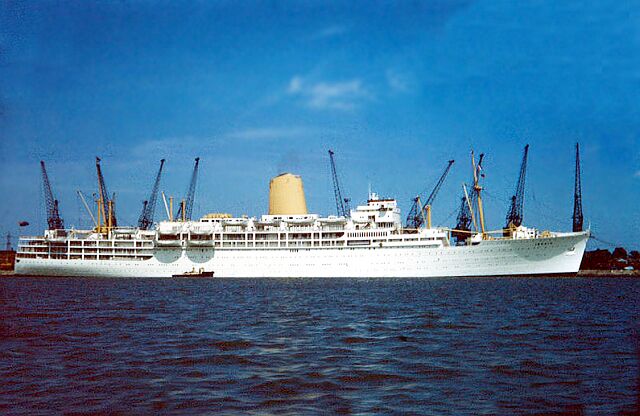
A
superb photograph of the Iberia
in mid 1972 - Note that her lifeboats are being removed
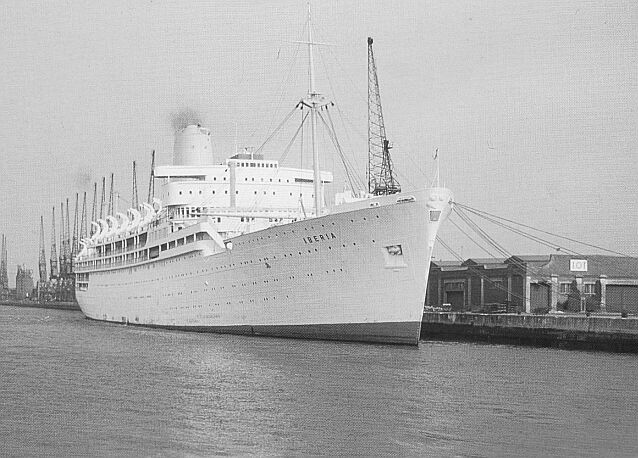
Again
we see the Iberia
mid 1972, but now without any lifeboats
For she was about
to sail to Taiwan
with just two lifeboats
On June 28, 1972 Iberia
sailed from Southampton
for the final time, but this time without passengers and with just two
lifeboats up on Boat deck. She was under the command of Captain Michael Prowse. There were also 66 other crewmembers, 14
on deck, 20 in the engine room and 32 catering and fire-patrol staff. Iberia
made calls for fuel and stores at Dakar,
Durban,
Mauritius
and Hong Kong arriving at Kaohsiung
Taiwan
on September 5, 1972. Demolition of the still
beautiful looking 18-year-old SS Iberia commenced in October 1973.
*********************
Statistics of the S.S. Iberia:
Built by: Harland & Wolff
Ltd - Belfast
Yard Number: Yard 1476
Launched: January 21, 1954
Launched by: Lady McGrigor
the wife of the “First Sea Lord” - Admiral Rhoderick
McGrigor
Official No: 186127.
Call Sign: GBCN.
IMO No: 5157781.
Maiden
Voyage: September 28,
1954
Length: 718.8 ft –
219m
Breadth: 90.10 ft –
27.5m
Draft: 36.6 ft
Tonnage: 29,614
Power: Single Reduction
Geared Steam Turbines
Propellers: 2 – 42,500 SHP
Speed: 22 knots service
speed - 24.9 max
Passengers: 679 First Class, 735 Tourist.
June 1973: 1,350 Tourist (One)
Class.
Crew: 711.
The way we like to remember her!
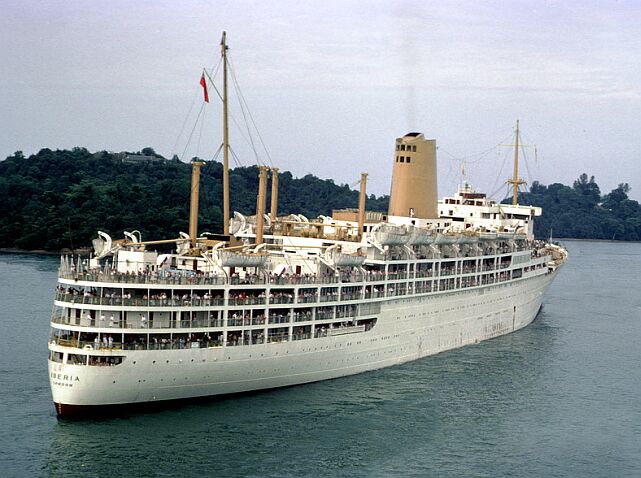
S.S.
Iberia, a ship with a superb stern and built for the tropics, thus all those
wonderful wide promenade decks!
Today ships are closed in like apartment
blocks and deck spaces are taken up by private balconies that are seldom used.
How I miss those great days when ships like the S.S. Iberia made
you feel like you lived on a real castle at sea. I hope and pray that you enjoyed this
feature and that you relived some wonderful memories!
Reuben Goossens.
*********************
“Blue
Water Liners sailing to the distant shores.
I watched them come, I watched
them go and I watched them die.”

Featuring over 1,550
Classic Passenger Liners, Passenger-Cargo Liners & Classic Cruise Ships!
Or http://www.ssmaritime.com/index2.htm
For interest: Sadly an email service to ssMaritime is no
longer available, due to the author’s old age and chronic illness as well
as being disabled, etc. In the past ssMaritime received well over 120 emails
per day, but Mr. Goossens can no longer handle same. He sincerely regrets this!
*********************
Visit our mainpage: - www.ssmaritime.com
Where the ships of the past make
history
The Author has
been in Passenger Shipping & the Cruise Industry for well over 60 years
In addition he
was the founder of “Save the Classic Liners Campaign” in 1990.
Please
Note: ssmaritime and associated sites are 100%
non-commercial and the author seeks no
funding or favours of any shape or form, never have and never will!
Photographs on ssmaritime and associate pages are
by; the author or from the author’s private
collection. In addition there are some images that have been provided by
Shipping Companies and private photographers or collectors. Credit is given to
all contributors. However, there are some photographs provided to me without
details regarding the photographer/owner concerned.
This notice covers all pages; although, and I have done my best to ensure
that all photographs are duly credited and that this notice is displaced on
each page, that is, when a page is updated!
ssMaritime is owned & ©
Copyright by Reuben Goossens - All Rights Reserved