Burns
Philp TSMV Bulolo 1938 to 1968 also the SS Malaita I & II
Note: iPhones, iPads, Firefox &
some other Search Engines may not be suitable
Use Google Chrome for this Web
Page to load perfectly!

Click
the logo above to reach the ssMaritime FrontPage for News Updates
& “Ship of the Month”
With
Reuben Goossens
Maritime
Historian, Author, Lecturer & Cruise‘n’Ship
Reviewer
Please Note: All ssmaritime as well as
my other related maritime & cruise sites are 100%
non-commercial and privately owned sites. Be assured that I am
NOT associated with any shipping or cruise companies or agencies
or any other organisations! The author has been in the passenger
shipping industry since May 1960, but although retired and
unwell, I occasionally attempt to write an article now and then,
in order to bring enjoyment and pleasure to ship enthusiasts past
passengers and crew.
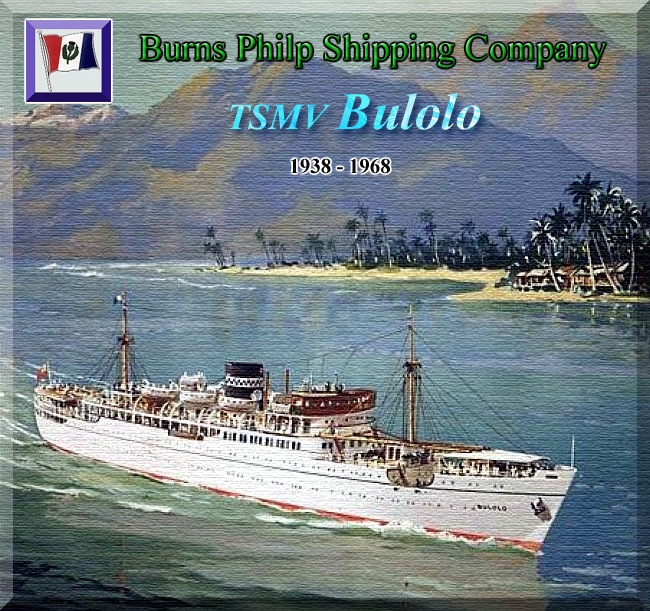
A
fine artist impression from a Burns, Philp Travel Poster
Featuring the - T.S.M.V. Bulolo
…
Also Featuring the S.S. Malaita I & M.S.
Malaita II
Photographs on this feature are
either part of the author’s private collection or as marked,
Part One - Company Background:
Brothers James and John Burns arrived in Brisbane
in December 1862. They decided to head into the country and after
several of years working as Jackeroos (mostly outdoor &
horseback workers taking care of cattle or sheep) at Springsure
in Central Queensland. Eventually they left and headed for the
Goldfield town of Gympie and became storekeepers there in 1865.
In the mid-1870’s James Burns and Robert
Philp had become friends and they had gone into a business
partnership in Townsville that included a shipping service to
Brisbane and Sydney for the inter-colony and overseas trade.
After 1876, James Burns worked from an office in Sydney, where
Burns, Philp & Company limited was incorporated in 1883.
Their business quickly expanded with new branches around the
country and in the Pacific and there was an expansion with a new
range of merchant activities as well as establishment of Pacific Island
plantations and trading connections. Burns, Philp & Company
was set to become a pioneer as well as an ambassador for
Australia in much of the South West Pacific area, and in due
time, a much-respected multi-national group of companies.
Between the 1880s and early 1970s, Burns, Philp
& Co. Ltd., operated some thirty-eight ships as well as
inter-island sailing and powered vessels. Although World War I
physical impact on Burns, Philp's areas of interest was limited,
sea-going raiders presented a constant hazard to its ships. Most
significant was the experience of its steamers S.S. Matunga which
was en route from Sydney to Rabaul, when on August 6, 1917 it was
captured by the German raiding ship “Wolf,” and it sank
the Matunga a few days later; the raider took the crew and
passengers into captivity to Europe until the end of the war.
Between the wars the ships of Burns, Philp
became a household name in Australia and South East Asia, as well
as an indispensable link with the Pacific Islands, particularly
appreciated by expatriate residents. Burns, Philp ships were
easily distinguished by their black funnels with a
black-and-white check band and their Scotch Thistle house flag.
Their sustained service to remote locations as well as main
cities and towns led to the Company sometimes being described as
“The Hudson Bay Company of the South Pacific.”
Part two - The two Malaita ships:
Prior to building the T.S.M.V. Bulolo, Burns,
Philp already operated the M.S. Malaita II on the mail service
between Australia, Papua, New Guinea, Solomon Islands, etc. M.S. Malaita
II had been named after the 1893 built Malaita I a ship Burns,
Philp had purchased in 1905. What follows is her brief history:
S.S. Malaita I - built as the S.S. Antilla:
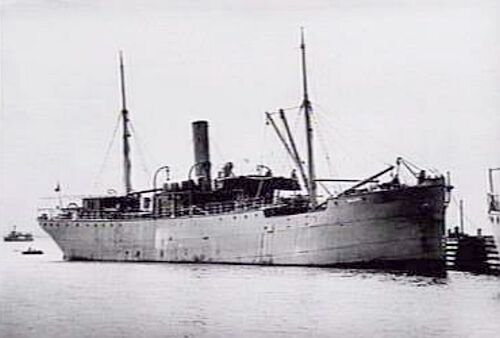
S.S. Malaita
I
From the Victoria State Library
S.S. Antilla was a small steamship of just 929
GRT (Gross Registered Tons), 200 ft long and a beam of 30.2 ft
and she had a draught of 12.3 ft. She was an all steel ship built
in 1893 by the Grangemouth Dockyard Company on the River Fourth
in Scotland. She had been ordered and built for the Bahamas
Steamship Co Ltd, Nassau. She had triple expansion engine with a
single screw giving her a respectable 10 knots for her day.
However in 1904 she was damaged by fire and she was placed on the
market.
In 1905 she was purchased by Burn Philp and was
fully reconditioned and renamed Malaita I. And she soon commenced
to trade the Pacific islands service out of Australia. She
operated this service until 1914 when she was sold.
She was obtained by another famed shipping
line, Huddart Parker and converted her into a coal hulk, but she
was later sold to Moreland Smelting Co Ltd., 1918 or 1919, towed
to Melbourne where engines of the famed paddle steamer Excelsior
were installed. She was reregistered in Melbourne by H. B. Black
& Co Ltd. However on November 17, 1926, whilst in Port
Phillip Bay whilst she was at anchor there was a storm and she
was blown ashore and smashed against the South Melbourne baths.
She was refloated, and moved to be partially dismantled and then
towed to be scuttled in the ships graveyard, just off Port Philip
heads, November 20, 1927.
M.S. Malaita II:
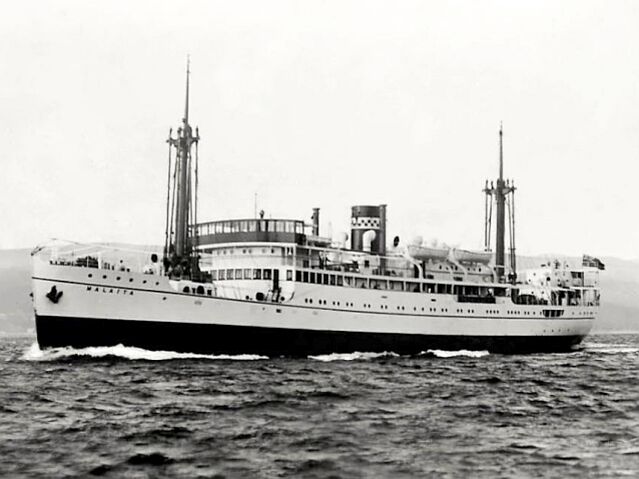
Postcard
of the stately looking M.S. Malaita II
The new ship to be built and named after the
first Malaita would be a motor ship and she was built by Barclay,
Curle & Co., in Glasgow Scotland in 1933. She was 3,310 GRT,
a length of 328 ft with a beam of 47.1 ft. She had B&W type
diesel engines and a single screw giving her a speed of 12 knots
(max 14.5). Malaita II accommodated 48 passengers in comfortable
all First Class accommodations. Her regular ports of call
were” Sydney, Brisbane, Port Moresby, Samarai, Rabaul, Lorengau,
Lombrun, Madang, Lae, Sydney. She operated this schedule every
six weeks.
Like most ships, the Malaita was taken into the
service as a Transport ship and was transporting troops and war
materials to Papua New Guinea she had an interesting time of it,
for on August 29, 1942 a torpedo struck her amidships close to
No.3 hatch and it exploded on the bulkhead between No.2 and No.3
hatches. The ship listed dangerously to starboard and it was
thought at first that she would keel over and sink, but she
survived. The HMAS Arunta was close by and came to her
assistance. By August 31 H.M.S. Malaita had moved to a safe
anchorage and the crew has started to make repairs where required
and patch up as much as possible of all the damage. In addition
the engineers had worked hard to restore the ships power and she
was fully operational again. Thus, on 15 September 15 the H.M.S. Malaita
II departed under her own power, but sailing at a reduced speed
and she proceeded to Cairns Australia where she arrived on
September 20, meaning she had steamed the 790 miles from Port
Moresby at an average speed of 7 knots. In Cairns her hull was
reinforces and she then sailed south to Sydney where she arrived
on November 13.
However, having inspected the damage it was
decided that it was too severe for repairs to be made at that
time and nothing was done until October 1945. They were then
undertaken and completed in April 1947 when she was ready again
for commercial service and returned to Burns, Philp. She resumed
trade to New Guinea with Burns, Philp.
She was sold 1965 to San Fernando Steamship Co
(John Manners subsidiary concern) and was renamed M.S. Pilar Regidor.
Three years later in 1968 she was sold to Jaguar Shipping Corp,
renamed Linda JR and continued operations. She was finally
scrapped at Kaohsiung Taiwan in August 1971
Part Three – T.S.M.V. Bulolo:
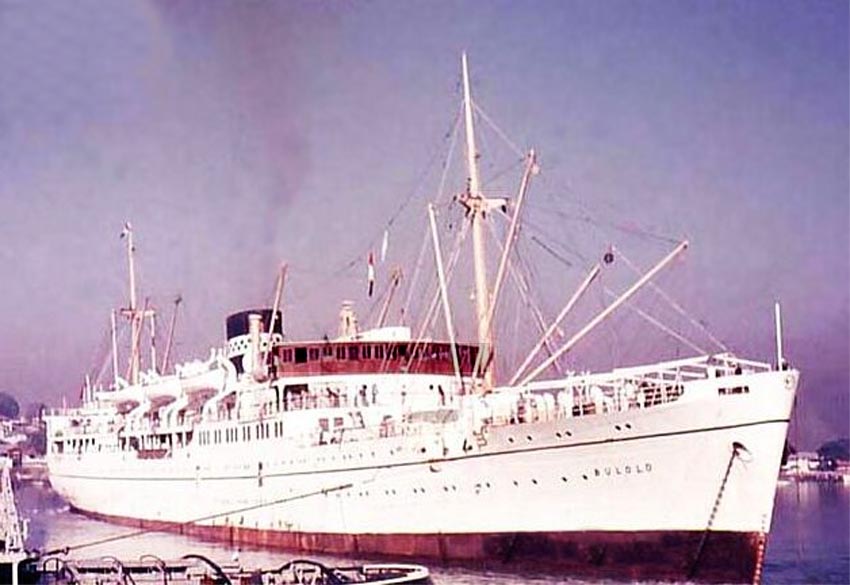
T.S.M.V.
Bulolo seen arriving at Newstead, Brisbane being assisted by the
tug Fearless
Photograph
? Wallace Cray
With the M.S. Malaita II continuing in
operation, Burns, Philp realised that a new and a larger ship was
required to enable them to operate a more efficient mail, cargo
and passenger service. Thus with their designers having laid
plans for a more modern liner, Burns, Philp ordered for their
larger which was very much an updated version of the M.S. Malaita
II. The result would be a 6,397 GRT, 240 Passenger-Cargo Liner,
which like the Malaita II, would also to be built by Barclay
Curle & Co, in Glasgow Scotland.
On May 31, 1938 the ship was officially named *“Bulolo”
and she was launched and was towed to her fitting out berth.
*The Name & the Natives of Bulolo:
The origin of the name Bulolo is based on Papua
New Guinea’s “Bulolo River” and the old
1920’s Gold Mining Town Bulolo along the river, which became
the world’s largest Gold Mine. Native land owners of the
region were an ancient tribe of cannibals, known as the Biangai
who were discovered after the news of old along the Bulolo River
between Bulolo and Wau in 1910. In the early 1920’s Charles
“Yorkie” Booth staked his claim along the river near
Bulolo, with him was his wife Doris Booth, who was also an
author, who wrote the book “Mountains, Gold and
Cannibals” which was finally published in 1929.
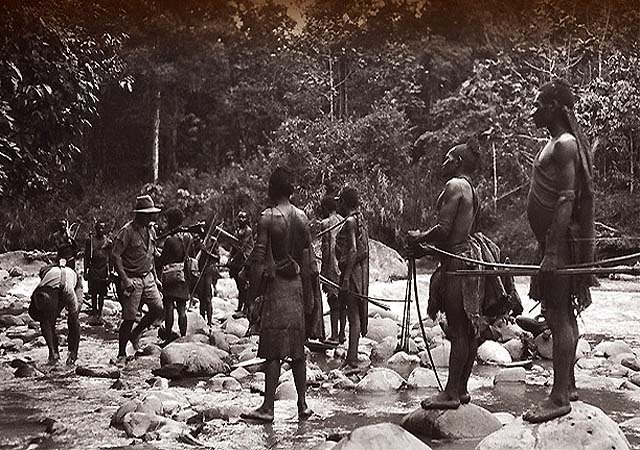
A
scene at a Bulolo gold claim in the 1920’s
Source
is unknown - Please see photo notes at the bottom of this page,
as I always wish to provide full credit
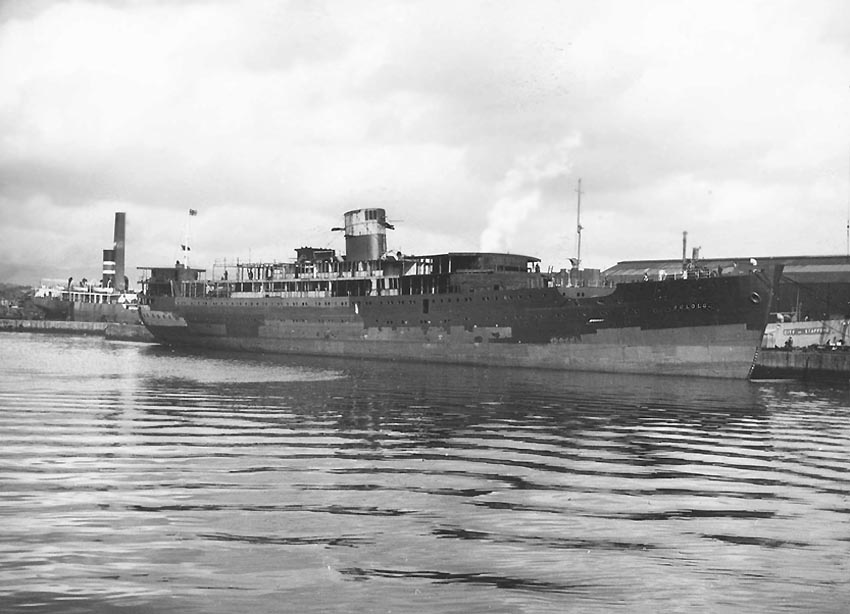
Here
we see the Bulolo at the Barclay Curle fit-out berth
Photograph originally
distributed by Barclay & Curle & Co
When completed she made her delivery voyage to
Australia and soon the Twin Screw Motor Vessel - T.S.M.V. Bulolo departed
on her maiden voyage on November 19, 1938 sailing between
Australia and Papua New Guinea ports being the traditional
official Burns Philp service.
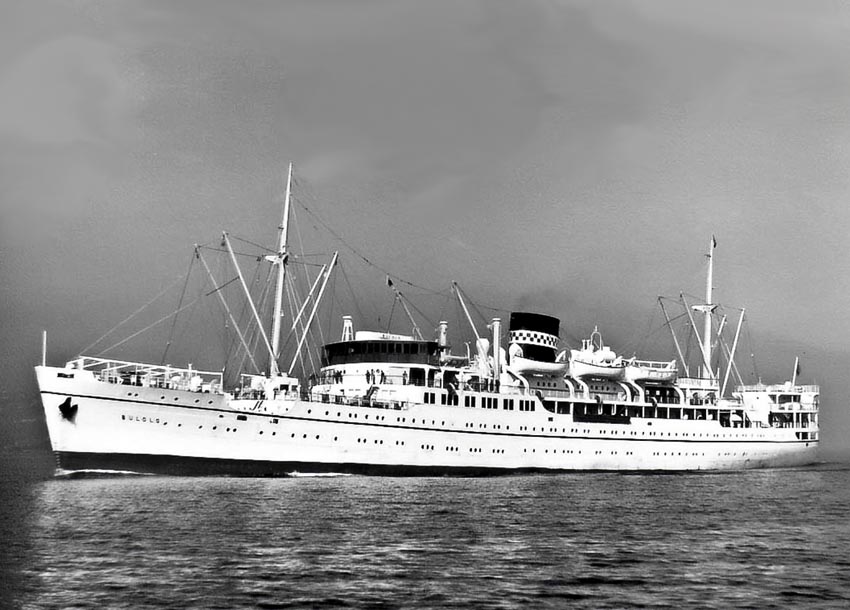
The
wonderful T.S.M.V. Bulolo is seen here at sea whilst on one of
her round voyages to the PNG
Her ports of call would be; Sydney, Brisbane, Port
Moresby, Samarai, Lae, Madang, Rabaul. Samarai, Port Moresby, Brisbane,
Sydney. Sailings operated every six weeks.
The Bulolo would manage just eight return
voyages before World War II commenced, and then from 1939 her
next six years she would become a very different ship indeed and
also become one of the most famous wartime ships in the
Australian/British war time fleet!
H.M.S. Bulolo:
The T.S.M.V. Bulolo was taken over by the
British Ministry of War Transport on behalf of the Royal Navy on
September 22, 1939, and on October 21 she was placed in a London
shipyard where she was given a comprehensive conversion to become
an “Armed Merchant Cruiser” (A.M.C.). Her makeover was
completed and officially commissioned on January 4, 1940 as the H.M.A.M.C.
Bulolo F82. However, in 1942 she was converted once again, but
this time to become one of the most important ships of the war, a
“Landing Ship and Headquarters” (L.S.H.), and it is
during this time she reached the height of fame with General
Montgomery choosing her as the official “Head
Quarter’s” ship for the D-Day Normandy invasion. And
even King George VI stood on the H.M.S. Bulolo’s Bridge
watching and saluting the invasion fleet that would soon be bound
for Normandy.
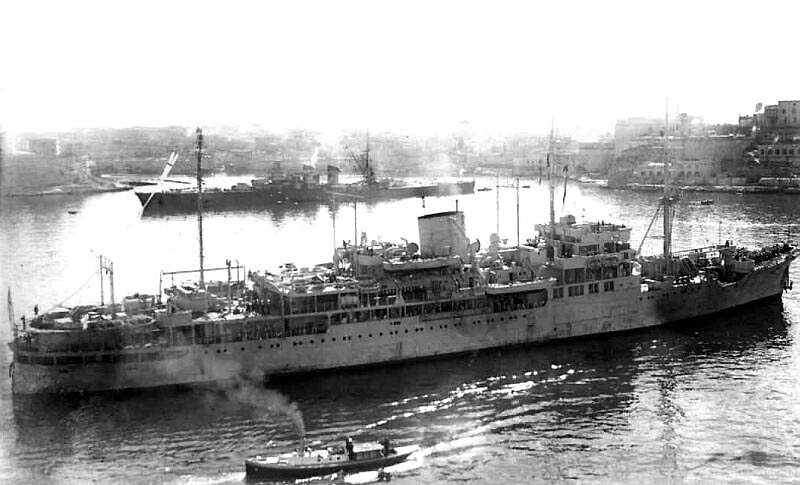
H.M.S.
Bulolo (F82)
Photograph ? the National
Archives (NA)
Please Note: There is a special feature
on Page Two detailing the Bulolo WW2 services, which were
more than remarkable, including an amazing personal story. You
can enter this feature via a Link at the bottom of this Page.
Return to Commercial Duties:
Her Naval service terminated on December 5,
1946, and she was handed back to Burns, Philp and she was given a
comprehensive refit. The T.S.M.V. Bulolo resumed her original
service on August 18, 1948.
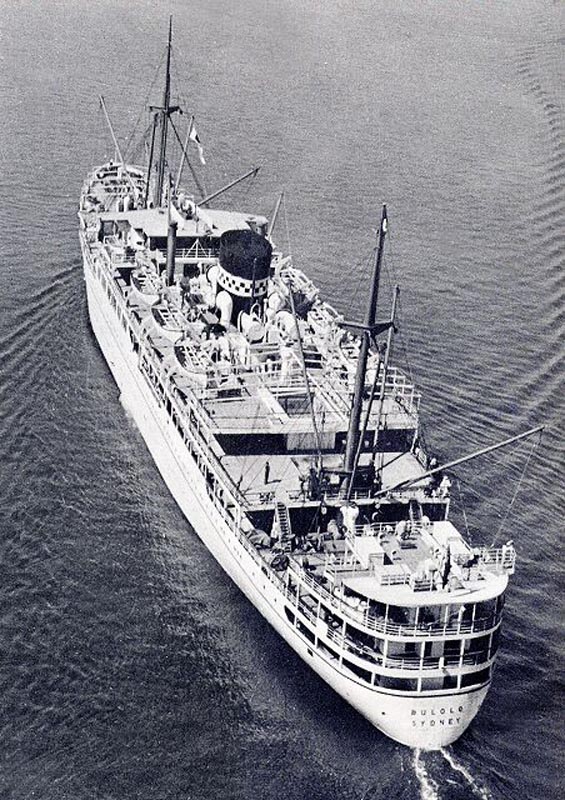
T.S.M.V.
Bulolo seen as she passed under the Sydney Harbour Bridge
Photo by & ? Mr David Finch
– Provided by Mr Stan Evans
Her refit saw her become a superior passenger
ship with some fine new facilities added, and her passenger
accommodations having being lowered, to just 180 First Class
passengers.
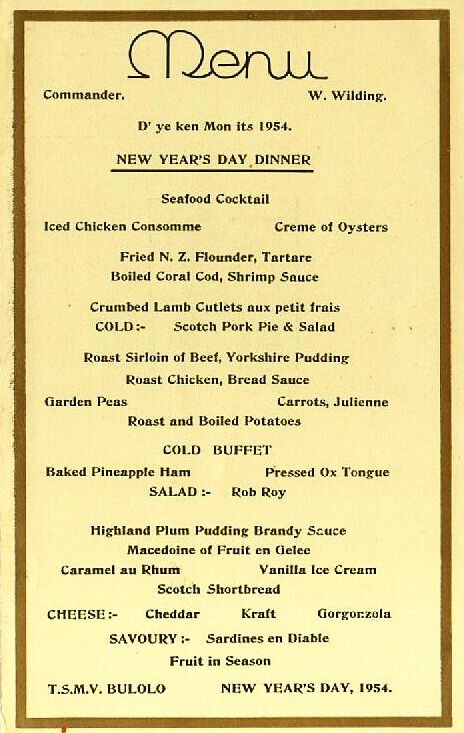
Three Dinner Menus:
These
menus were kindly provided by Margaret Flynn
On
all occasions T.S.M.V. Bulolo was under the command of Captain W.
Wilding
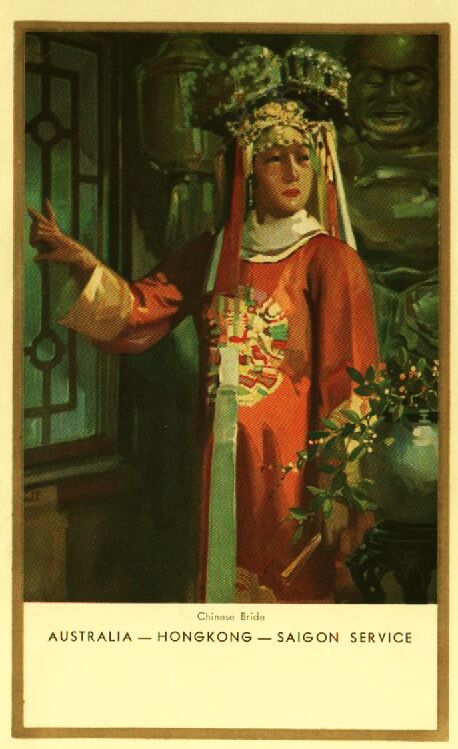
Above
and below: Christmas Day Dinner 1949
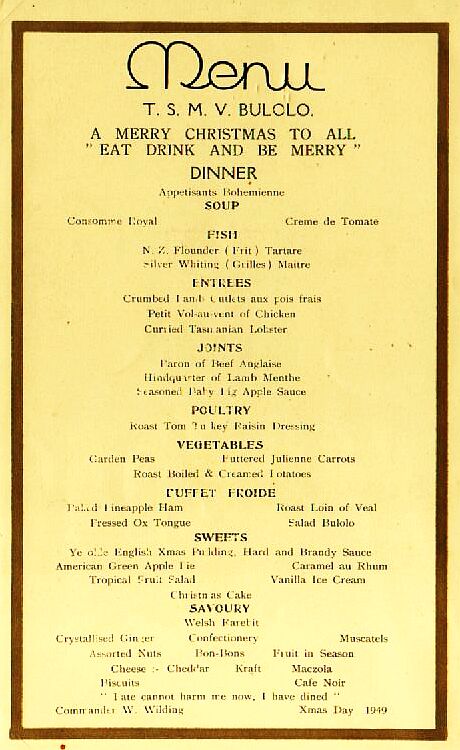
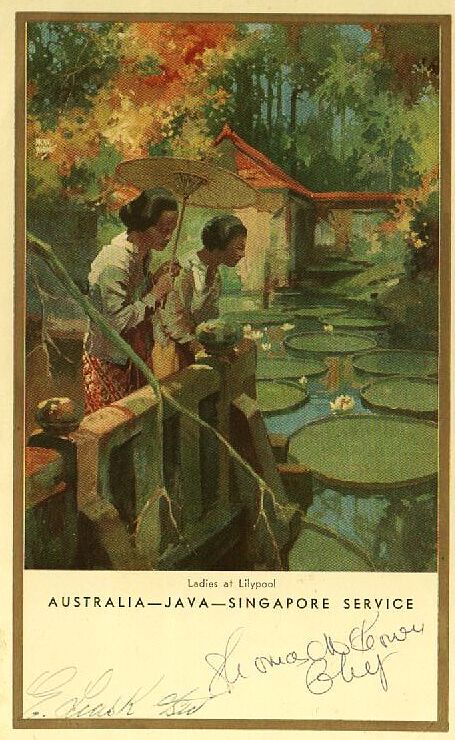
Above
and below: Christmas Day Dinner 1953
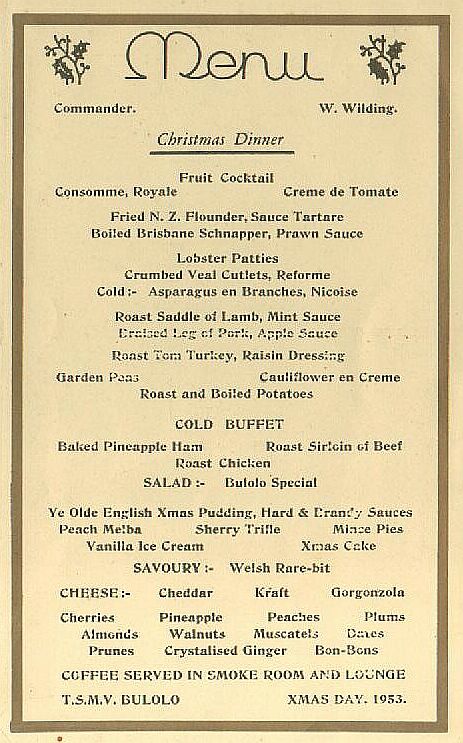
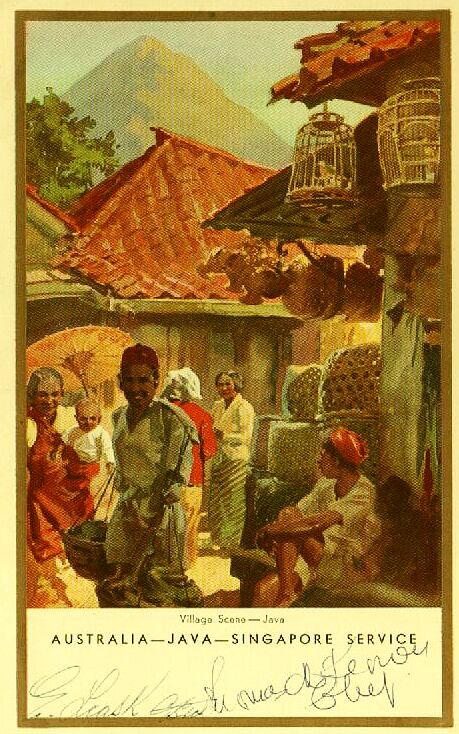
Above
and below: New Years Dinner Day Dinner 1954
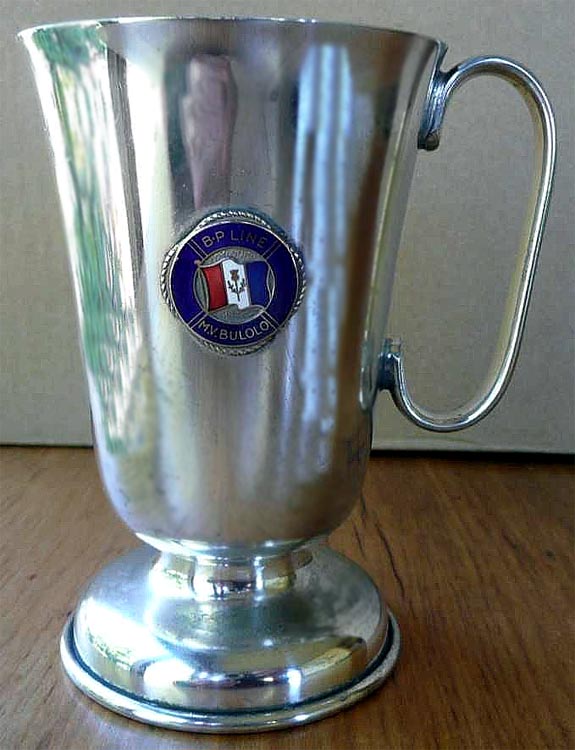
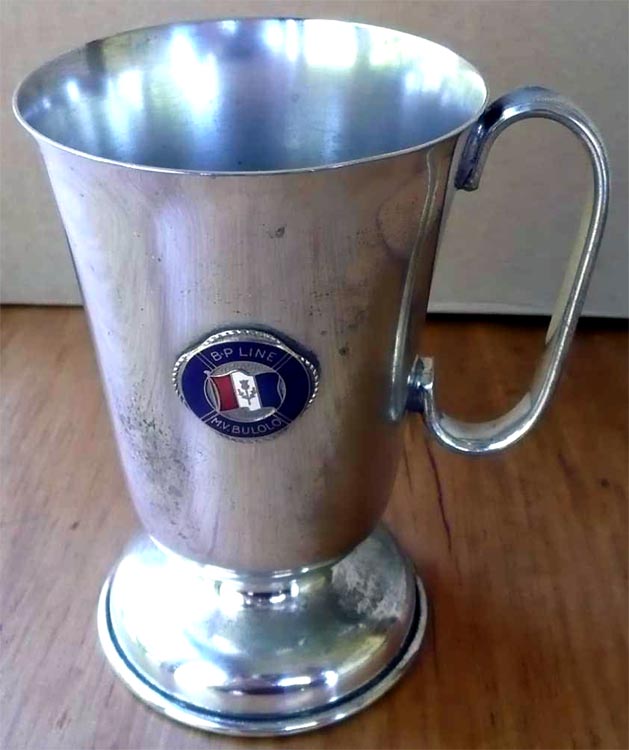
An Item of Memorabilia from the Author’s Collection:
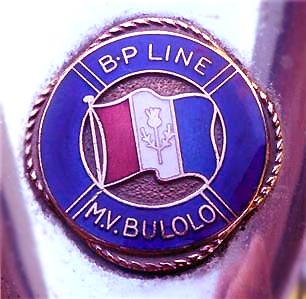
Above
& below: A Silver-plated souvenir cup obtained whilst on
a voyage on the T.S.M.V. or just the M.V. Bulolo. The Badge has
B.P for “Burns, Philp” as well as the ships name with
the traditional company banner
The delightful M.V. Bulolo continued to
undertake another 161 return voyages, and as she also made eight
return voyages prior to WW2, thus she made a grand total of 169
return voyages for Burns, Philp. She was taken over in 1939 by
the British Ministry of War Transport to be converted as an
“Armed Merchant Cruiser” F82 (A.M.C.) and in 1942 she
was converted into Admiral Mountbatten renowned “Landing
Ship Headquarters” (L.S.H.), being the official Head Quarter
ship at the Normandy landings! In addition the Japanese signed
the surrender of Singapore aboard her.
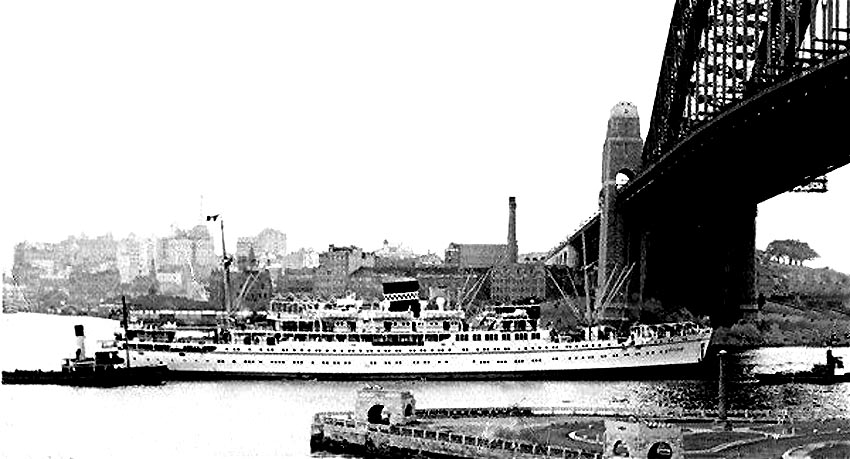
*Bulolo
seen in Sydney
Note
the Burns, Philp Scottish Thistle House flag flying from the aft
main mast
However, she did have one dramatic incident
whilst she was in Sydney harbour on August 29, 1951. Somehow
copra stored in her number three hold caught fire and although
the fire fighters commenced their drill immediately, it managed
to get out of control. Thus harbour authorities decided to beach
her at Kerosene Bay and ensure that the fire was fully
extinguished in order that the ship would cause no danger in the
harbour. Thankfully, the damage turned out to be reasonably
minimal, but it still took several months of repair work before
she could return to service.
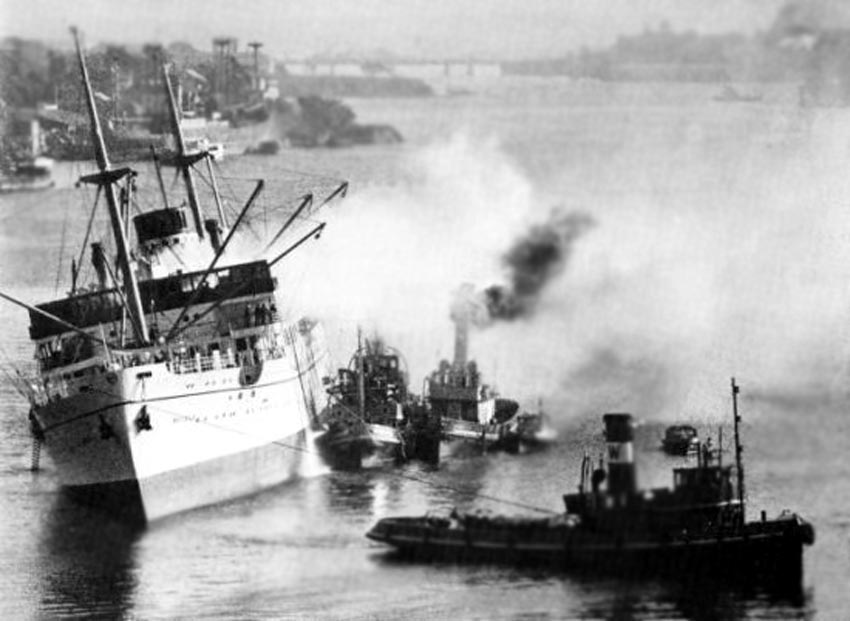
Tugs
seen towing the Bulolo to Kerosene Bay during the fire in hold
number 3
Photographer unknown - Please
see Photo Notes at bottom of the Page
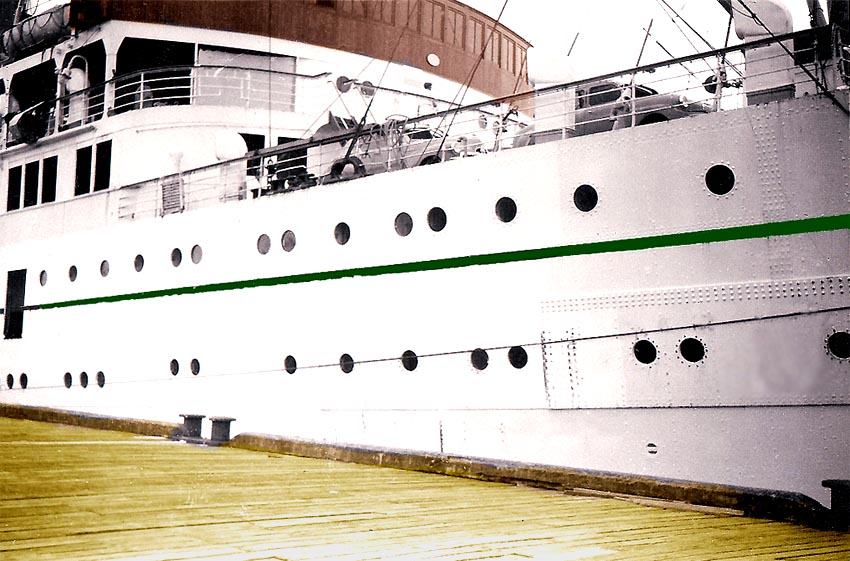
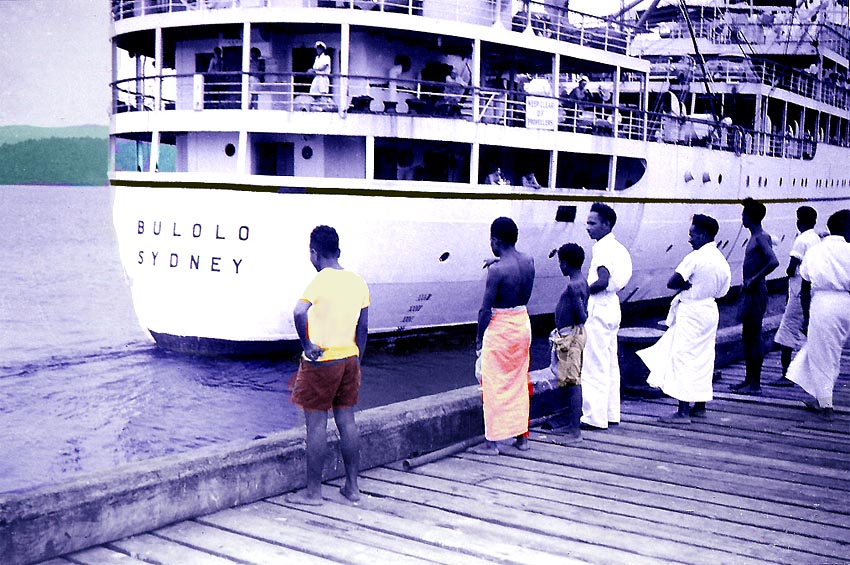
Above
& below: Here are two superb photographs of the
Bulolo’s bow and stern views, whilst she was in Lae PNG in
1957
Photographs are by & ?
Peter Young
Specifications:
Built:
Barclay Curle & Co, in Glasgow Scotland.
Yard:
668.
Launched:
May 31, 1938.
Tonnage:
6,397 GRT (Gross Registered Tons).
Length:
127m - 412 ft.
Width:
18m - 58 ft.
Draft:
7.1m – 23 ft.
Engine:
Three MAN B & W (Burmeister & Wain) Diesel-electric type
diesels.
Screw:
Twin.
Speed:
15 knots (max 17 knots).
Registered:
Sydney, Australia.
Passengers:
Originally 223 First Class passengers.
After WWII: 180 First Class passengers.
Career
Details:
Maiden
voyage from Sydney:
November 19, 1938.
Entered
Naval Service:
September 22, 1939.
Officially
commissioned:
January 4, 1940 as the H.M.S. Bulolo – F82.
In April 1942 became the LHS Bulolo.
Decommissioned:
December 5, 1946.
Returned
to civil duties:
August 18, 1948.
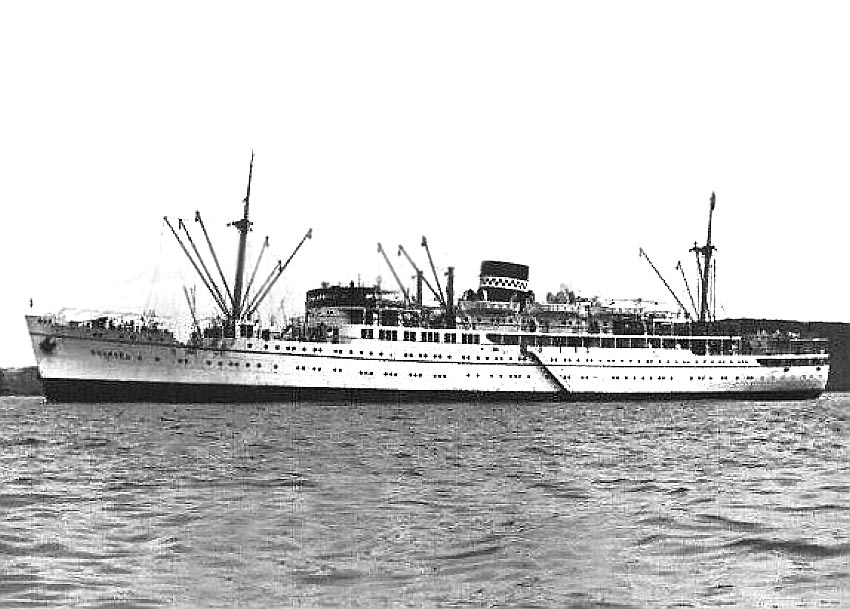
*Wonderful
memories of what was a fine, much loved and classic ship indeed
She
was one of the last passenger ships sailing with an all varnished
timber bridge!
Her Final Days:
In 1967 Burns, Philp decided that the Bulolo
would be taken out of service and prior to her final voyage Papua
New Guinea being very grateful to this fine ship, which had
served the country so well, decided to issue a special
commemorative stamp in honour of their beloved M.V. Bulolo.
Late in December, it was Captain Brett Hilder,
who was in charge of the T.S.M.V. Bulolo as he took her on her
final voyage sailing via her regular ports of course. Thus she
departed from Sydney and headed to Brisbane and then she sailed
north of Australia whilst passengers were able to enjoy Christmas
at sea as she headed for Papua New Guinea and to Port Moresby
where passengers would disembark as well as new ones would join
the ship for the ten-day round cruise from Port Moresby and back!
For this return sector she had 120 passengers.
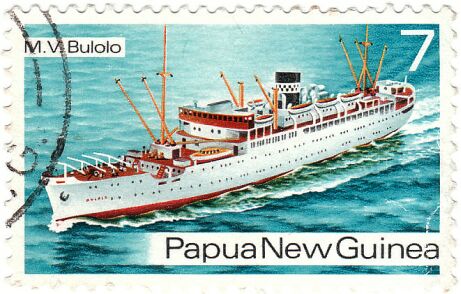
Papua
New Guinea’s commemorative M.V. Bulolo stamp
From Port Moresby the Bulolo then headed for Samarai,
Lae (on New Years Day), Madang and Rabaul and returning via Samarai
to Port Moresby again. This ten day round voyage from Port
Moresby was a popular option as it visited such fascinating
places and Australians and others would fly to Moresby and join
the ship there and save the voyage to and from Australia! The
Bulolo then returned to Sydney via Brisbane arriving early
February 1968!
Having returned from her final voyage in
February 1968, she was laid up in Sydney and was soon sold to the
“China Steel Corporation” of Taiwan. The Malaita II had
already been sold three years earlier, but she continued to
operate with a new company and was not broken up until 1971. Yet,
the delightful T.S.M.V. Bulolo served Burns, Philp proudly for a
good thirty years and of course the main reason for the sale of
their ships was the change in conditions, for cargo handling was
rapidly changing to containerisation, and the passenger trade was
dropping off rapidly due to the ever-decreasing airfares!
Still looking her beautiful self, the T.S.M.V.
Bulolo departed Sydney, and headed for Taiwan and she arrived at her
destination, the port city of Kaohsiung in Taiwan on May 24, 1968
where she would soon to be broken up.
However, this small passenger liner had
achieved so much in her thirty years for she sailed around the
globe and hosted more Admirals, Generals than any ship that were
far greater in size than her, In addition, she had HRH King
George VI standing on her Bridge and from the Bridge wing he took
the salute from all the passing invasion ships! In so many ways,
the Bulolo was remarkable, a hero and she did so much more than
almost any of the other passenger ships in civil service or
during war duties! It was said by crews and those who sailed on
the Bulolo be it “when she was in commercial or naval
service, the Bulolo did Australia proud.” - “We fondly
miss this wonderful small white ship, with that green ribbon
around her hull and that distinctive black and white checked band
on that black funnel and the Burns, Philp Scotch Thistle house
flag flying from the mast!”
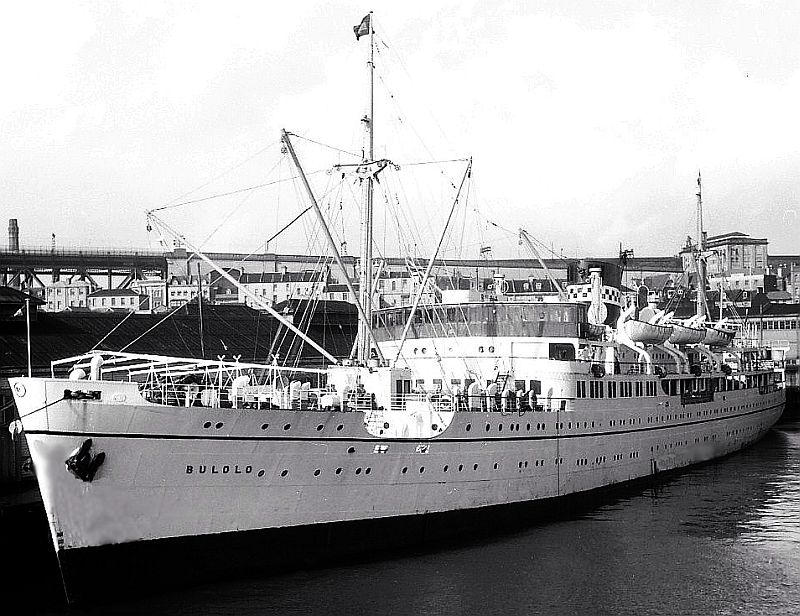
The
delightful Bulolo seen berthed in Sydney
I
trust that you have enjoyed reading about the interesting
Passenger-Cargo Liner, the T.S.M.V. Bulolo that also served King
and Country during World War II for she accomplished so much to
say the least!
Head
to Page Two to discover why the Bulolo will long be
remembered in Australia’s Wartime history as well as being
amongst one of the finest Passengers ships of the world!
A Wonderful Memory of a Fine Small
Liner
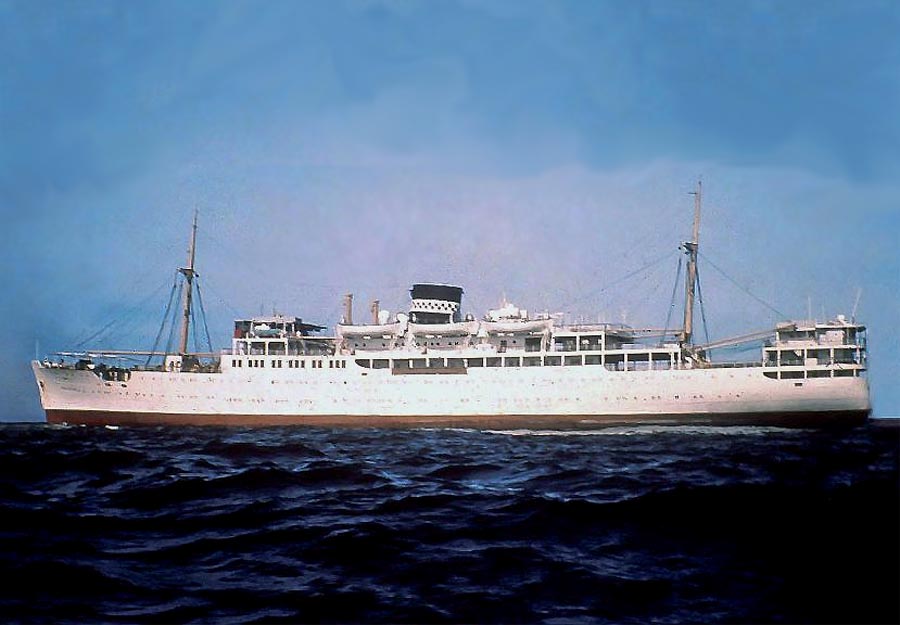
A
fine photograph of the T.S.M.V. Bulolo seen on her portside
sailing at full speed at sea
Photographer unknown - Please
see Photo Notes at bottom of the Page
Enter Page
Two; The Bulolo WW2 Feature
Also visit
the 1911 Burns Philp ship - S.S. Montoro
*Photographs on ssmaritime and associate
pages are by the author or from the author’s private
collection unless otherwise stated. Credit is given to all
contributors. However, there are some photographs provided to me
without details provided regarding the photographer or owner
concerned. I hereby invite if any owner of these images to be so
kind to make them-selves known to me via my email address
that may be found at the bottom of www.ssmaritime.com only, in order that due
credit may be given.
***********************************
“Blue Water Liners sailing to
the distant shores.
I watched them come, I watched them go and I watched them die.”
Return
to the ssMaritime MAIN
INDEX
ssMaritime.com & ssMaritime.net
Where
you will discover over 1,300 Classic Liners & the
1914 built M.V. Doulos Story
The
Author has been in Passenger Shipping & the Cruise Industry
for some 60 years!
Also
visit the …
“Save The Classic
Liners Campaign”
Founded
in the early 1990’s - The author is the founder and
president
Please Note: ssmaritime and associated
sites are 100% non-commercial and the author seeks no
funding or favours of any shape or form, never have and never
will!
Photographs on ssmaritime and associate
pages are by; the author or from the author’s
private collection. In addition there are some images that have
been provided by Shipping Companies and private photographers or
collectors. Credit is given to all contributors. However, there
are some photographs provided to me without details regarding the
photographer/owner concerned. I hereby invite if owners of these
images would be so kind to make them-selves known to me (my email
address may be found on www.ssmaritime.com only), in order that
due credit may be given.
This notice covers all pages; although,
and I have done my best to ensure that all photographs are duly
credited and that this notice is displaced on each page, that is,
when a page is updated!
ssMaritime is owned &
? Copyright by Reuben Goossens - All Rights
Reserved