Huddart
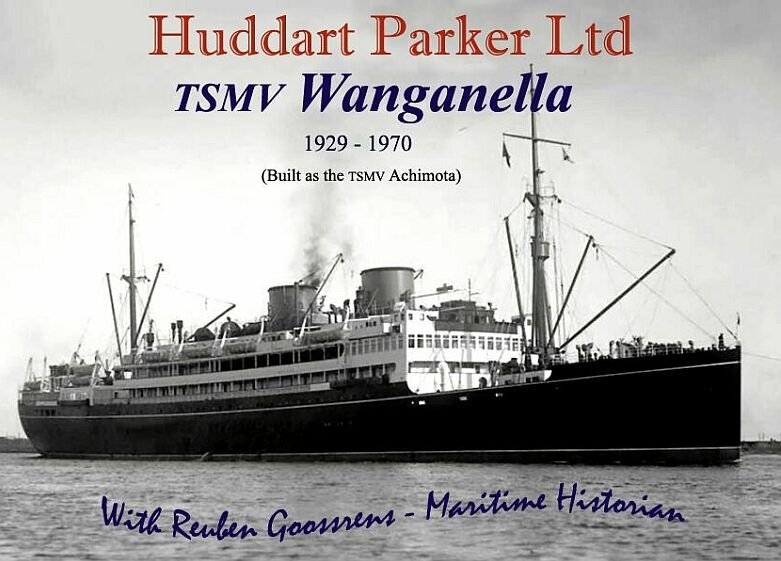
Parker Liner - TSMV Wanganella - 1929 to 1970
Please Note: Firefox and some other
Search Engines may not be suitable
Use Google Chrome for this Web Page
to load perfectly!

Click
the logo above to reach the ssMaritime FrontPage for News Updates
With Reuben
Goossens
Maritime
Historian, Cruise‘n’Ship Reviewer, Author &
Lecturer
Please Note: All ssMaritime and other related
maritime sites are 100% non-commercial and privately owned, thus
ssmaritime is NOT associated with any shipping company or any
other organisation! Although the author has worked and been
involved in the passenger shipping industry for well over 60
years, but due to his old age and poor health, he was forced to
retire. Yet, he has completed well over 1,360 Classic Liners,
Passenger-Cargo Liners as well as humble converted C3 converted
Migrant Liners, which has transported countless thousands folk to
the new world, as well on vacations’. I trust the features
online will continue to provide Classic Liner and Ship
enthusiasts both the information they are seeking, but more so
provide a great deal of pleasure and relive many happy memories!
Page One
The History and Story of a Very Special Ship!
This page was recently updated:
The TSMV Wanganella had quite an amazing
forty-one year history during which she served four owners
extremely well! Although she was owned for the majority of her
days at sea by the famed Huddart Parker Ltd and in 1961 she was
obtained McIlwraith McEacharn but this was a short engagement as
she was obtained just over a year later by a Chinese Hong Kong
based Company - Hang Fung Ltd late in 1962. Thereafter she was
sold again to become a workers accommodation ship in New Zealand
and this feature will cover all these aspects.
But let us start from the very beginning and
cover the story in short regarding a well-known Melbourne based
Australian Coastal Shipping Company that in due course ventured
further afield!
Huddart Parker Ltd:
Huddart Parker Ltd was officially formed on
August 1, 1876 by James Huddart, who was also the nephew
associated to T.J Parker, as well as John Trail and Captain Webb
who made up the company board members.
The Huddart
Parker Ltd - House Flag
Although the firm, under various operating
names, commenced operating their first vessel in 1854, being the
199-ton schooner-rigged iron steamer named “Express,”
which operated a service between Geelong and Melbourne in the
southern parts of Australia. Over the years the company grew from
strength to strength, and obtained bigger and better ships and
slowly commenced services further afield to Sydney, Newcastle as
well as Tasmania. But is would be the SS Ulimaroa that would make
inroads for Huddart Parker and sailed as far as New Zealand!
SS Ulimaroa:
It was not until 1908, when the delightful
5,777-GRT SS Ulimaroa came into service and commenced the
company’s service on the Trans Tasman service, between Australia
and New Zealand. Although, she was still considered as a partial
coastal liner considering that she sailed from Sydney via Melbourne
to Hobart and only then she would cross the Tasman to New Zealand.
She would then sail back to Sydney. Thus she carried passengers
on both coastal voyages and well as Trans Tasman sailings. Then
there were those who preferred to book a full round voyage for
their vacations, and make it what we would call today “a
cruise.”
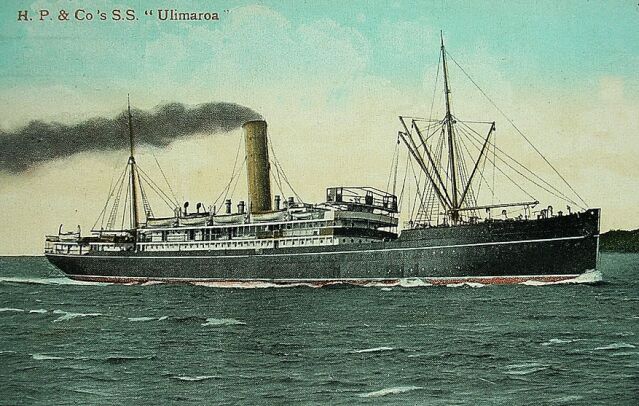
A postcard
on the SS Ulimaroa
Postcard
is from the author’s private collection
The 5,777 GRT, all steel, twin screw SS Ulimaroa
was built by Gourlay Bros & Co ship builders at Dundee in
1908. She had twin triple expansion engines producing some 1,095
NHP. She has passenger accommodations for 190 First Class, 120
Second Class, and 120 in Third Class. She was sold to Japanese
breakers in 1934.
TSMV
Wanganella - The all-British ship that became a Great Australian
Liner:
Personally I love to think back to the days of
my youth, for as a child I always loved passenger ships. Then
when I was a teenager I came to New Zealand in May 1958 on an
elegant Dutch passenger liner, the MS Sibajak of the Rotterdam
Lloyd. I clearly remember the two remarkable “Express
Trans-Tasman Liners” that operated at the time between New
Zealand and Australia. The senior of the pair being the Union
Steamship Co, 1925 built, accommodating 386 passengers,
11,036-ton, TSS Monowai and the ship in question, the TSMV
Wanganella. Amazingly neither ship was built nor designed for
their owners or the service they were operating, but both did the
job extremely well and they became much loved and each had their
own charm as well as countless followers!
The Wanganella was built by Harland and Wolff
shipyards at Belfast, but she was originally ordered by one of
the Royal Mail / Elder Dempster Group of Companies and she was to
be named “Achimota,” and she was to be operated by the
“British and African Steam Navigation Company” for
their Britain to West Africa mail service. She was launched and
officially named Achimota on December 17, 1929, and upon
completion some ten months later, due to financial difficulties
within the Royal Mail Group the ship was not handed over to her
intended owners and instead she was laid up for around a year.
Harland and Wolff then placed her on the market and Huddart
Parker Ltd of Melbourne Australia immediately showed interest in
the ship. Still having the name Achimota on her bow she undertook
her deep-sea trials from Belfast in September 1932 as well as
another voyage with the Huddart Parker executives on board.
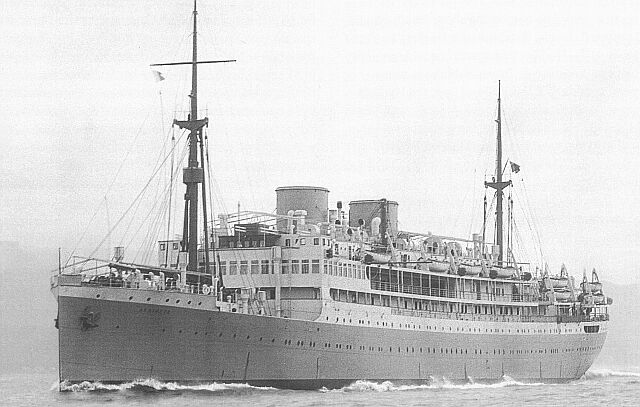
MS Achimota
seen on her second trails with the Huddart Parker executives on
board
Obviously
she still has her original Elder Dempster livery, which would
soon change
Photo
– Ulster Folk and Transport Museum
That same month Huddart Parker decided to
purchase her, although they advised Harland & Wolff that a
refit would be required to make her suitable for the Australian
trade as she would required considerable upgrading, as she had
originally been built to accommodate just 236 First Class and 64
Second Class passengers as well as some Third Class and Deck
passengers, between port in Africa. In addition, the crew
quarters as built would certainly not meet “Australian
Maritime Standards,” thus these also required upgrading as
Australian standards are very much higher than the British
requirements at the time. In addition the Bridge as built was set
back with a walk by deck in front of it, and her new owners
required the Bridge to be placed flush with the promenade deck,
which was done (See the photographs above and below). With all
the work completed the ex Achimota became a fine ship indeed and
soon the new TSMV Wanganella was ready for her duties Down Under!
It is believed that her original cost was
£520.000 (UK pounds), but with the cancelation of her original
order, it is believed that Huddart Parker purchased her at a
bargain price of just £346.376 fully completed and delivered to
them in Sydney Australia.
For interest: There seems to be some
debate of timing regarding the purchase and from whom she was
obtained, as some historians claim she was obtained from Royal
Mail, whilst others state it was whilst she was being built,
which is quite wrong. Be assured that the official records agree
with what I have written above.
There was no doubt that Huddart Parker had
obtained themselves a very special ship, a ship that was never
intended for the service that she would soon be operating on Down
Under, and there was no doubt that she was a very British ship
indeed! She had a delightfully striking profile with a rather
strong rectangular, yet elegant lines, enhanced by her twin
rather squad buff coloured funnels (the forward funnel being a
dummy one) and her two tall masts. She would prove to be the
perfect ship for the “Express Trans Tasman” service and
she became a popular ship indeed and she outlasted her rivals,
the Union Steamship Monowai and Awatea.
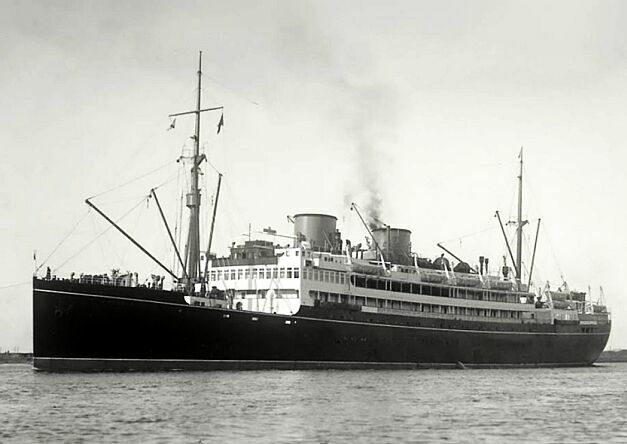
The elegant
Twin Screw Motor Ship Wanganella
From the
author’s private collection
As can be seen below, Wanganella was of a
similar design to other ships of that time being built for the
Royal Mail Line, as well as its associated companies such as the
Elder Dempster Lines, including Royal mail’s 22,000-ton
sisters the MS Asturias and Alcantara, built just after the Achimota
in 1926 and 27 respectively.
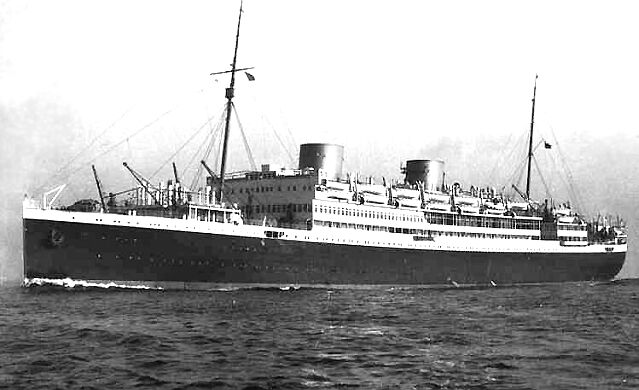
The Royal
Mail Lines Liner MS Asturias
From the
author’s private collection
Interiors
- Sheer elegance personified:
The Wanganella featured a fine range of elegant
lounges in both classes, especially the First Class lounges in
the manner of the Main Lounge located forward on Promenade Deck.
This supreme venue featured fine timbered panelled walls and in
the centre of the ceiling the main feature being a dome reaching
high up to Boat Deck and superb light fittings and décor
mouldings that gave every part of this room a touch of class. The
windows were offset by elegant columns on both sides, and
featured luxuriant drapes. Located forward of the room in the
center there was a massive traditional fireplace that would offer
artificial heating on cooler days. Throughout the lounge, Grecian
style carved pillars graced the room and it featuring a fine
Persian carpet in the middle as well as a grand piano. Yet
somehow, there was also a touch of understated luxury, which was
“Ever so British!”
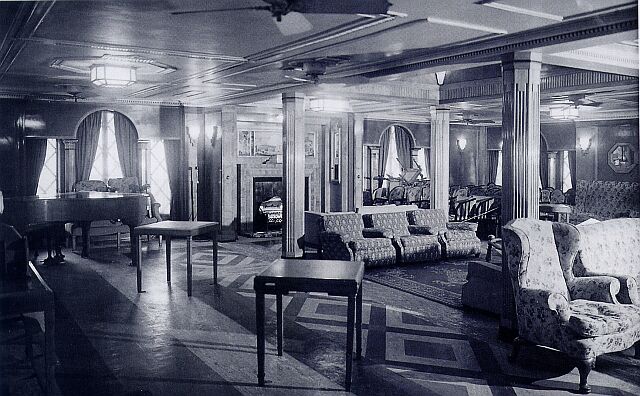
The
magnificent domed First Class Main Lounge
Photo
provided by Mr. W.H. Raine
Just aft of the Main Lounge was the Library and
Reading Room. Going further aft past the machinery section, you
would first reach the Smoking Lounge, which was a much lighter
venue and this Lounge also featured that ever so British
traditional fireplace and it was a far more casual venue both for
ladies as well as the younger set on board.
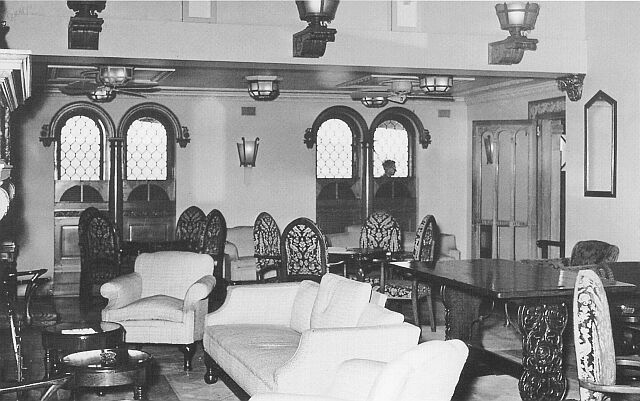
The lighter
and brighter Smoke Lounge had some delicately carved timber
furnishings
Photographer
unknown – *Please see photo notes at bottom of page
The last venue on Promenade Deck, far aft was
the somewhat sombre, but elegant dark timbered and velvet
wallpapered Smoking Room, which was very much the
Gentleman’s Lounge. It offered luxuriant leather chairs and
sofas and the floor featured several tones of inlaid marble. It
overlooked the aft decks and the Verandah Café.
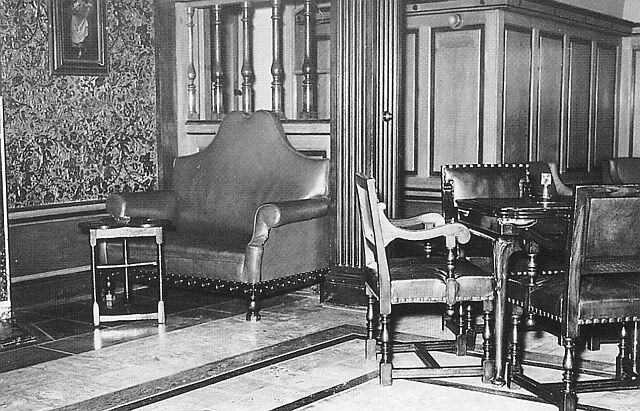
The First
Class Smoking Room located aft on Promenade Deck
Photographer
unknown – *Please see photo notes at bottom of page
One deck down on A (Bridge) Deck aft was the
Second Class Main Lounge, as well as the Library, Card and Games
Rooms.
Located forward on C (Main) Deck was the First
Class rather grandiose Dinning Room with its huge dome and its
lattice-glazed windows and its unique concealed decorative
lighting. The Second Class Dining Rooms was located aft, and
although smaller it certainly had a similar charm, but obviously
on a lesser scale.
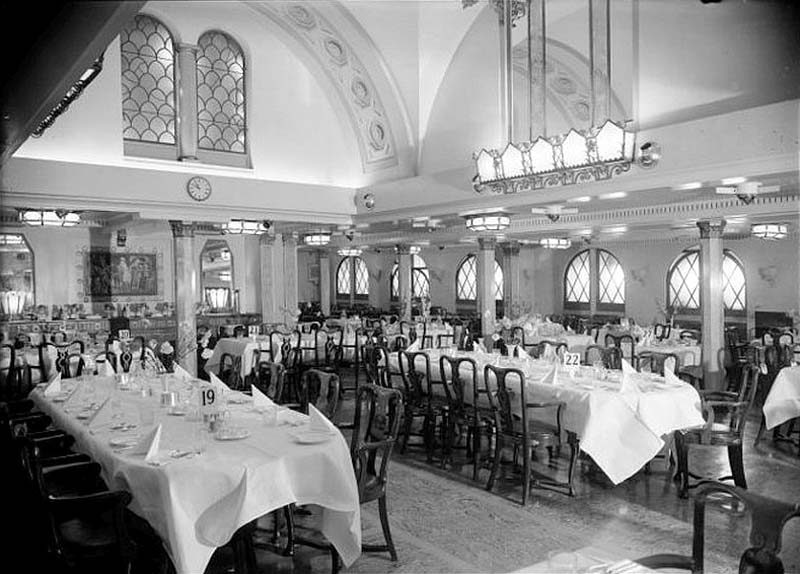
Wanganella’s
First Class Dinning Room was grand in every possible way!
Photo
provided by Mr. W.H. Raine
Wanganella’s accommodations were simply
superb for the day as she offered superb First Class cabins for
one, two and three for 304 passengers who would live in style and
comfort, as well as 104 Second Class passengers who enjoyed
accommodations well up to standard! To attend to all their needs
there were 160 crewmembers on board. Although these were not days
where air-conditioning was standard and forced air ventilation
was the norm, as well as windows and portholes that could be
opened.
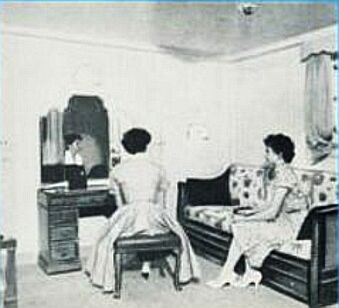
One of the
luxury First Class Twin bedded cabins that converted into a
lounge during the day
Provided
by Neil Higgins
Her Career:
TSMV Wanganella departed Belfast on November
29, 1932 under the command of one of Huddart Parkers other fine
Coastal ships, the Westralia’s former Master, Captain Bates.
She made a voyage of record proportions of just thirty-one days
to Sydney. Her arrival in Sydney made the news and she was
featured in the “Sydney Morning Herald” on January 2,
1933, which stated, “The arrival of Wanganella provided the
occasion for an unusual reunion. Mr. L. S. Brew, the guarantee
engineer sent out with the ship by the builders, Harland and Wolff,
found that the pilot who brought the ship into Sydney Harbour was
his brother (Captain A. Brew), whom he had not seen for 20
years.”
It so happened that Harland and Wolff had
appointed Leonard Septimus Brew, their Guarantee Chief Engineer
to officially deliver the ship to Huddart Parker in Sydney, and
he was rather surprised that it was his brother that would meet
him on board.
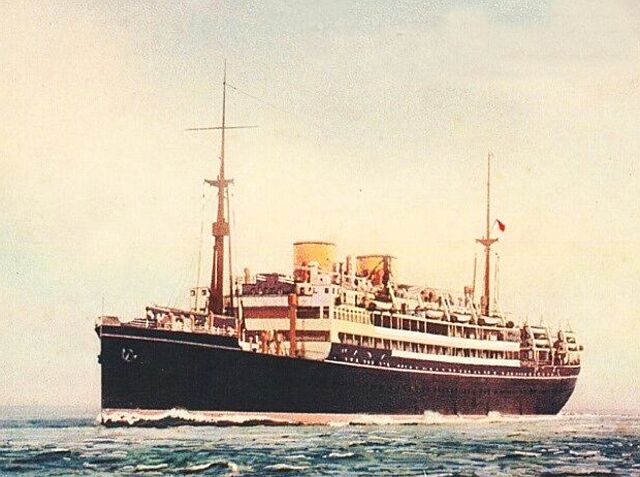
An artist
impression of the TSMV Wanganella
The
artist is unknown -*See photo notes at the bottom of the page
Ten days later after the ship had been fully
stored, and her crew trained, the Wanganella was ready for her
maiden departure from Sydney and head for New Zealand, which she
would do for many years, except during the war years when she
would become a Hospital Ship. She departed Sydney on January 12,
1933 and commenced her regular Trans Tasman Express service
sailing between from Sydney via Melbourne to Auckland, Wellington
and back to Sydney. She would take three and a half days to cross
the Tasman Sea, unless there were unusual weather conditions,
which did happen knowing the Tasman Sea! For her return to Australia
during this first voyage she would sail down the South Island of
New Zealand and visit the famed Fordland’s of the South
Island and visit Milford Sound before heading back to Australia.
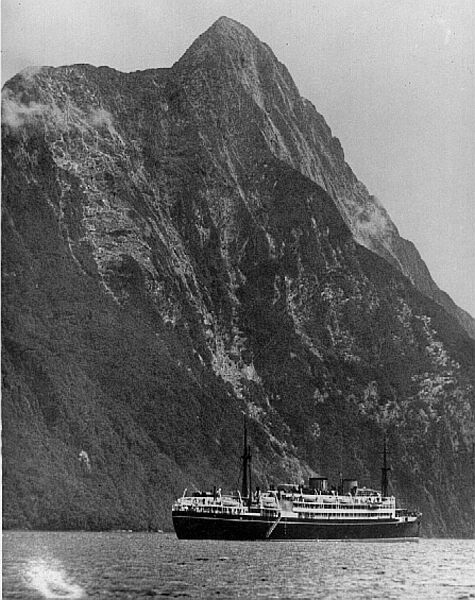
The
Wanganella is seen here in Milford Sound during her
maiden
round voyage from Sydney to New Zealand in January 1933
Photo by
Mr. W.H. Raine
Wanganella soon became the darling of all Trans
Tasman liners with both Australian’s and New Zealanders, for
she was indeed the luxury liner they felt they deserved, and
although the Monowai was an excellent ship, the Wanganella
certainly had the edge of superiority!
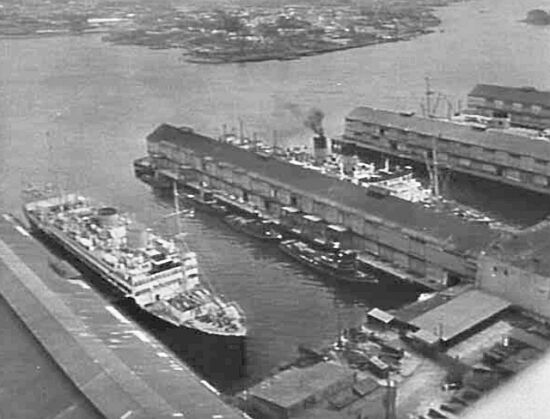
Here we see
the Wanganella (left) and the Monowai (center) berthed at Darling
Harbour Sydney in the late 30’s
Provided
by Frank G. Farquhar
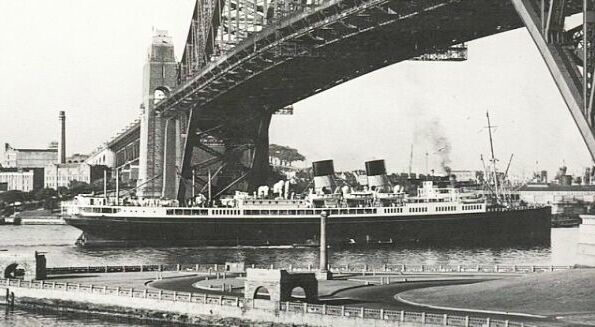
The TSS Monowai
is seen here heading under the Sydney Harbour Bridge
Provided
by Frank G. Farquhar
Over the years there were many other ships that
competed with her on the Trans Tasman service, the Monowai and in
due course ships such as the Union Steamship Company’s newer
liner the Awatea. There were also a good number of much larger
liners owned by, Orient Line, P&O, Shaw Savill, the American
Matson Line, and the Dutch, Italian and Greek companies would
also take passengers between Australia and New Zealand or visa
versa depending on their itineraries when operating Tasman
cruises, but the Wanganella continued to do very well having a
very strong following.
In 1937 the Wanganella did have an accident at
sea when she collided with a trawler just off the New South Wales
Coast, although no great damage or injuries on Wanganella were
recorded, I have no details on the outcome of what happened to
the trawler and its crew.
Then on June 19, 1940, Wanganella went to the
assistance to the ill-fated Union Steamship liner Niagara that
had hit a German mine and Wanganella’s crew managed to
rescue the survivors, both passengers and crew, from the Pacific,
just north of New Zealand.
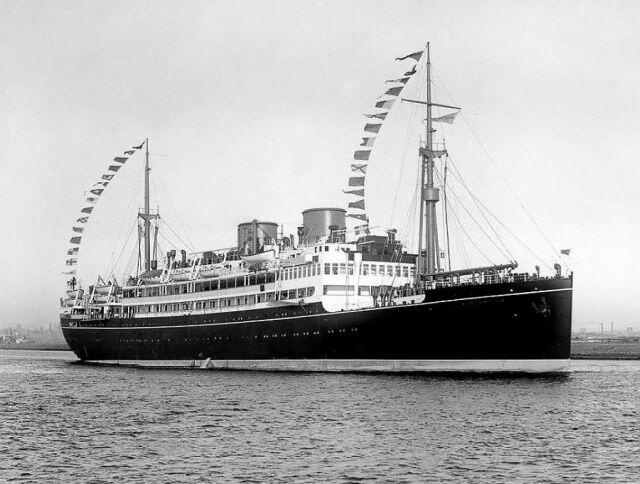
Wanganella
looking superb as she is seen here fully dressed with flags
Photo
from the author’s private collection
At some time in the late thirties she did have
windows fitted aft on A (Bridge) Deck being part of the Second
Class Promenade Deck, thus providing an enclosed space and
shelter being a great improvement considering the occasional
windy weather that can occur on the Tasman.
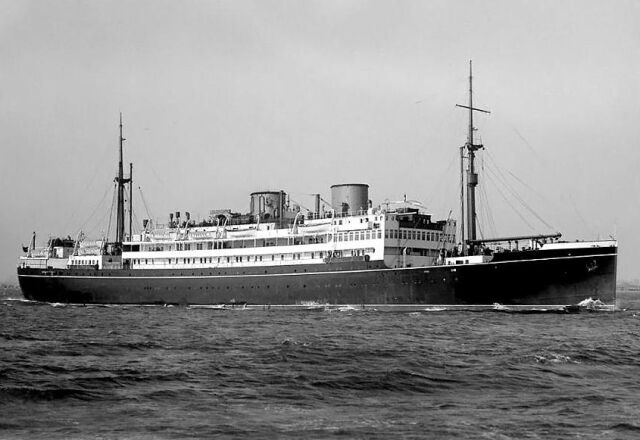
Wanganella
seen heading out to sea – Note her new Second Class windows
aft
Photo
from the author’s private collection
TSMV
Wanganella - Dimensions:
Built
at:
Harland and Wolff – Belfast.
Launched:
December 17, 1929.
Length:
144.5 m - 474ft.
Beam:
19.5m - 64ft.
Draft:
7.6m – 25ft.
Tonnage:
9,876 GRT – 5,625 Net.
Engines:
2 x 4 stroke Burmeister & Wain 8 Cylinder diesels - 6750 BHP.
Screws:
Twin
Speed:
15 Knots - Service Speed.
Passengers:
304 First Class - 104 Second Class.
316 First Class - 108 Second Class - post war.
292 First Class - 108 Second Class - 1960.
Crew:
160/130/150 - Originally/HMAHS/1960.
Wanganella becomes a Wartime Hospital Ship:
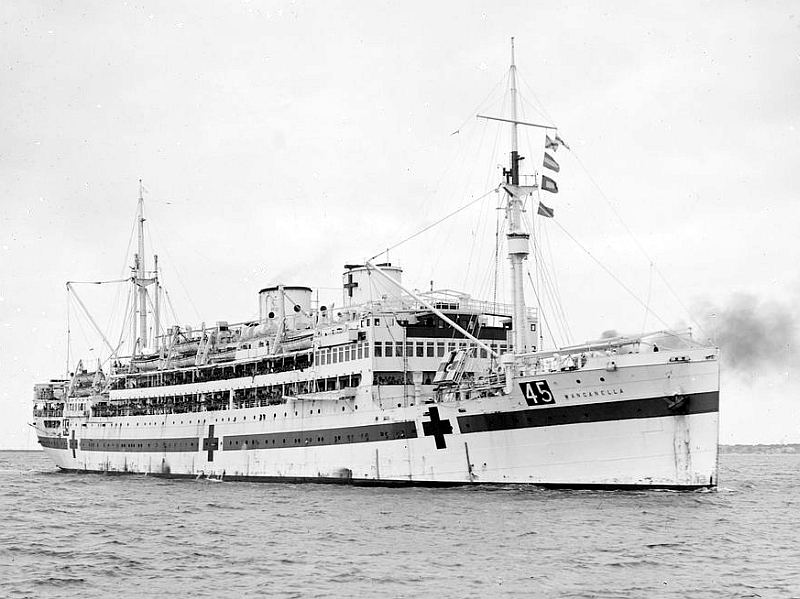
His Majesty
Australian Hospital Ship - HMAHS Wanganella Number 45, is seen
departing Melbourne
From the
Victoria State Library collection
The Wanganella was commissioned to serve as a
Hospital Ship in World War II for the Australian Government.
Australian registered and crewed, the ship officially became
HMAHS Wanganella and she served from May 1941, through to 1946.
During this time she carried and cared for Australia and New
Zealand soldiers, and the many wounded and sick evacuees from
Europe, the Middle East, New Guinea, Solomon Islands, Borneo and
the South Pacific. Thus she became a very hard working ship!
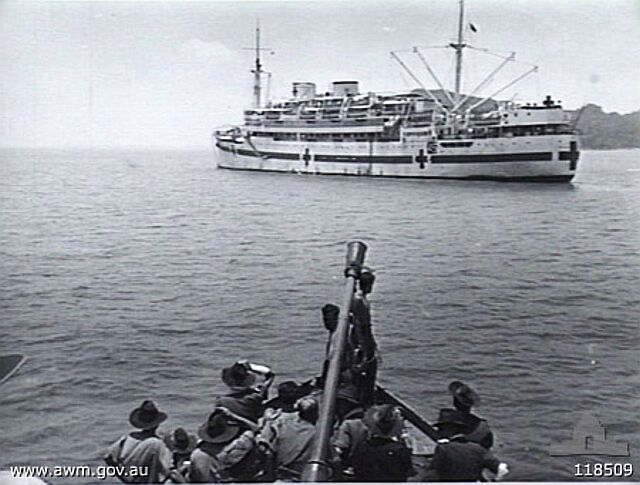
HMAHS
Wanganella at anchor at the Solomon Islands
Provided
by “The Australian War Museum” #118509
On May 19, 1941, the Wanganella was
converted in Melbourne to become a Hospital Ship allowing her to
transport equipment and medical personnel as well as to be fully
operational as a hospital complete with operating theatres. She
was painted white, with the conventional broad green band
circling her hull, broken at intervals for large red crosses.
During the night the ship would be fully illuminated according to
International law. HMAHS Wanganella could accommodate some 434
patients, which was increased to 550 late in 1943. She carried a
large medical staff of around 110, which were sourced from the
Royal Australian Army Medical Corps. The ships crew was decreased
slightly to 123.
The Wanganella was officially commissioned July
21, 1941 in Melbourne and was designated as HMAHS Wanganella
number 45 and she departed for Singapore. She sailed first to Sydney,
then returned to Melbourne and continued her voyage via Fremantle
transporting the “2/13th AGH” (Australian General Hospital).
She arrived in Singapore on September 15, after which she
returned to Sydney transporting her first load of patients, being
Australian troops with various health issues. Also on board were
some 216 passengers, some being Government representatives as
well as senior Military personal, but most were and civilians.
Her second voyage she headed to Suez where she
embarked wounded men from the Middle East campaign and returned
first to Sydney and then to Brisbane. It was during this voyage
that she experienced first enemy attack. Whilst the Wanganella
was at Port Tewfik in Egypt, a bombing raid occurred and a good
number of bombs fell very close to her, however luckily she came
through it without any damage, whereas the famed English liner
the Georgic, which was operating as a troop transport ship, was
badly hit and she was on fire in the harbour.
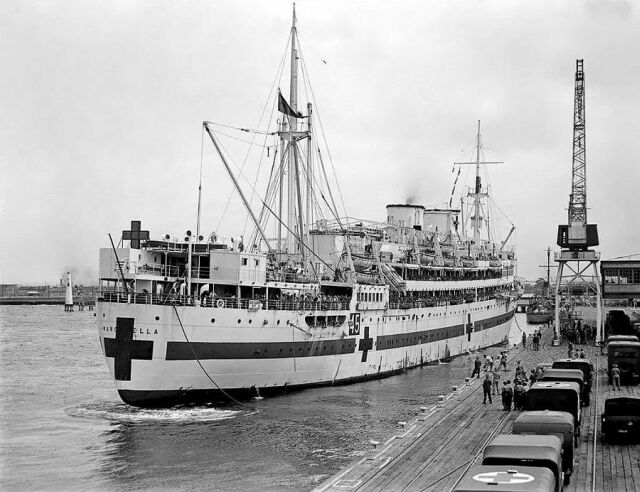
Stern view
of the HMAHS Wanganella #45 - as she returns from yet another
rescue voyage
Image
source unknown – *Please see photo notes at bottom of page
The Wanganella was also involved with a rather
famed incident off the coast of Western Australia related to a
Shell Tanker the MS Ondina. Although Wanganella only came into
the story late in the incident, she certainly assisted to save
precious lives at sea. I suggest that you read the whole story “The
MS Ondina Story”.
During the war years HMAHS Wanganella sailed to
many far away ports and carried large numbers of wounded and sick
evacuees from countless destinations around the globe. In
addition she had many other close calls, but the most famed one
is the one that became known as the “Bombay
Explosion”!
Her 13th.voyage to this day the most recorded
one of HMAHS Wanganella’s service record, and here are just
some of the details: She departed Sydney late in March 1944, and
she sailed via Fremantle to Bombay India. On April 14, 1944
whilst she was at anchor at Bombay, the Wanganella was shaken by
what was obviously a several massive explosions and all on board
would soon know this would be having a very serious effect upon
the harbour and the nearby city. Apparently there was a ship in
the harbour that was loaded with bales of cotton as well as a
huge load of high explosives, and she had caught fire causing two
massive explosions that shook the harbour and the city. The
Wanganella just shook badly as the explosion waves from the blast
struck her as she was a reasonable distance away. There were
massive columns of fire and smoke as well as debris to be seen
and it was flying hundreds of feet into the air. Very quickly the
greater part of nearby Bombay was ablaze and destruction
followed. It is said that around twenty-two ships were damaged
and destroyed that day and some ships had capsized due to the
explosion and others were a heap of twisted metal, whilst other
vessels only had minor damage.
There were many gruesome scenes along the
waterfront, including the many dead and the badly injured. As
hospitals were filled to the brim, a request was made for the
Wanganella to come to the assistance of Bombay, which Wanganella
medical team did. Many of the wounded arrived on board and the
surgical Staff operated without a break for days. The ship
remained in Bombay for another week, then having discharged her
patients.
With the week in Bombay completed, she headed
for Italy, as she was to take on many New Zealand wounded
soldiers and take them home to Wellington in the North Island,
and Lyttleton, being the main the Port of Christchurch in the South
Island.
The Private Stanley Charles Niel French Story:
Private Stanley French was with the 26 NZBN
Regiment Number 254801, and he sailed from New Zealand to the
Italian battlefields, where he became involved in one of the most
famous Italian battles and was severely wounded and was patched
up and sent home on the HMAHS Wanganella. His amazing story and
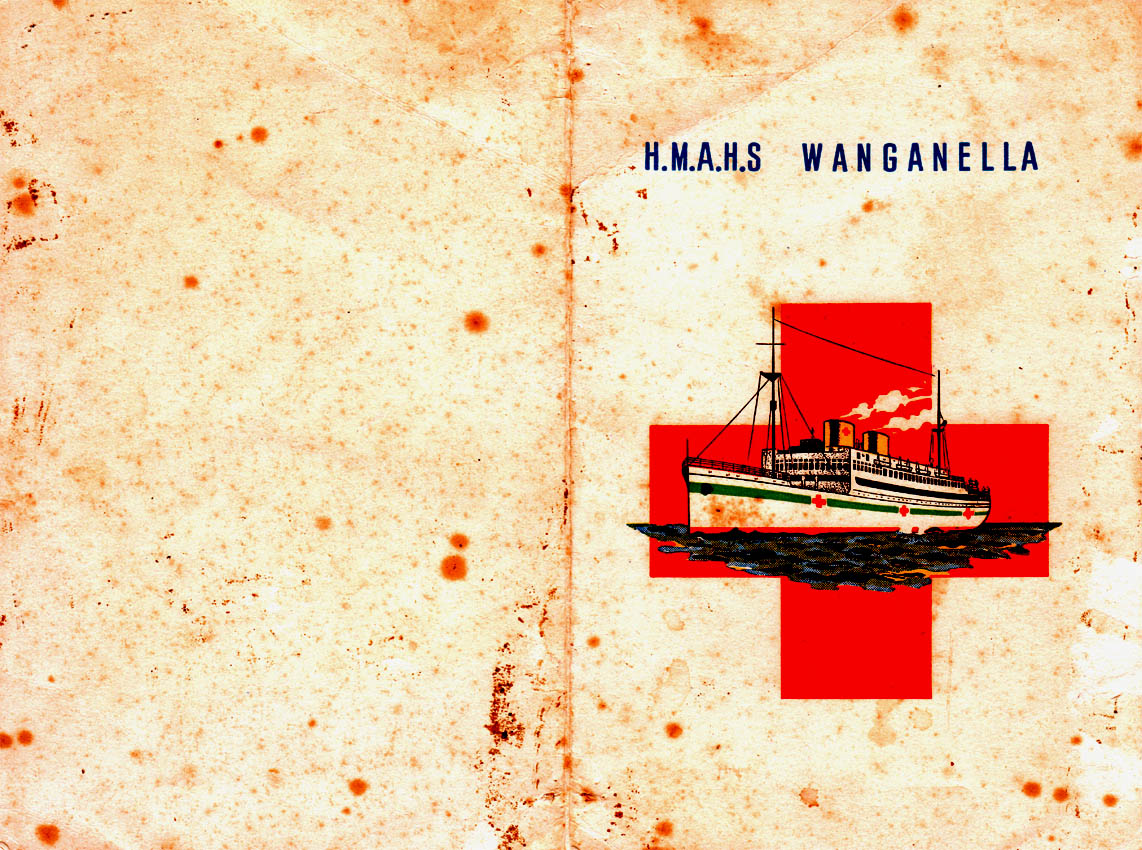
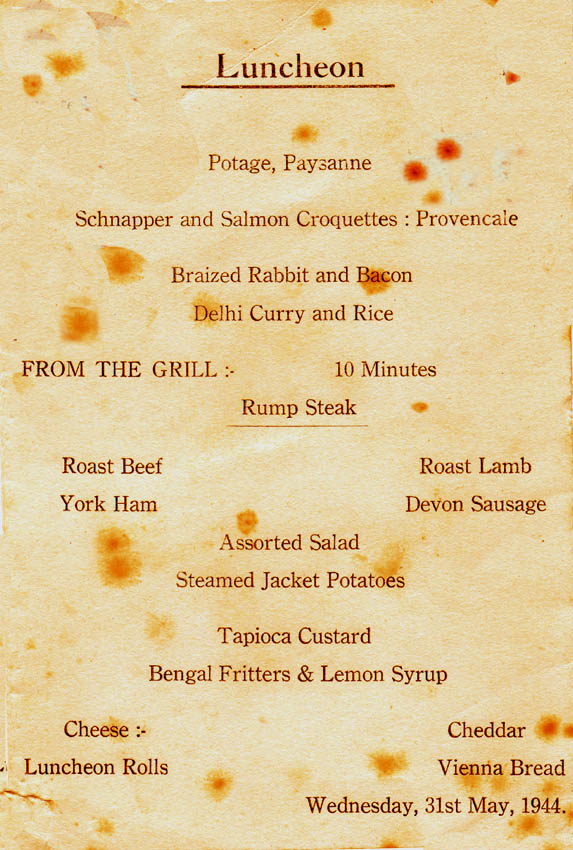
menu as seen below was sent in by Stan’s daughter Judy, but
you will find so much more as well as many photographs on a very
special page.
Visit … “Stan’s
Story” or use the Link at the bottom of the page,
located on the TSMV Wanganella INDEX:
Above &
below:
This is the
front & back cover of the lunch menu complete with all the
shrapnel markings and the inside menu below
On Stan’s
page, you will find the Author’s Photo-shopped version,
where both the cover and the menu has been cleaned up
Menu
provided by Judy French, Stanley’s daughter
After the Wanganella dropped off the wounded New
Zealand soldiers in Wellington and Lyttleton, she returned to Sydney
in June 1944 and berthed at Circular Quay.
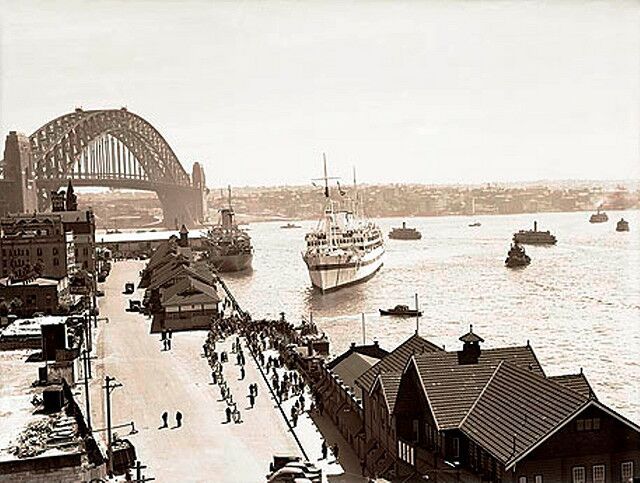
HMAHS
Wanganella arrives at Sydney’s Circular Quay in June 1944 -
returning from New Zealand after the Bombay experience
Image
source unknown – *Please see photo notes at bottom of page
During her war service HMAHS Wanganella sailed
a good 251,611 nautical miles and carried 13,389 wounded and sick
evacuees from the Various War Zones, comprising of Australian, New
Zealand and American Service personnel. HMAHS Wanganella served
her country with great pride!
Post War Years:
The Wanganella was returned to Huddart Parker
Ltd late in 1945, and she was sent to Melbourne have her refit,
returning her into the luxury passenger liner everyone loved.
This refit would see a number of changes, with her accommodations
increasing slightly to 316 in First Class and 108 in Second Class
passengers. Externally it was obvious that there was a new
two-lever superstructure placed on her aft decks, which contained
vastly improved crew accommodations and facilities. In addition
the aft section of the First Class A (Bridge) Deck promenade was
plated and glazed in to provide protection from the Tasman winds.
Along the First Class Promenade Deck, canvas covers could be
raised or lowered, pending weather conditions. Obviously the
weather was in the companies mind! The refit was completed in
September 1946.
Having been completed it was decided by Huddart
Parker that the fresh looking TSMV Wanganella would first operate
a return voyage to Vancouver, sailing from Sydney sailing via
Auckland and Honolulu, returning to Sydney on December 28. She
departed Sydney for her first post war Express Trans Tasman
Voyage, which would prove to be rather eventful!
Her first voyage after the war sailing as a
full-fledged liner with some 400 passengers on board could easily
have Wanganella’s very last voyage, for she had a narrow
escape when she ran aground on Barrett Reef that is located at
the entrance to Wellington Harbour in New Zealand. This reef is
well known and it would later claim the Union Steamship newest
Inter Island Ferry between Wellington and Lyttleton (Christchurch)
the TMV Wahine with a tragic loss of 51 lives, on April 10, 1968.
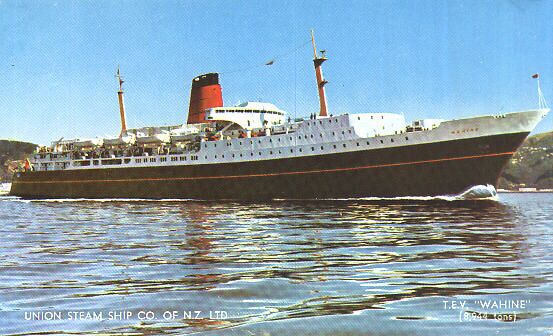
The
8,944-ton Inter Island Ferry TEV Wahine
Postcard
from the author’s private collection
The Barrett Reef incident at Wellington:
On January 19, 1947, the Wanganella struck Barrett
Reef at 11.30 PM, whilst she was sailing at a speed of 13 knots.
Apparently (and this is the short version) the Captain, Commander
R Darroch, had mistaken the flashing buoy in front of Barrett
Reef for the light to guide the ship into Wellington harbour. The
Wanganella was firmly stuck on the reef and it would prove to be
difficult to remove her from the Barrett Reef as she was stuck
badly on the rocks, in addition she had two massive gashes below
the waterline at her bow, with the larger of the two being some
12.2m long and up to 6.7m wide.
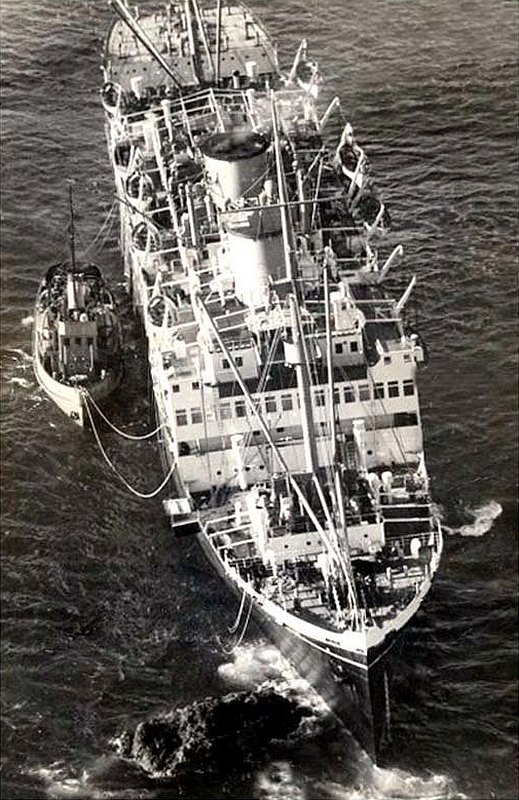
Here is an
aerial view of the Wanganella seen here on Barrett Reef
Thankfully, there were no injuries on board.
The next day all passengers were evacuated from the ship. For the
duration she was stuck on the reef there were a number of
attempts to free her, but it would eighteen days the Wanganella
would spend on the rocks.
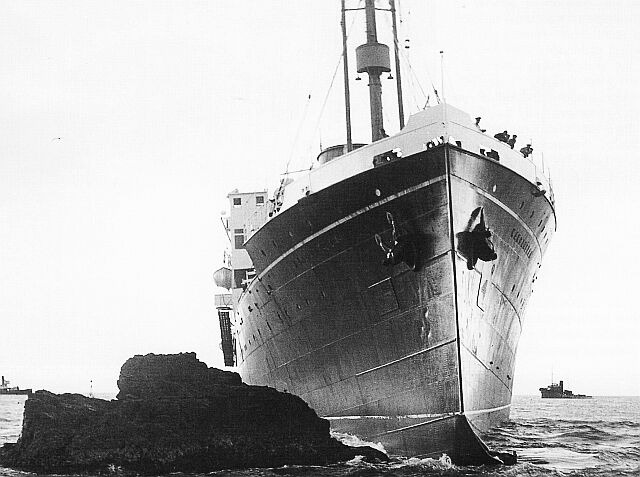
Wanganella
is seen here on Barrett Reef - Some damage can be seen at her bow
on water level
Photograph
by an “Evening Post” staff photographer
Finally on February 6, when there was a
combination of tides, good weather and hard work of the tugs and
engines at full astern, Wanganella succeeded in being hauled free
late in the day and she was towed into the Harbour, arriving at
the Aotea Quay just before midnight and she remained there to
undergo some internal repairs until she could be levelled and
sail into the Floating Dock twelve days later.
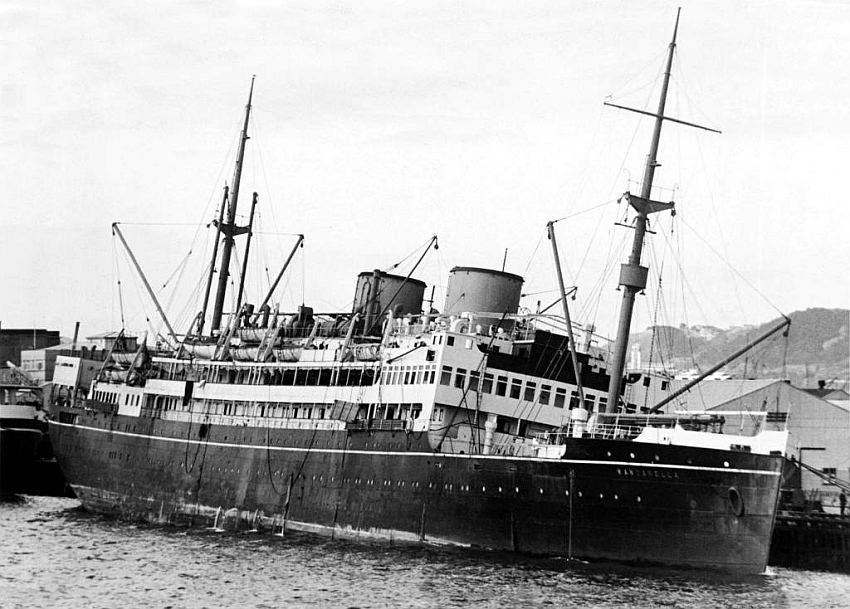
Here we see
a rather sad looking Wanganella whilst she was under repairs
berthed at Aotea Quay, Wellington
Photograph
by a Free Lance photographer, but obtained from “Alexander Turnbull
Library” Wellington
Wanganella headed for the Jubilee floating dock
under her own power on February 18, 1947, and the people of Wellington
were there to cheer her in, and soon underwater repairs were
underway. However with her extensive damage, it was going to be a
very big repair job!
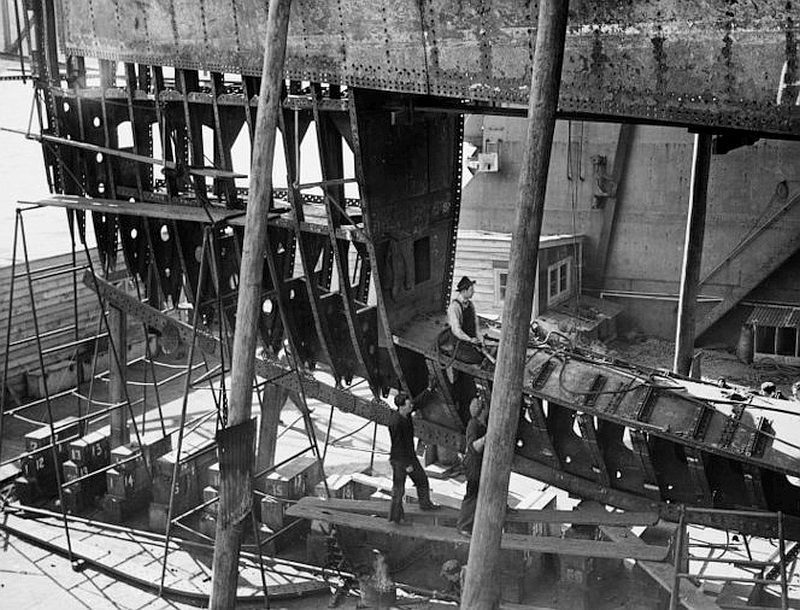
Repairs are
seen being undertaken in the “Jubilee floating dock”
Photo
taken by the “Dominion Post” Wellington
Wanganella’s crew had by now been paid off
and returned to Australia on board the rather small 4,436-ton
Union Steamship Company liner Wahine. Although some of the
engineers and electricians remained on aboard. She came out of
the dock again on May 27, 1947 and she was berthed.
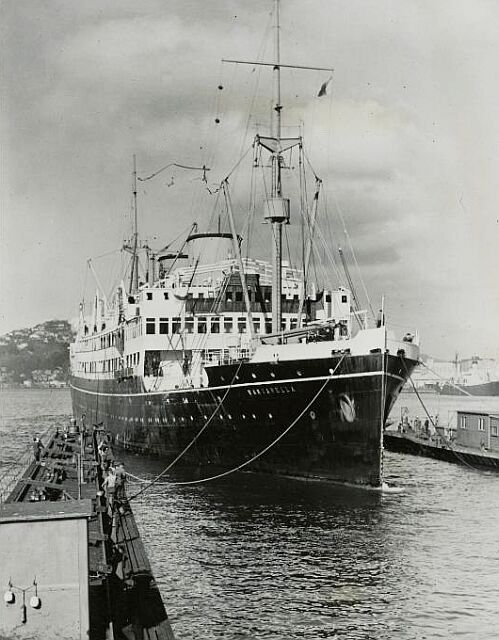
A much
better looking TSMV Wanganella seen leaving stern first from the
Wellington Jubilee Floating Dock on May 27, 1947
Photograph
by an “Evening Post” staff photographer
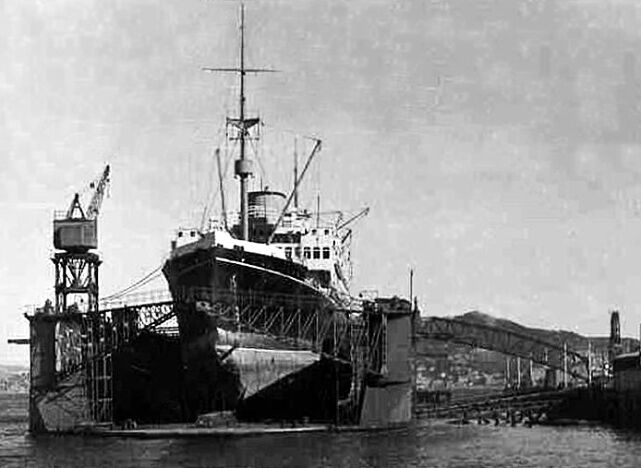
The
Wanganella is seen here in back in the Jubilee Floating dock
Photograph
provided by John Davidson
The long wait was due to a partial new forepeak
for the ship having to be built in the UK, and as soon as it
arrived it had to be fitted, under supervision of a Harland &
Wolff Assistant Works Manager, after she returned into the
Jubilee floating dock. She returned to the dock and work
continued, and it was finally completed on October 29, 1948. She
undertook her trails on Cook Strait on November 29 and 30 and
departed for Sydney on December 9, and as a bonus, she was fully
a fully booked ship, for everyone was delighted to have their
favourite liner back in service!
The Wanganella had indeed cheated death, but
this fine ship would continue sailing and she certainly did have
a good long life!
A Menu with a special history:
Recently I received an email from a lady in South
Australia who discovered a very special Menu from the MV Wanganella
in her Mother in Law’s belongings. It is obvious that she or
a family member had sailed on her in 1947. However, what makes
this Menu extremely special is this - 1: The date, and 2: A
notation on the Menu in pencil.
The date was “Friday, 17th.January
1947,” which just happened to be two days Wanganella
ill-fated conclusion of her voyage as she tragically hit Barratt
Reef at Wellington and was firmly stuck there for some time and
badly damaged. Therefore, this family member was obviously a
passenger on the ship and experienced this ordeal.
The rather simple notation in pencil on the
Menu reads, “on rocks 11.30 pm Sunday.” Sue Laidler has
been so kind to forward this rather valuable Menu to me for
safekeeping and to make sure that it will be retained for
historical safekeeping.
Below you can relive the history as you view
its cover and the interior of this Menu, knowing full well what
was going to happen just less than 48 hours later, because the
passengers certainly did not, they were having a wonderful
evening! Call it the calm before the storm!
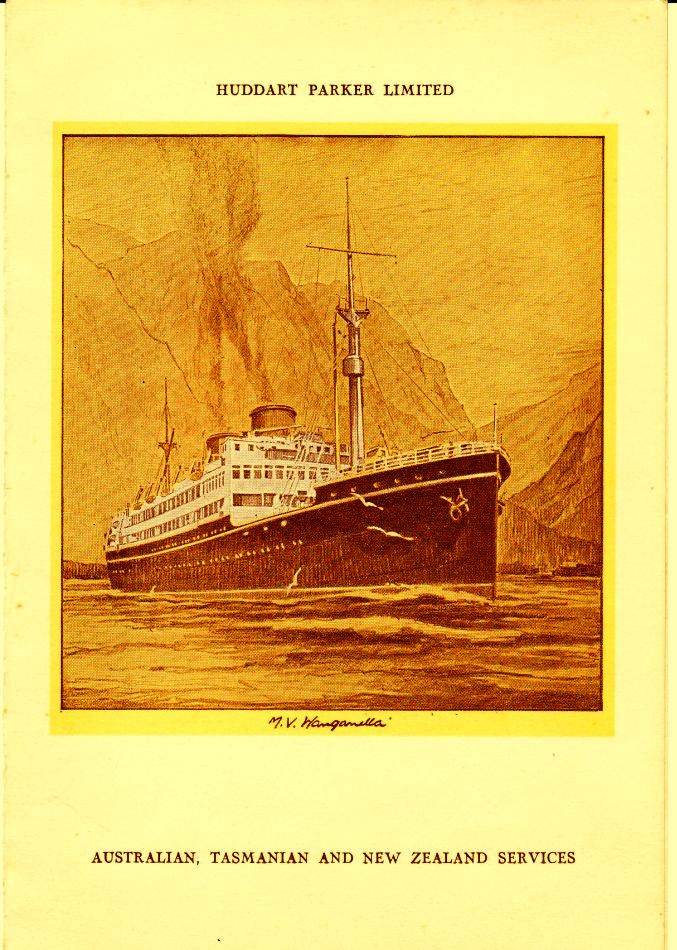
Front
cover on the MV Wanganella’s Menu dated January 17, 1947
The menu
was provided by Sue Laidler and I am most grateful to her –
Please do NOT copy it!
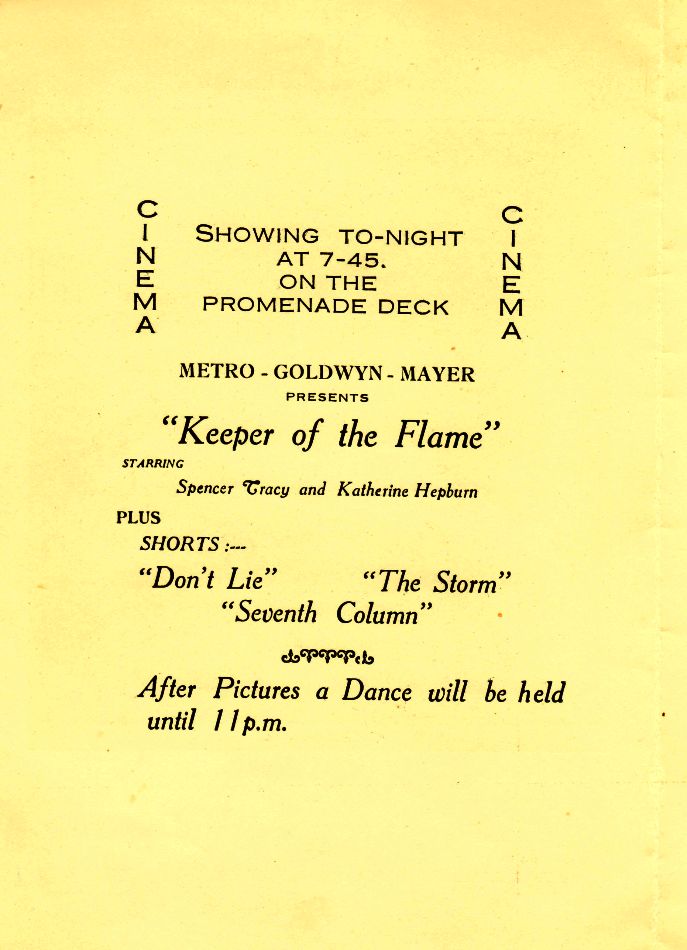
Inside
from cover of the menu with details of the evenings events
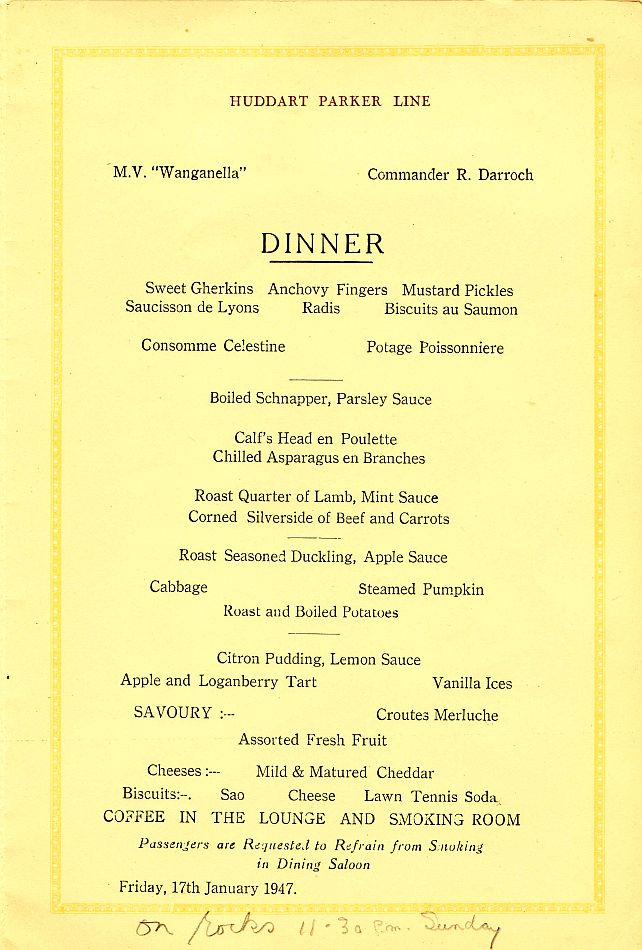
The
Menu as well as the passenger’s pencil notation!
“on
rocks 11-30 pm Sunday”
Return to Service:
From 1948 TSMV Wanganella continued her regular
Trans Tasman service as well as operating various cruises. In
1952 the Wanganella was given an another refit, which saw her
forward First Class Promenade Deck mostly glazed in leaving only
a small aft section open. In addition her aft superstructure was
in due course also extended far aft and this provided a stewards
recreation room.
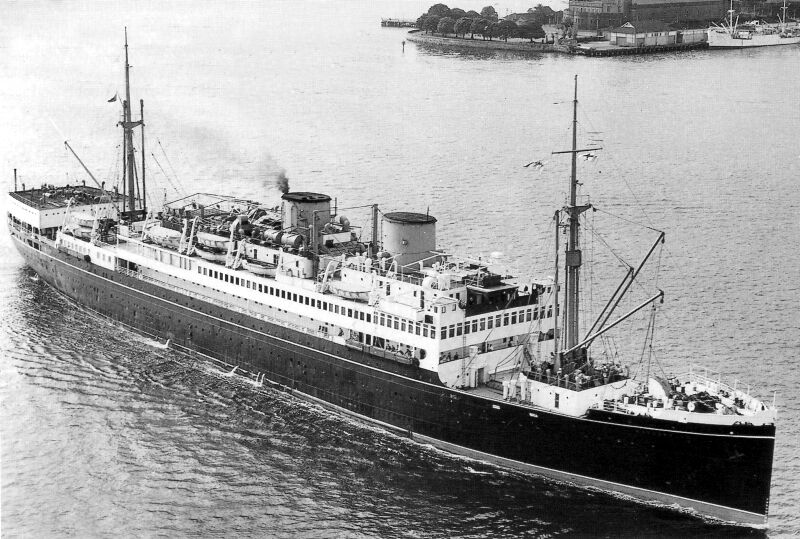
The
Wanganella is seen here towards the end of her Huddart Parker
days heading under the Sydney Harbour Bridge
From this
photograph you can see the glazed in Promenade Deck & that
her forward funnel is a dummy
Originally
a Huddart Parker publicity photo – From the author’s
collection
Refitting her for Occasional Cruising:
In 1955/56 her public rooms and some of her
accommodations were refurbished in an attempt to keep her up to
date with the competition as well as the possibility to make her
suitable as the occasional cruise ship!
1956 was the year for the “Melbourne
Olympics” that was officially known as the “Games of
the XVI Olympiad” and it commenced with the Opening Ceremony
on November 22, and concluded with the Closing Ceremony on
December 8. The TSMV Wanganella undertook a special Olympic Games
Cruise from Auckland New Zealand.
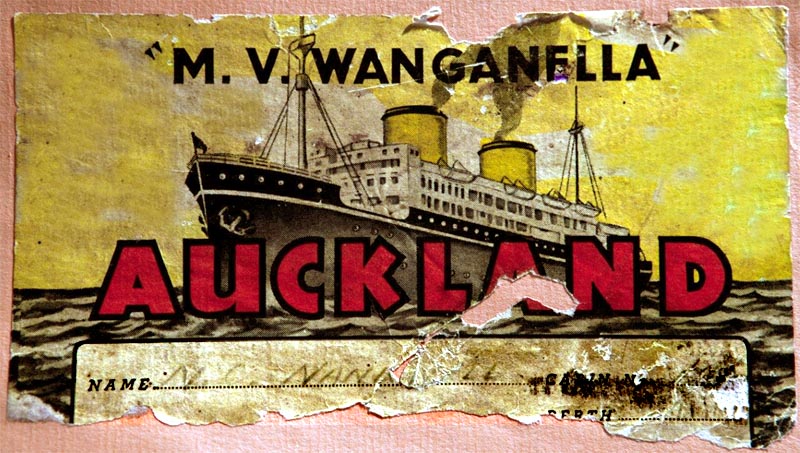
I received the label and photograph above and
below from Mr. Paul Nankivell of New Zealand early in 2015, and
he told me that he was very young he sailed on this fine ship and
still has some memories, but as a two year old. Young Paul and
his family boarded the Wanganella in Auckland in November 1956
and she departed for this special cruise to the Melbourne
Olympics. Onboard were Mr and Mrs. Nankivell and their children.
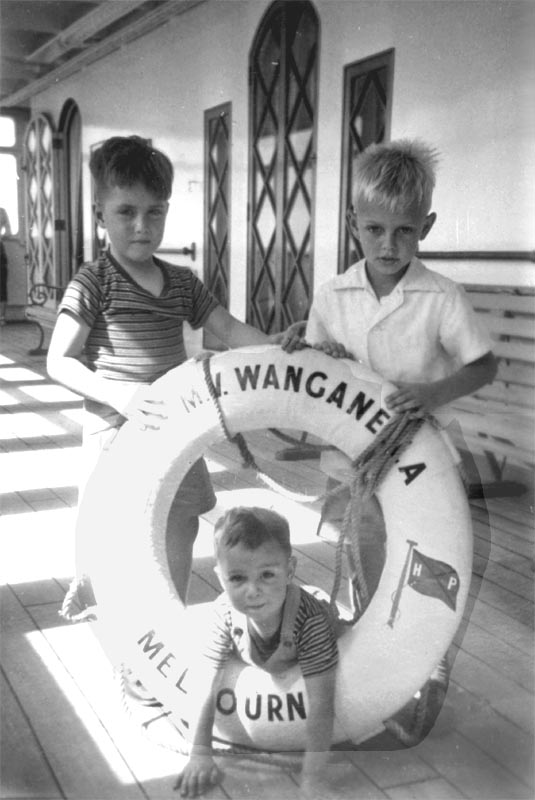
Here we
see Young Paul at the bottom of the Life Buoy and I assume
his two brothers
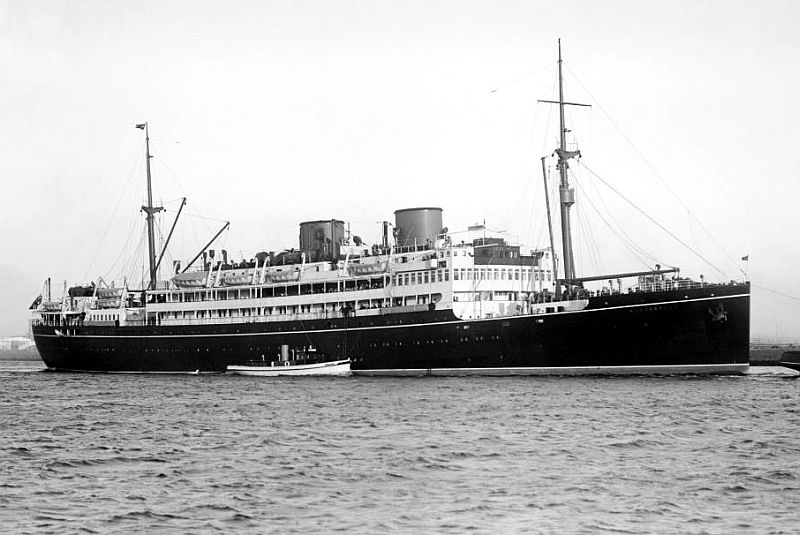
The TSMV
Wanganella is seen arriving in Melbourne for the Olympics
Mid 1958 she commenced a series of South
Pacific and New Zealand cruises from Australia and New Zealand.
Although these did prove to be quite successful as her past
Trans-Tasman passengers revelled not only in the tropical South
Pacific, whilst it was winter at home, but they enjoyed the
elegant surrounding of a ship they knew so well. Others just
loved the relaxed way of cruising around New Zealand and the Fjordland’s
rather than just the express Tasman service and the menus were
also far superior and the entertainment was better.
But as I tend to say in so many of my features
on passenger liners - “Times are-a-Changing” as a
popular song was clearly telling us all in those days! Certainly,
air travel commenced to make rapid inroads and with the arrival
of the Jumbo Jet, the Boeing 747, air-fares had become cheaper
and cheaper, thus passenger loadings on ships worldwide, be they
great or small, luxurious or budget, began to decline rapidly and
thus shipping companies worldwide has to start rethinking their
strategies.
Huddart Parker produced brochures proclaiming
Trans-Tasman voyages as being cruise vacations full of fun and
relaxation. These could be taken from Australia to New Zealand
and return again to their home port, thus a round voyage, or from
New Zealand, thus cruises from either end. Although this was
marginally successful, and there were even those who undertook
the round voyages as a cruise, sadly all too soon Huddart Parker
Ltd decided to offload their very last passenger division, and
sell this part of their operation to another great Australian
shipping Company.
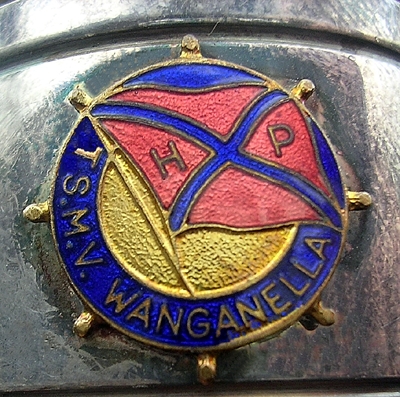
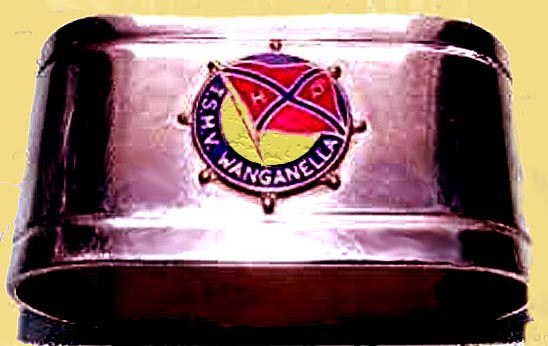
Above
& below: A silver Wanganella Napkin ring (after cleaning)
& a close up of the logo
From the
author’s private collection
TSMV Wanganella’s new owner McIlwraith McEacharn Ltd:
On October 27, 1961 Huddart Parker and the
wonderful and elegant Wanganella came under the ownership of
“McIlwraith McEacharn Ltd,” who were the owners of the
once famed and greatly loved and what was called the last
Australian coastal liner, the TSMV Kanimbla.
The Wanganella was delivered to her owners in Sydney,
with just one change being made to the ship, being that her
funnels were repainted deep red with black tops (hats).
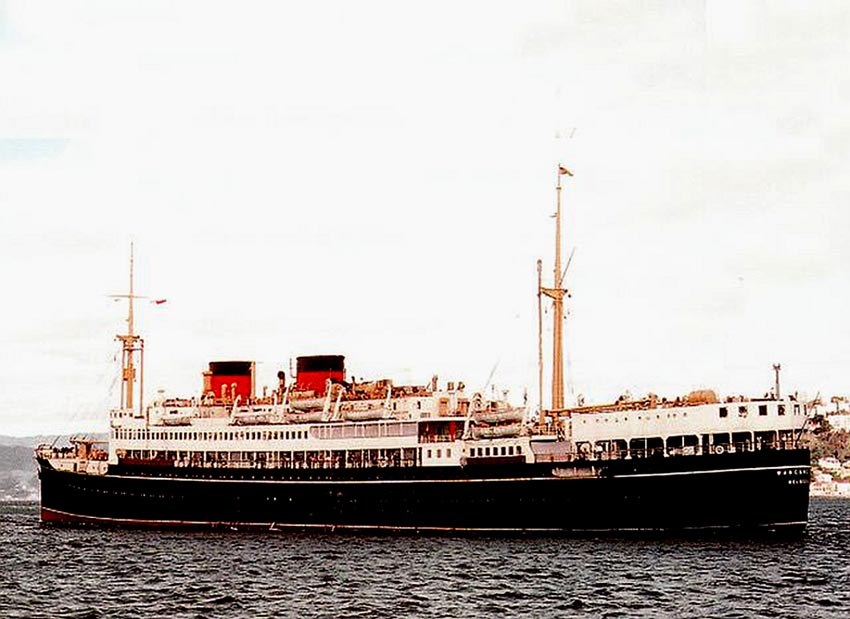
A excellent
photograph of the TSMV Wanganella in her McIlwraith McEacharn
livery, which was so short lived!
Photographer
unknown – *Please see photo notes at bottom of page
McIlwraith McEacharn decided that she would
remain on her regular service and she soon departed on her first
voyage acroos the tasman under a new owner, but the same Captain
who had been in command of the Wanganella for countless years, Captain
William Uttley
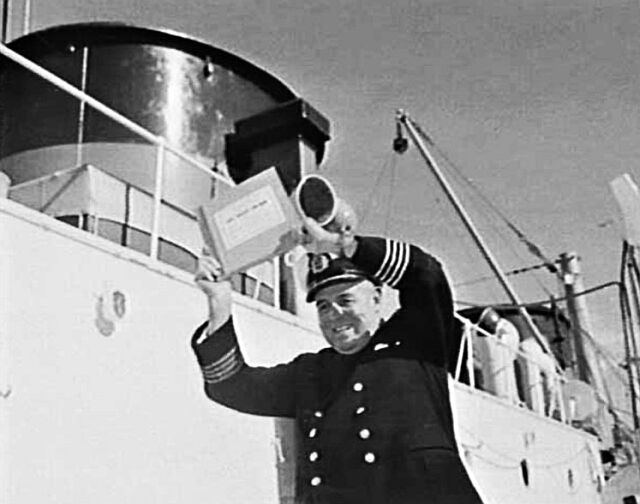
Captain William
Uttley of the McEacharn Wanganella celebrates her first voyage
with her new livery
Image
source unknown – *Please see photo notes at bottom of page
However, this venture would be relatively short
lived for loadings sadly did not improve, for on March 26, 1962,
a sudden major mechanical problem occurred, mid Tasman Sea. It
turned out that she was having problems with her port engine
whilst on her way to Auckland. Although she managed to continue
to New Zealand by using her starboard engine, under a reduced
speed, then having reached Auckland she departed again with
passengers and headed home again using the one engine and she
arrived back in Sydney on April 4. She immediately went into a
shipyard for repairs, which were completed just under a month
later, on May 2.
However at this stage, McIlwraith McEacharn Ltd
had decided that they would sell her as soon it was possible. A
buyer was found rapidly, as she was sold to a Chinese Company
with the handover was to take place in Sydney in August 1962,
thus within six months the Wanganella would change hands once
again!
McIlwraith McEacharn decided that there was
time for the Wanganella to return to service until August, but
tragically this again proved to be a very costly problem for the
company. It was on June 12, 1962 whilst the Wanganella was
manoeuvring to dock in Sydney harbour having arrived from Auckland;
she suffered an explosion in her engine room. Thankfully there
were no casualties, but again just like in the past, she was a
lucky ship! She was repaired once again and when completed she
returned to service again. When the TSMV Wanganella arrived in Sydney
on July 25, 1962, from her “Express Trans-Tasman”
voyage as an Australian owned liner, it had been her last voyage
officially! Her final official voyage was under the command of Captain
William Utley who had sailed on Wanganella for many years and he
was sad to see her end as an Australian owned liner! She was dry
docked, destored and all her crew were paid off. She was laid up
for several weeks after which she would be handed over to her new
owners.
Hang Fung Shipping:
Then on August 15, 1962 the Wanganella was
officially taken over by “Hang Fung Ltd” of Hong Kong
who would at first intended to operate her between New Zealand, Australia
and Hong Kong, but also as a Pacific cruise ship as well as
operate occasional Trans-Tasman voyages. The only exterior change
was that her funnels were repainted black with two silver bands.
She was given a crew of 36 European officers and 120 Chinese
stewards and other crewmembers. Noteworthy was that the
Wanganella was now a One Class liner and cruise ship! “Hang
Fung Shipping” maintained the Wanganella magnificently, and
she always looked spotless!
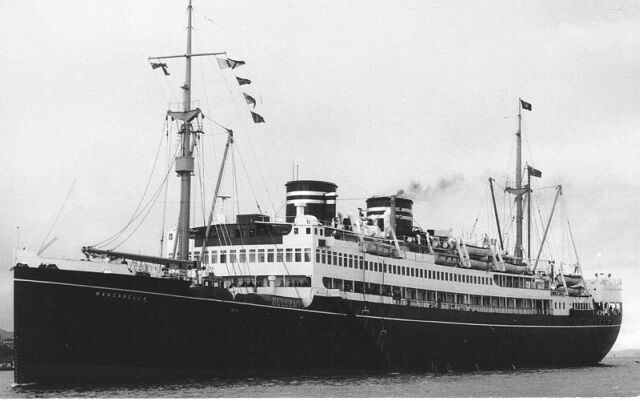
The
Wanganella is seen here with her Hang Fung Ltd funnels and
looking very smart
Photo
from the author’s private collection
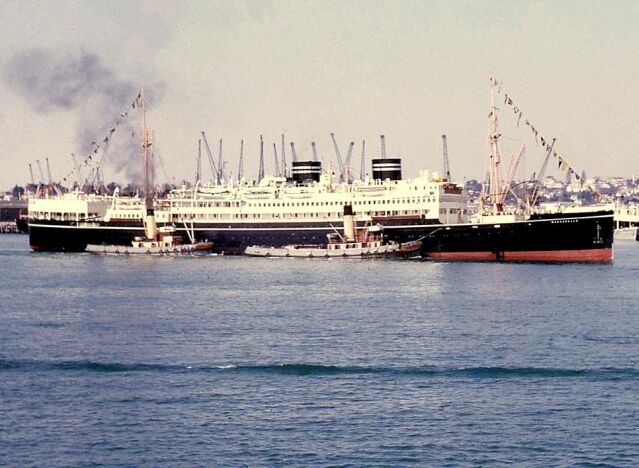
The
Wanganella is seen here arriving in Auckland in 1962, on her
“Melbourne Cup Cruise”
Photographer
unknown – *Please see photo notes at bottom of page
She commenced by heading to Auckland from where
she operated a “Melbourne Cup” cruise, then South
Pacific cruises, as well as cruises covering various Australian
ports. In November 1962 it was announced that she would head for
Fremantle in Western Australia where she would be used as a
floating hotel during the “Perth Empire Games” (today
these games are called the “Commonwealth Games”). After
the Games she continued to operated a few more South Pacific
cruises, and although her official cruise schedules went as far
January 1964, but these never eventuated! Instead, she was placed
on the market.
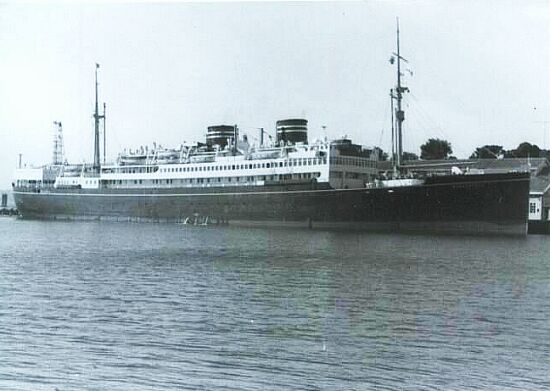
The
Wanganella is seen berthed in Fremantle as an accommodation ship
for the Games
Photo
from the author’s private collection
The Wanganella and her “Doubtful” Days:"
The question on the minds of all ship lovers,
especially those who dearly loved the Wanganella, was “Is
her time up?” Obviously ship lovers clearly felt that this
could well be end of the once superb Huddart Parker Liner, for
there was no doubt that Trans-Tasman voyages were no longer
viable and with air travel having taken over, and taking in
consideration that the once line old ship was aging, and with her
ongoing engine problems, all felt that the elegant two funnelled
Wanganella could well be sold to Asian ship breakers very soon.
However thankfully, there was a last-minute
reprieve from her going to the breakers, for in mid 1963 she was
sold to an American consortium “Utah Constructions” who
were going use her as an accommodation ship for workers at the
construction site of the Manapouri Power Station, an
Hydro-Electric Scheme in the South Island of New Zealand.
Maritime friend, Neil Higgins wrote: “I
was with the Port Agent in Auckland and we did give her quite a
send-off to Doubtful Sound being her last voyage (under her
own power), with a skeleton crew including the Chief Steward.
From memory (prior to this) she was part way through a
South Pacific cruise and the balance of which was cancelled. It
was all a last minute surprise to me.” (Words in italics
added by the author).
She would be in use at the Hydro-Electric
Scheme from 1963 to 1969 and she was moored in the beautiful
surroundings of Doubtful Sounds whilst being used as a
comfortable hostel for workers building tunnels and roads, etc.
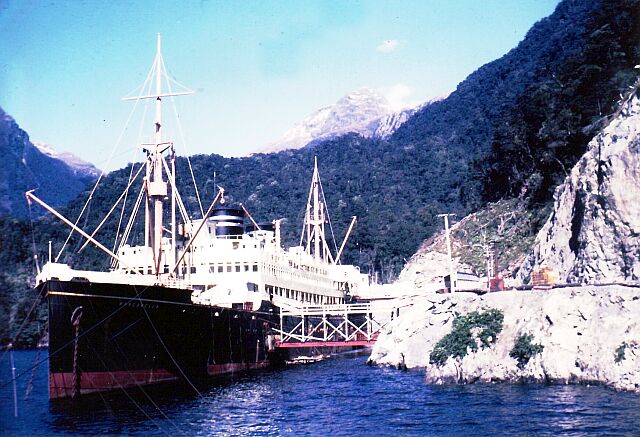
The
accommodation ship Wanganella is seen here berthed at Doubtful
Sounds
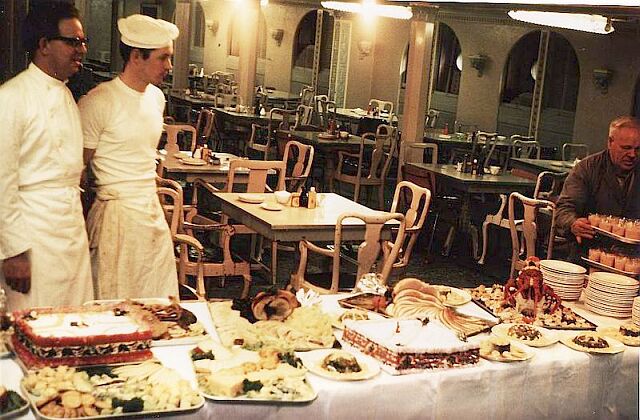
The Dinning
Room Buffet on Christmas Day 1967
Photograph
by Aaron Nichoson
Although she was still at location, when the
work was finally completed Wanganella’s days was finally at
an end and she was sold to Australian Pacific Shipping Company
late in 1969. Due to her having been idle for seven years, it was
not possible for her engines to be restarted successfully and for
her to sail under her own power, therefore early in 1970 the once
proud TSMV Wanganella had to be towed to her final destination,
she was taken to Hong Kong where her new owners sought out if her
engines could be repaired satisfactorily, but the answer was that
the costs would be prohibitive, or even an engine replacement.
Therefore they quickly resold her to Taiwanese breakers “Shyeh
Sheng Fuat Steel and Iron Works Ltd,” and she was towed to Kaohsiung,
Taiwan where she was soon broken up late in 1970, aged 41 years.
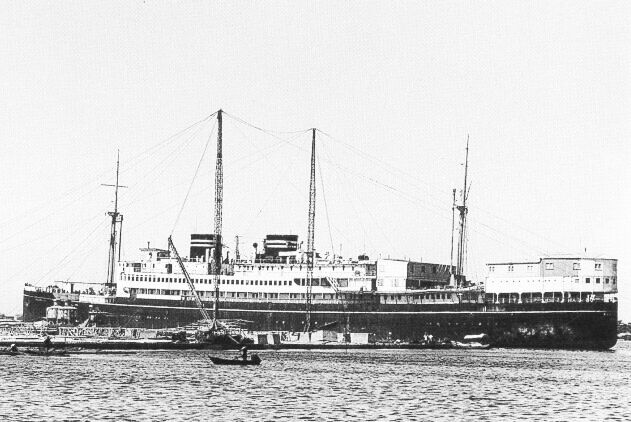
The
Wanganella is seen here in Taiwan mid 1970, and still looking
beautiful!
Photographer
unknown – *Please see photo notes at bottom of page
Memories of a fine Trans Tasman Express Liner!
As I stated earlier, there are ships that stand
out in ones mind from the days of our youth, and TSMV Wanganella
is just such as ship, as is the TSS Monowai for that matter, and
there will be a page on her in the very near future. There is no
doubt that the Wanganella was a graceful looking ship with her
strong rectangular, yet elegant lines and she was a much loved
ship by the many who sailed on her as well as those who would go
to the harbour and gaze at her graceful lines when she was in
port! I also recall my time as a young man who had just started
in the shipping industry and I would go and visit the Wanganella
and I loved her stately lounges and superb accommodations, they
were quite something for those days! Being built for the British
trade, obviously, she was so traditional, giving her that special
appeal the kind of appeal that is just not found on the modern
ships these days! But at least we can remember!
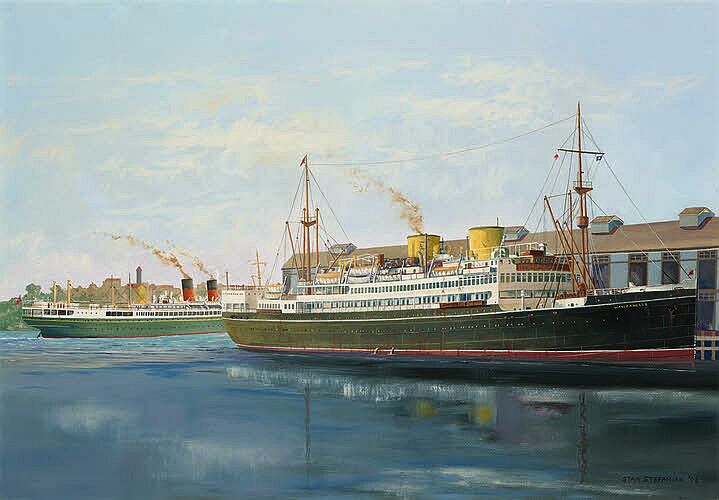
A superb
painting of the TSS Monowai (left) and TSMV Wanganella (berthed)
Painting
by Stan Stefaniak
I trust that these three pages on the
Wanganella will provide you with many happy memories, especially
for all who sailed on her, or those who may have served on this
fine ship, be it whist a liner or a hospital ship. I trust that I
have done this ship justice and if you have something to add,
please let me know, my email link is located below!
THANK YOU: Once again, I wish to thank Mr.
Neil Higgins for his excellent photographs, but also Mr Stanley
Evans for providing other images that originally came from a
variety of sources, but has been credited to their original
source. There are other images sent by other supporters, for
which I am very grateful, however I do not know the original
owners details. Please see the note below re these! Thank you
everyone, you have been of great assistance in making these pages
what they are!
Reuben Goossens.
TSMV
Wanganella INDEX:
Page
One …
Ships History Page
Page Two …
Photo Page
Page
Three …
Deck Plan & Brochure
Page
Four …
Pte Stanley French heads for war and returns on the Wanganella a
wounded soldier. A remarkable story of New Zealand soldier Stan
who fought in a major Battle.
Remembering the Magnificent T.S.M.V. Wanganella
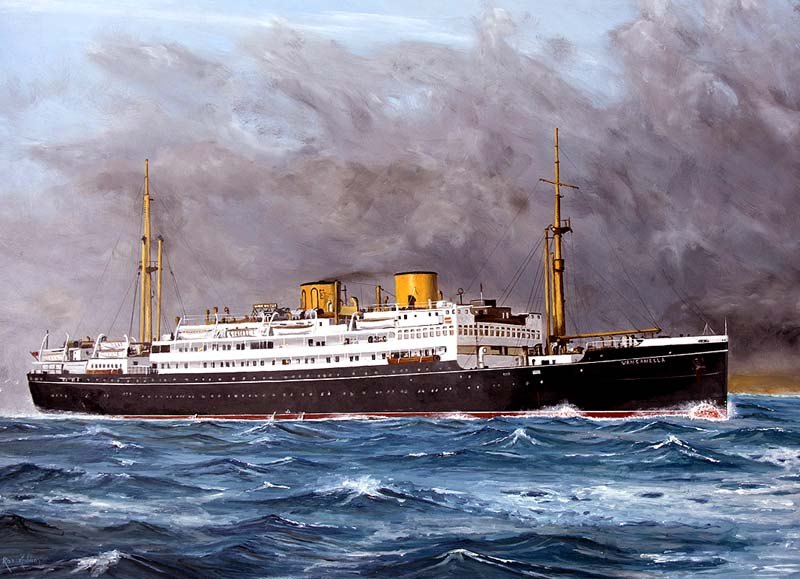
Painted by
the brilliant Australian painter Rob Kennedy
“Blue Water Liners sailing to the
distant shores.
I watched them come, I watched them go and I watched them
die.”
********************************
Featuring over 1,360
Classic Passenger Liners, Passenger-Cargo Liners & Classic
Cruise Ships!
Or ENTER
HERE
For interest: Sadly an email service to
ssMaritime is no longer available, due to the author’s old
age and chronic illness as well as being disabled, etc. In the
past ssMaritime received well over 120 emails per day, but Mr. Goossens
can no longer handle same. He sincerely regrets this!
**************************
ssMaritime.com
& ssMaritime.net
Where the ships of the past make
history & the 1914 built MV Doulos Story
The Author has been
in Passenger Shipping & the Cruise Industry for well over 60
years
In addition
he was the founder of “Save the Classic Liners
Campaign” in 1990
Please Note: ssmaritime and associated sites
are 100% non-commercial and the author seeks no funding
or favours of any shape or form, never have and never will!
Photographs on ssmaritime and associate pages
are by; the author or from the author’s private
collection. In addition there are some images that have been
provided by Shipping Companies and private photographers or
collectors. Credit is given to all contributors. However, there
are some photographs provided to me without details regarding the
photographer/owner concerned.
This notice covers all pages; although,
and I have done my best to ensure that all photographs are duly
credited and that this notice is displaced on each page, that is,
when a page is updated!
ssMaritime is
owned & © Copyright by Reuben Goossens - All
Rights Reserved