Please Note: Firefox and some other search engines are not
suitable – Use “Internet
Explorer” for this page to load perfectly!

Click the logo above to reach the ssMaritime
FrontPage for News Updates & “Ship of the Month”
With Reuben Goossens
Maritime
Historian, Cruise‘n’Ship Reviewer, Author & Maritime Lecturer
Introduction Page
This ZIM feature
covers all of their passenger liners, from their first ship in 1947 to the day
ZIM ceased its passenger operations 1969. ZIM passenger liners were as follows:
SS Kedmah, SS Negbah, SS Galilah
and SS Artza
The famed SS Exodus
was originally built in 1911 for Chesapeake Steamship Company, but she
became best known as the luxurious night boat, the SS President Warfield for
the “Baltimore Steam Packet Co’s (Old Bay Line) that operated an
overnight service between
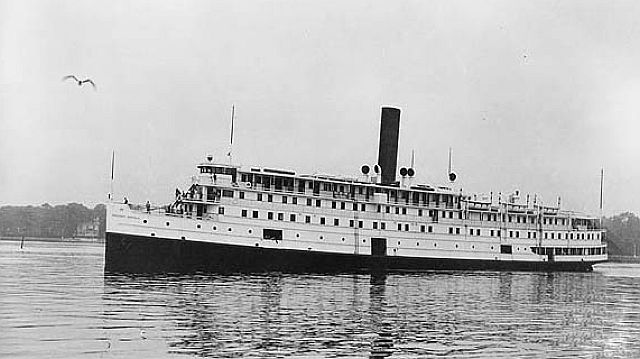
SS President Warfield
In June 1942 she was
acquired by the War Shipping Administration (WSA) and was refitted to become a
transport vessel for the British Ministry of War Transport and she was fully
manned by a British crew.
After the war, on
November 9, 1946 the ship had well and truly come to the end of her days as she
was well worn and WSA decided to sell the President Warfield to “Potomac
Shipwrecking Co” of
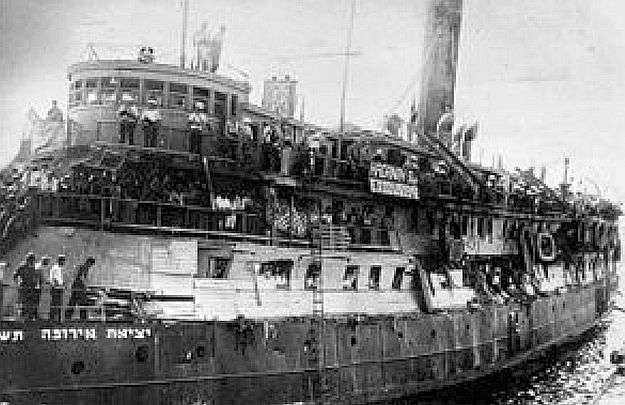
The famed refugee ship - SS Exodus
Please Note: The story associated in the movie of
the same name and the actual event has little in common!
From the
She departed the
The ex President
Warfield had been taken to
The Birth of ZIM
In 1947 a special holiday
was declared throughout the then British-ruled
ZIM Lines was
incorporated in 1945 by the Jewish Agency, the Labour Federation and the Israel
Maritime League. The company was led by Dr. Naftali Vydra, a man of vision who together with his cohorts were not seamen.
After the
establishment of the State of
***********************************
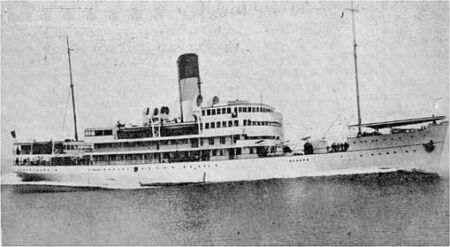
Straits
Steamship Co Liner, SS Kedah
SS Kedah
ZIM's first passenger ship, the SS Kedmah, entered service
in 1947. She transported passengers and immigrants to the State
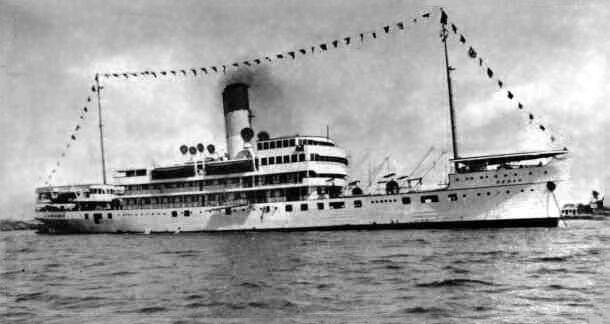
Here
we see SS Kedah with her upper hull portal’s open during hot weather
Conditions
These
were later sealed when she was sold to ZIM Lines
From the
author’s private collection
The SS Kedmah had her
beginnings back in 1926, when the Straits Steamship Company, being an associate
of the famed Blue Funnel Line, decided to build a ship designed especially for
the express tropical service, sailing between
SS Kedah had two
passenger decks, three holds and hatchways and 6 steam-driven cranes and a
double bottom that extended the entire length of the ship. She was powered by
two single turbine steam engines, and with her twin screws this gave her a
respectable speed of 18 knots. The Kedah commenced service in 1927 and she
quickly became a popular ship in the region and was nicknamed the “Little
Queen of Malacca Straits,” and there a special anchorage was marked on
charts of
War Time Duties
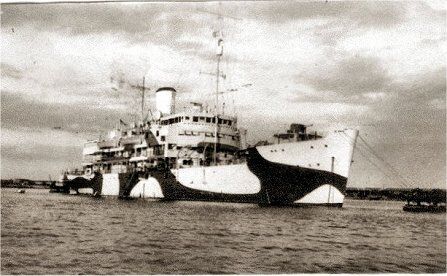
SS Kedah, armed auxiliary vessel number FY035
Photograph courtesy of Mrs. Harman, and taken by Second officer Dick
Harman
In December 1939, SS
Kedah was requisitioned by the Royal Navy as an armed auxiliary vessel number
FY035. The Navy made various changes, which included the top section of the
funnel being removed; also new taller masts were erected, as well as being
armed with two 4-inch guns and one 3 inch. Anti-aircraft gun.
Depth charge launchers were placed on the after deck. She served in the north
of Borneo and was used as an evacuation ship, prior the fall of
On her way back to
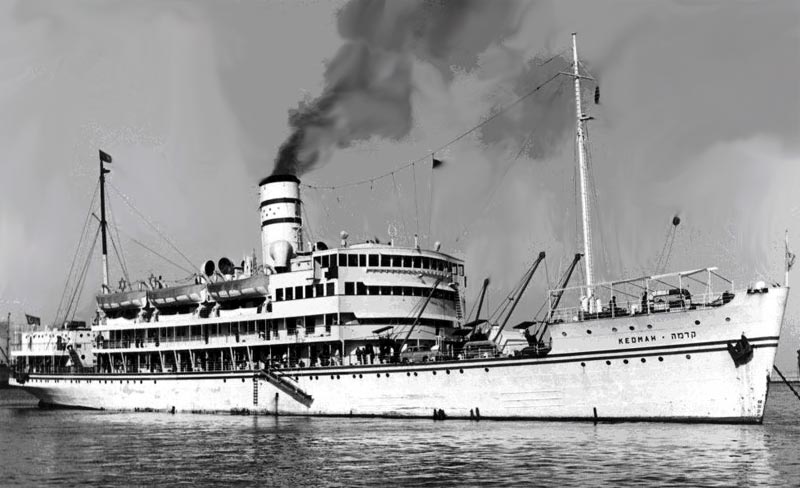
The newly rebuilt SS Kedmah, the pride of the Nation of
Israel
From the author’s private collection
Whilst still under
repair after the war, she was sold, for £75,000
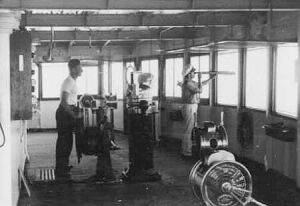
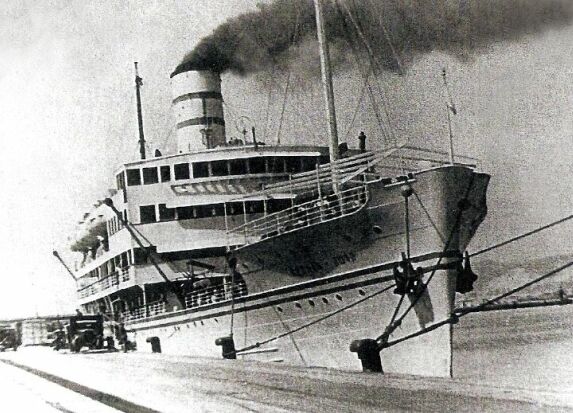
SS Kedmah see
berthed during her early days as a ZIM liner
Photograph provided by Yael G. Spier Jnr and was taken by a family
member
Countless thousands
of Jewish settlers and general passengers sailed from
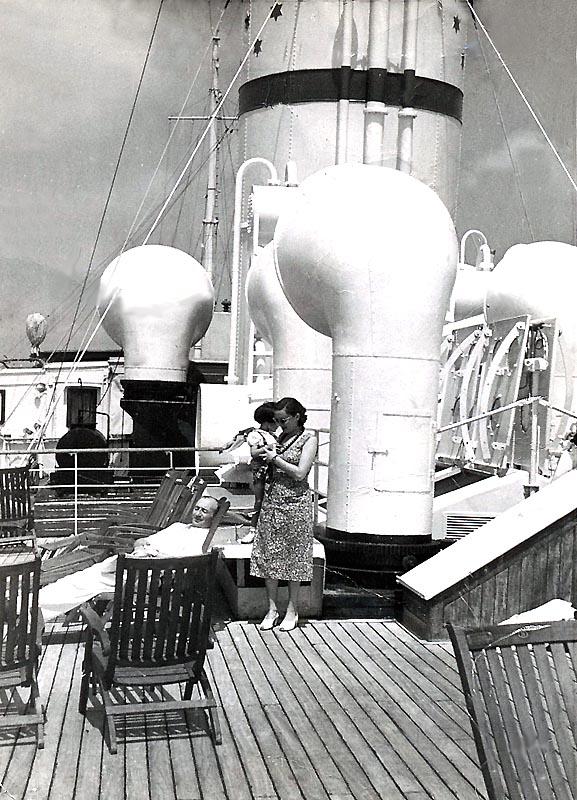
Here we see a Mother and child topside of the Kedmah
bound for
Photograph was sent in by a supporter – Photographer is unknown,
please see photo notes at the bottom of the page!
SS Kedmah was a very
popular ship both with the public as with the heads of state.
Captain Eliezer L.
Aczel.
I received an email
recently from a Mr. Amir D. Aczel who provided me with some information
regarding his late Father who was a well-known ZIM Lines Captain. I felt that
his story was worthwhile including on these pages and thus his details are
below. These have been sourced in part from his email and from what I have
gained from Mr. Aczel’s personal webpage and I have combined as much of
the story as possible.
“My Father was Captain Eliezer Ladislas Aczel and he was a captain throughout ZIM’s entire period of operation serving on their passenger fleet. He served as the first captain on the company’s first official passenger ship that commenced in service with ZIM in July 1947, being the 3,504 ton (GRT), SS Kedmah and later he served on both the 9,855 GRT SS Israel built in 1955, as well as the 1957 built 9,914 GRT SS Theodor Herzl. He was also the captain of the delightful 7,811 GRT, 1961 built, MS Moledet for some time.
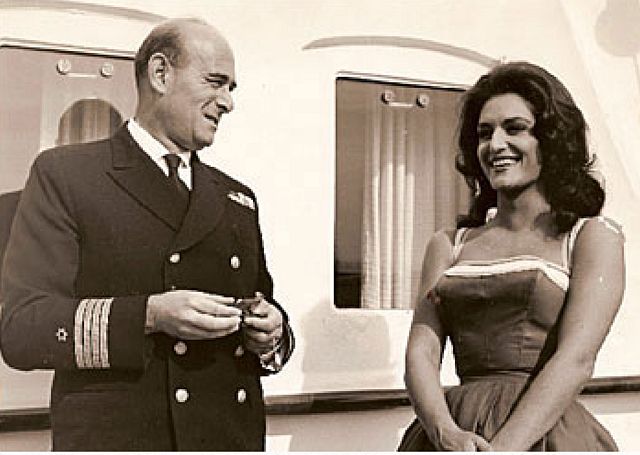
Captain
Aczel and famous French-Italian songstress ‘Dalida’ on board his
ship
Photograph provided
by Amir D. Aczel
During WW 2, Captain Aczel had done many
heroic acts whilst he had been working with the Allies, for which he had won a
good number of medals! But one of the worst things he had to do was he once
successfully delivered a baby on board his ship, something he said he would
never wish to do again! During his lifetime my Father was known simply as ‘Captain
Aczel’ and his ships ploughed throughout the Mediterranean during the
1950s and 1960s many of these were by then mostly popular cruises, departing
Haifa and sailing to Piraeus, Naples, Marseille and Barcelona. On some years
Thus it seems to be
quite clear that there is no doubt that Captain Eliezer L. Aczel must have made
Israeli maritime history in a good many ways, as well during the war years, but
he loved being a Captain during peacetime and commanding a good number of fine
ZIM Lines passenger ships!
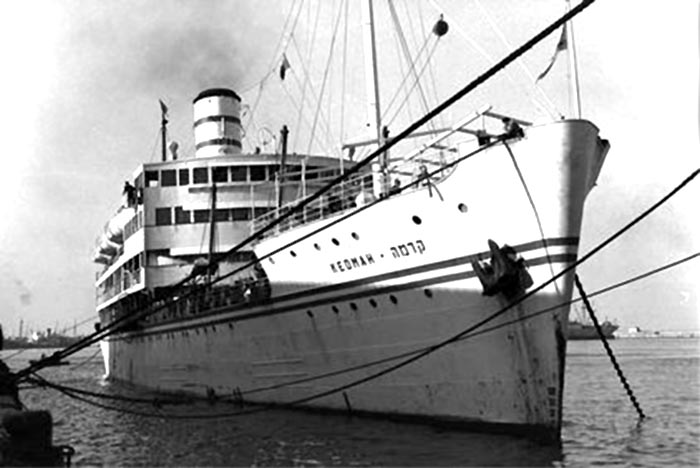
She is seen just berthing during her latter years
SS Kedah / Kedmah Specifications:
Built at: Vickers
Shipbuilding Ltd,
Launched: July,
16, 1927 by Lady Maxwell.
Tonnage: 2,499 GRT
(Gross Registered Tons).
Length: 100.6m - 330ft.
Breadth: 15.24m - 50ft.
Draught: 4.7m - 15.5ft.
Propulsion: Parsons
single-reduction steam turbines. 6,200 S.H.P.
Screws: Twin.
Speed: 18 knots.
Passengers: Kedah had 80
First class passengers & up to 960 deck Passengers.
A Kedmah
Owners: Straits
Steamship Company 1927 - 1947.
Kedem Israel Line Ltd
(ZIM) - Harris and
Harris and
SS Kedmah’s Final
days:
In 1952, ZIM and
Harris & Dickson decided to terminate their partnership and Harris &
Dickson purchased the part of ZIM and on November 2, 1952 the ship SS Kedmah
was once again transferred to the British flag once more. She was renamed
Golden Isles and she operated on Mediterranean cruises.
Then in 1954 ZIM Israel
chartered her for a number of voyages between Marseille and
The SS Kedah, Kedmah,
Golden Isles sailed operated for a good 30 years. During these years, her
silhouette and photo appeared on two postal stamps. First in 1980 on the 1$
stamp of Singapore, which had been issued within a set of ships stamps, and
second time in 1995 on a 4.40 shekel Israeli stamp issued on the occasion of
50th anniversary of ZIM Lines. In
Reuben Goossens.
***********************************
SS Negbah
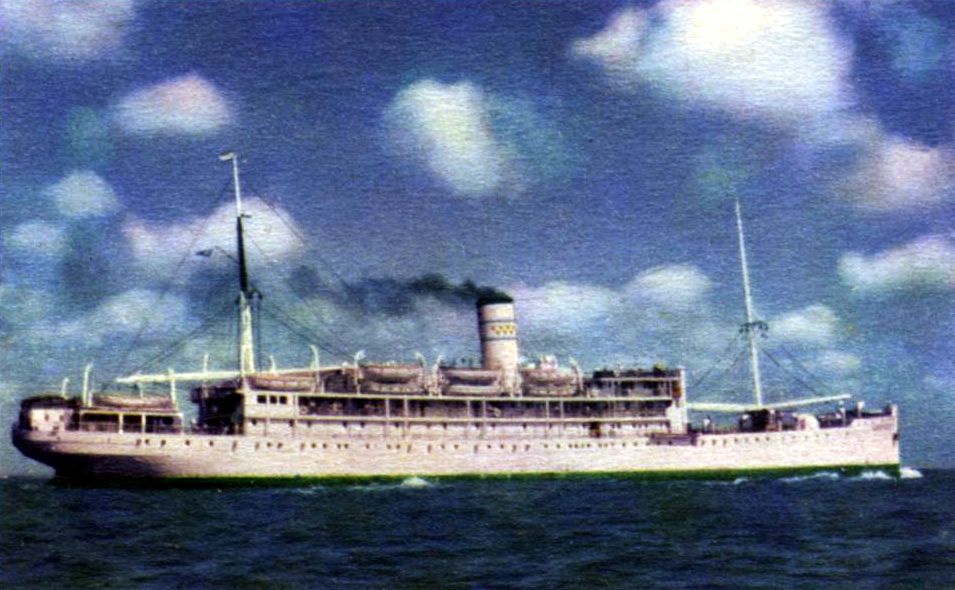
SS Negbah
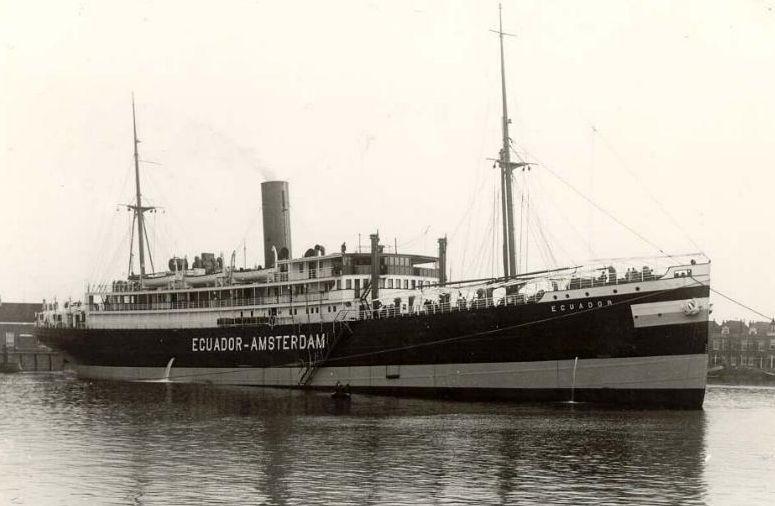
The short lived Dutch liner, SS Ecuador seen in 1915
However she was
placed on the market and sold and in January 1916 the Pacific Mail Steamship
Company of
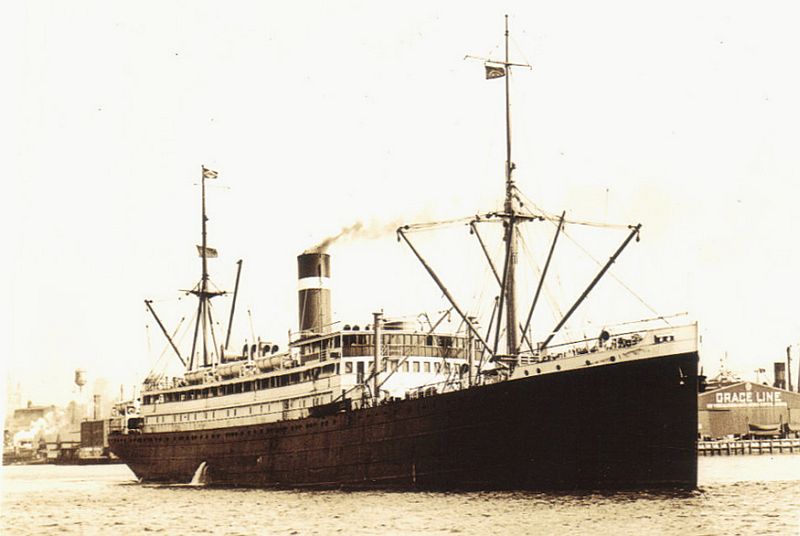
She
is seen here as the SS Santa Olivia
1931 she was
transferred to Grace Line to become the SS Santa Olivia, but in 1936 sold to
Libby, McNeill & Libby & Co who renamed her SS David W. Branch and used
her on the Alaskan canneries service.
With the
But the now new and
growing Israeli ZIM Lines was looking to obtain good ships for their fleet and
in 1948 they obtained her and had her completely refitted in the Netherlands at
the same shipyards that originally built her to turn her into a handsome three
class migrant/tourist liner. Her tonnage
was 5,544 GRT, with a length of 380ft and a beam of 48ft. With her steam
engines and single-screw she originally operated at 14 knots, but after her
refit she would operate at an average of 11.5 knots. She was able to
accommodate up to 1,350 passengers and some 1,000 tons of general cargo. She
was officially named SS Negbah and received the
Israeli flag on board on October 26, 1948. Negbah
operated on a multi class system, Cabin, Tourist, Third and a Dormitory class.
Later they also added First class with three rooms on C Deck, two deluxe suites
and a deluxe cabin all with private facilities.
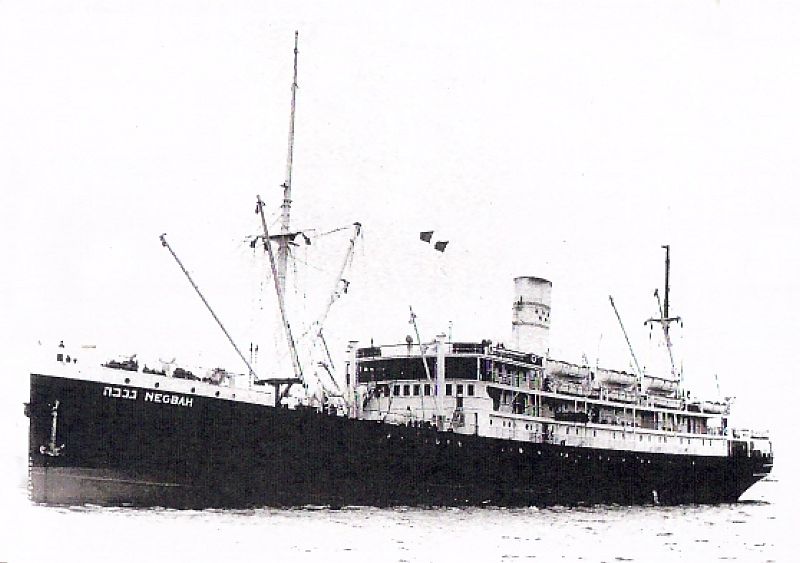
The Negbah is seen in her early days with ZIM still having a
black hull
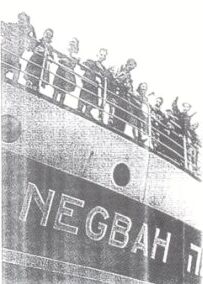
SS Negbah operated generally the same schedule as SS Kedmah
however, being 14 years older than the Kedmah, the Negbah
proved to be the far superior and more reliable ship at all times. Some said
that it was the precision of Dutch engineering! During her time with ZIM she
had two extensive refits of her public facilities and her passenger
accommodations were always fresh and bright!
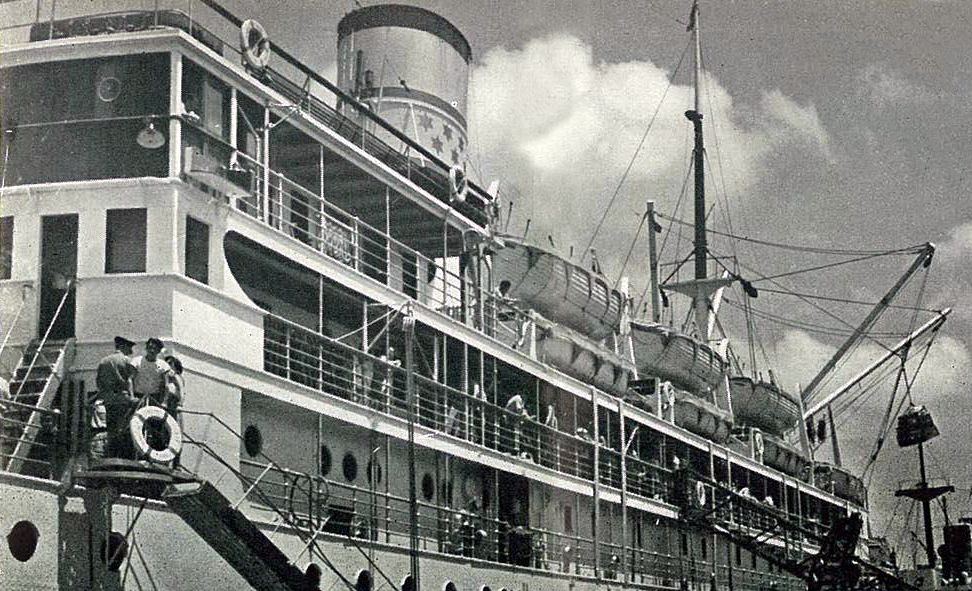
The Negbah is seen here in port
A Deck (Boat Deck) this was topside and the best
location for quiet sun baking and sport activities.
B Deck was fully occupied by Cabins Class -
Forward: there were 17 cabins they had from two, three or four berths, but all
cabins on board had a window or a porthole, none on this deck had private
facilities. Public bathrooms were available nearby. Aft on this deck, located
in one huge space, but somewhat divided, was the First/Cabin Class Bar, Lounge
and Smoking Room that was surrounded by large windows on three sides of the
room providing a superb view out over the sea and the stern of the ship.
Outside there was a full walk around covered Promenade Deck.
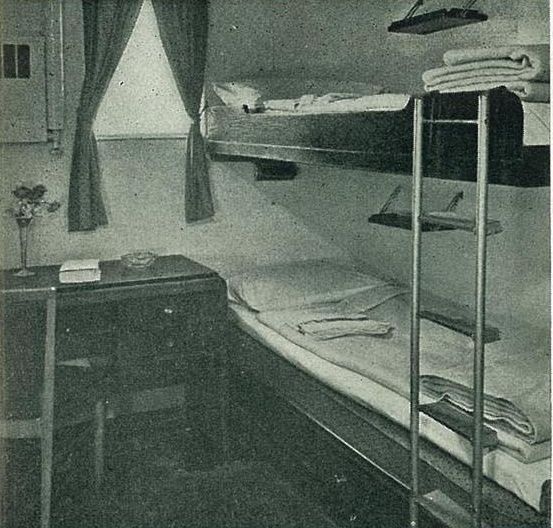
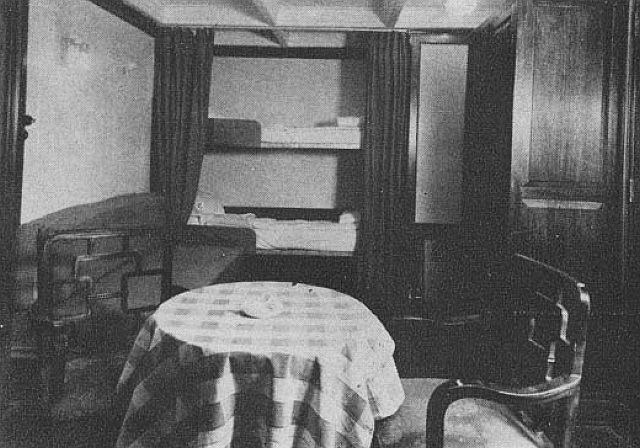
Cabin Class two berth
cabin on B Deck
C Deck had two classes occupy it, First Class and
Tourist Class, but both classes shared the same public venues and dinning room
and deck space, the only differences was their accommodations. On the starboard
side there were two deluxe suites complete with spacious full bathrooms, with a
tub, shower, etc. Alongside these two suites there was also one deluxe two
berth cabin with private facilities. All other 12 cabins on this deck were
Tourist Class and were from two berths to four berth cabins none with facilities.
Forward was the main lobby and stairwell and the
Pursers Office which led into the First, Cabin and Tourist Class Dining Room
featuring windows on her three walls overlooking the ocean at the side and her
bow.
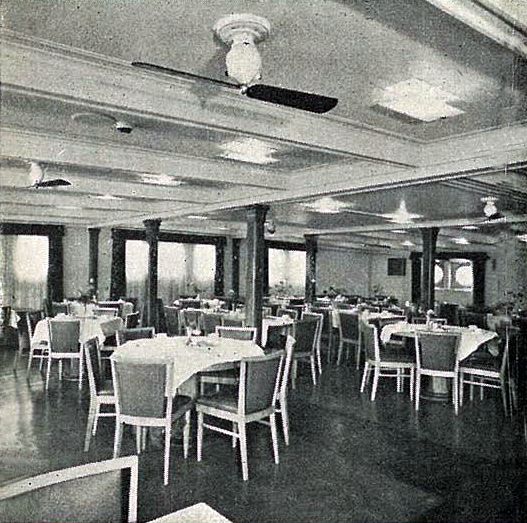
The
First, Cabin and Tourist Class Dining Room
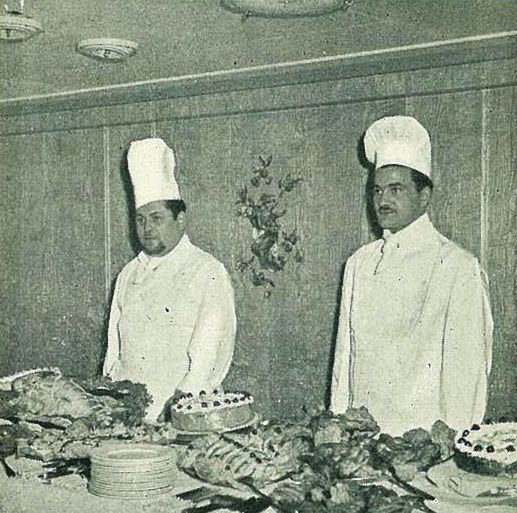
Buffet
in the C Deck Dining Room
There
was just one Deluxe two berth cabin with facilities on C Deck as well as two
twin bedded suites
D Deck has 19 Third Class cabins located on the
port side, varying from two, four to six berth cabins. In addition located
inside aft there is one of the smaller dormitories with 20 bunks, Far forward
was the Third Class and Dormitory Dinning Room, whist further forward again was
the only bathing facilities for the seven dormitories on board. Thus it would
have been a long walk for two dormitories located aft on this and down E Deck,
but at least the bathroom was located directly above two large dormitories that
was located forward on E Deck.
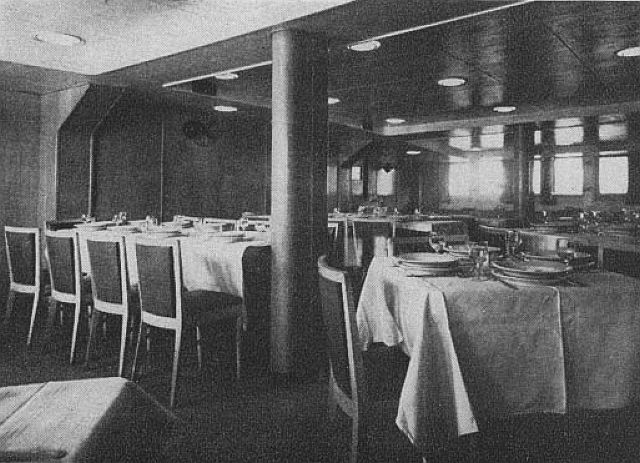
The
Third Class and Dormitory Dining Room
E Deck as already indicated had the four
dormitories aft, with the engine room amidships and two huge dormitories
located forward. They all shared the Third Class Dining Room, but according the
ships plan I have, I cannot locate any additional Lounges on board. Thus the
only public venues are the ones up on B Deck, and they were shared by Cabin and
Tourist, it is possible that Third Class may have also shared this facility.
But I doubt if migrants in the dormitories would be permitted up there and they
would have spent their time in the dinning room or out on deck for their
entertainment.
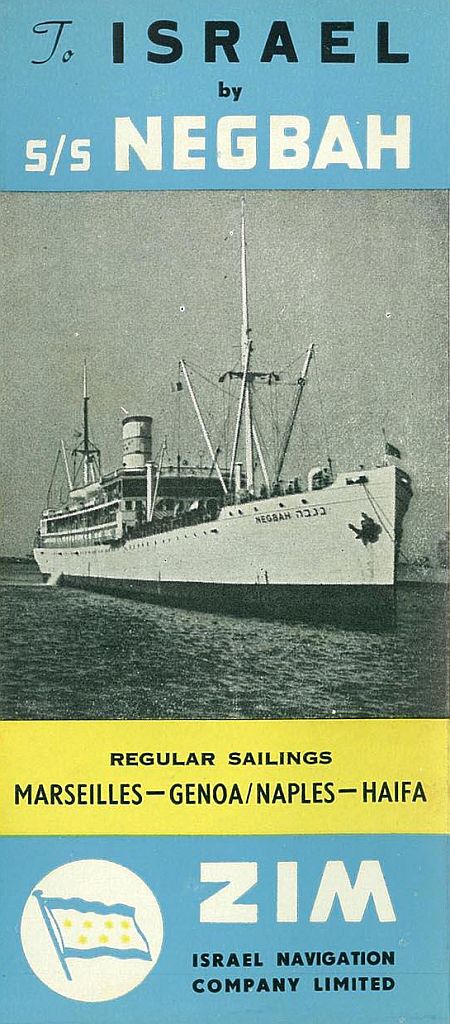
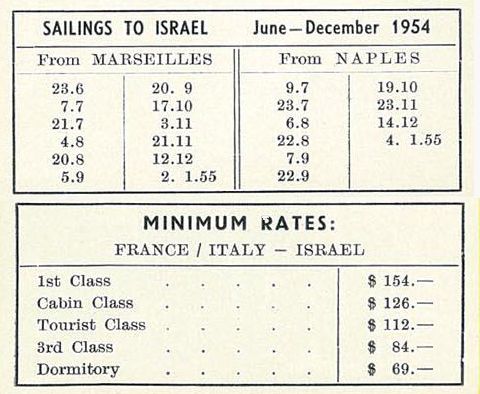
A
1954 SS Negbah brochure containing fares and a
sailing schedule as seen below
This superb Dutch
built liner had sailed a reliable 42 years pre and post War, as well as having
transported countless thousands of troops during World War II! SS Negbah was one of ZIM’s pace setters after ships such
as the little Kedmah.
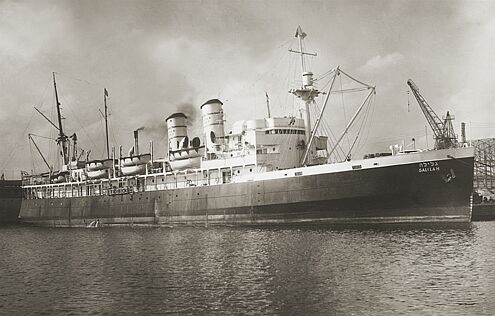
SS Galilah
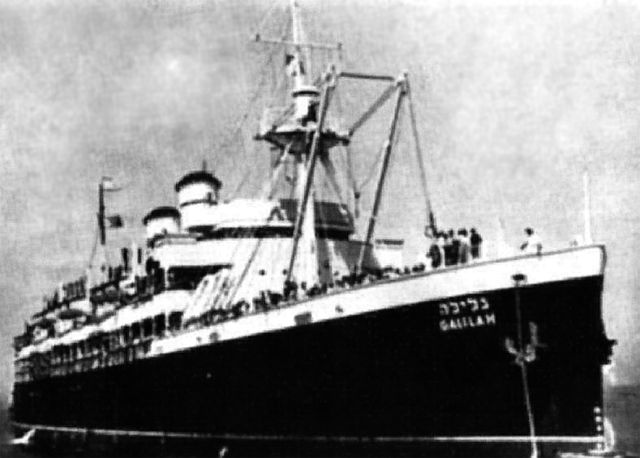
The
twin funnelled SS Galilah
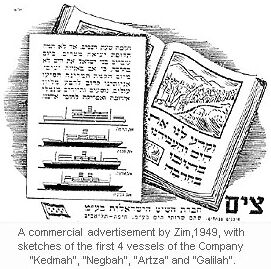
ZIM’s
first four ships
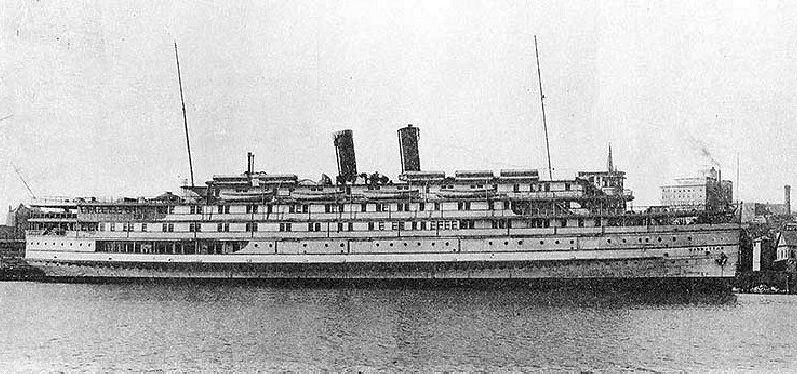
SS
Manhattan seen as built
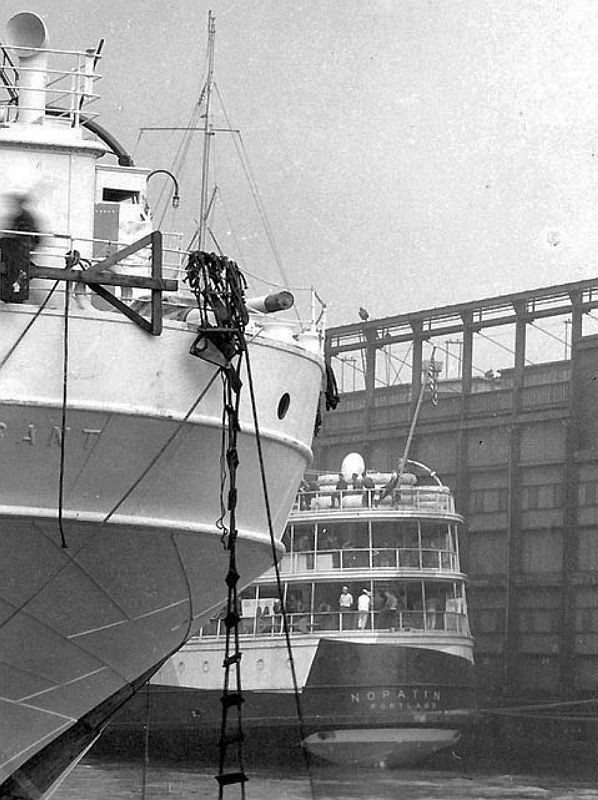
Here
we see the stern of the
In July 1920 the
Hudson River Day Line purchased her and renamed her SS DeWitt Clinton and she
once again commenced serving as a passenger vessel along the
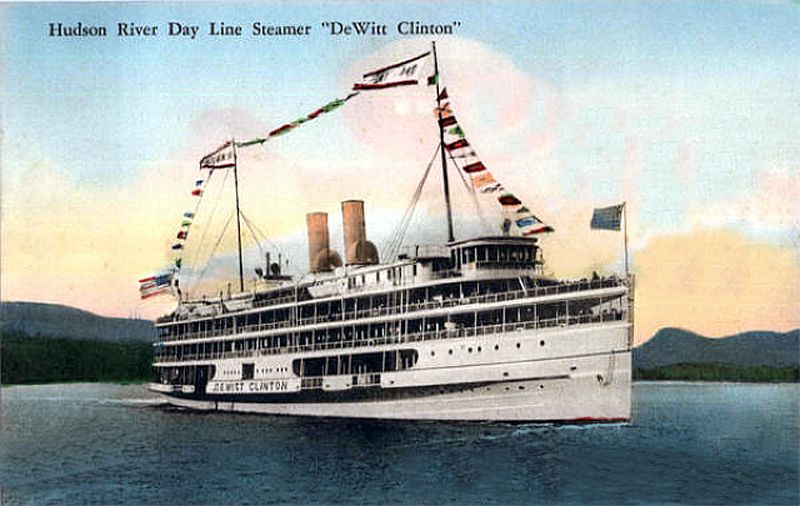
SS
DeWitt Clinton
In 1942 she was taken
up and refitted to become troop transport ship and given the name of SS Col.
Frederic C. Johnson and she served her country well and survived the onslaught.
In 1947 she was laid up and placed on the market.
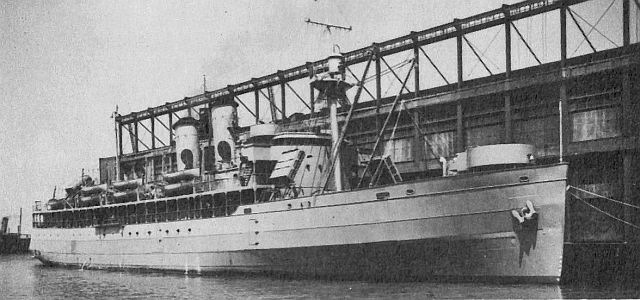
USS
Col. Frederic C. Johnson
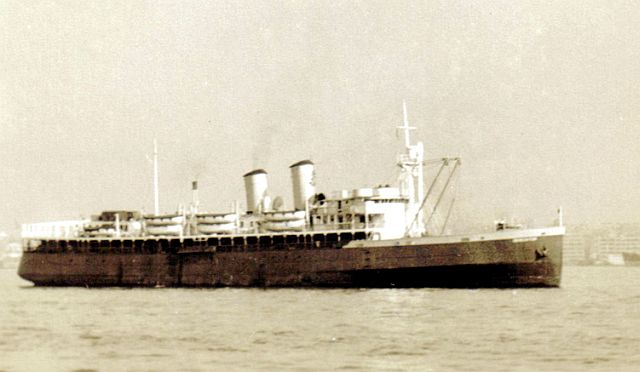
ZIM’s
new SS Derector, soon to be renamed SS Galilah
At the good age of 35
years she was sold to ZIM in 1948 and renamed SS Derector
and she proceeded to a shipyard where she was completely refitted making her
suitable to become a migrant ship transporting Jewish migrants from around
Europe to
SS Galilah’s Specifications: She had a Length of
320.2ft, with a beam of 48.1ft. Her Draught was 16ft. Her propulsion consisted
of: Six Scotch boilers, two 400hp Bethlehem Steel quadruple expansion steam
engines (23½”, 37½”, 42”, 42”
x 36” stroke), two screws operating at a good 23 knots.
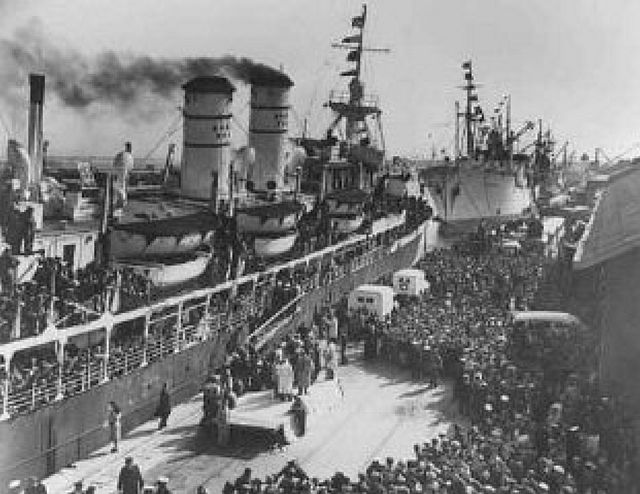
She
is seen here with so many immigrants all ready for a new life in “Eretz
Yisroel” (The Land of Israel)!
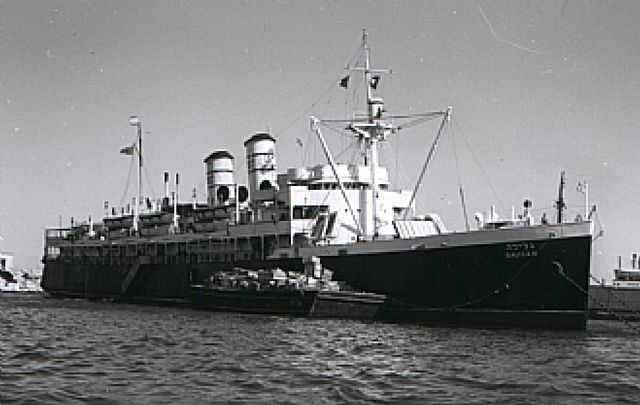
Another
fine photo of this ship that was once a river ferry
With the end of the
first massive wave of immigration, she became more of a regular passenger liner
on the
***********************************
SS Artsa
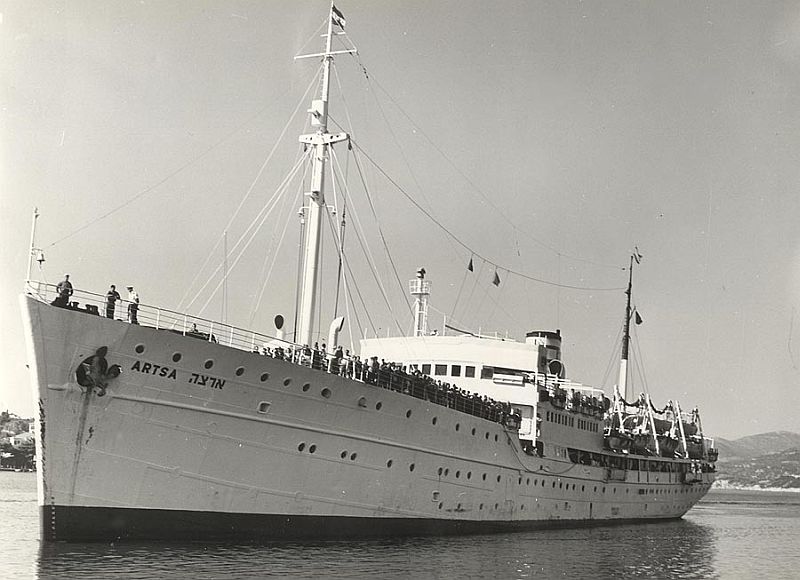
In 1949 ZIM purchased
their new ship, being the Passenger/Cargo liner SS Artsa.
She was built in Vegesack
Many years later
having had a rebuilding programme for her to become a Passenger/Cargo ship
named “Mare Ligure.” She was operated
mostly in the Mediterranean, but then the Italians commenced a service for the
Italians sailing between Italian ports and
ZIM decided that she
was the right ship for them and bought her, although she had a relatively slow
speed of 11 knots and accommodations for almost 400 passengers. She became
officially an Israeli registered liner on December 4, 1949, and after a further
refit she continued sailing on the
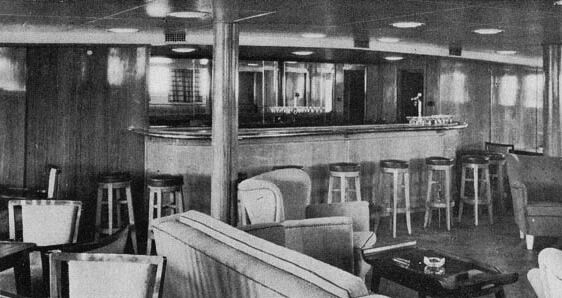
For her day her
Lounges were comfortable and well presented and her cabins although far from
luxurious but were quite comfortable and adequate as
can be seen below.
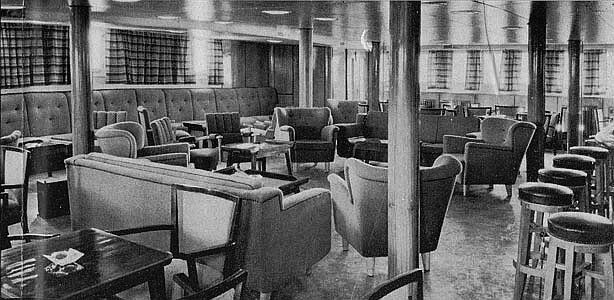
Above and below: Two views of the main lounge
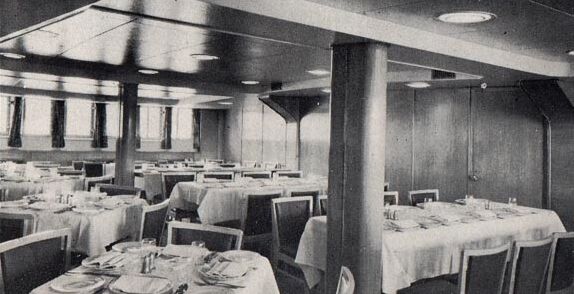
The
main Dining Room
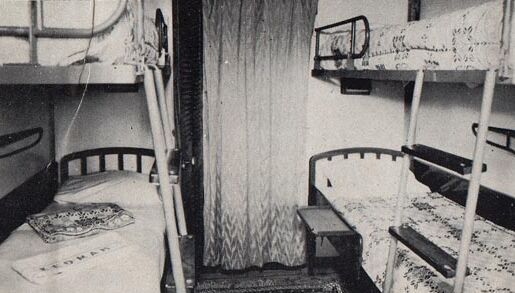
A
Typical four berth cabin
However as ZIM
commenced to build a series of larger and newer, and by far a superior fleet of
ships for the company, by 1963 it had been decided to conclude SS Artsa’s career and she was broken her up in
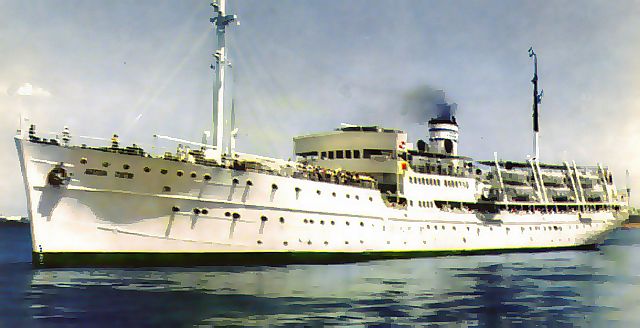
A fine colour image of the Artsa
Photographer unknown
For interest: An
unusual point regarding her name that has been mentioned by many is as follows.
Her name is rendered as “Artsa” on her
bow, but on the ZIM website she is named - “Artza.”
To understand this you need to realise that this is a differential between the
anglicised and the Hebrew.
***********************************
ZIM Lines INDEX
Introduction: ZIM Lines early history & their early
smaller passenger ships
SS
Kedmah, SS Negbah, SS Galilah
Page One: SS Jerusalem I,
ZIM’s very first Trans Atlantic passenger liner.
Page Three: SS Shalom, Hanseatic, Doric, Royal
Odyssey, Regal Sun, Sun
Who is the Author of ssMaritime?
Commenced in the passenger Shipping Industry in May
1960
Return to the ssMaritime MAIN INDEX
ssMaritime.com
& ssMaritime.net
Where the ships of the past make history & the 1914 built MV Doulos Story
Also visit these pages;
“Save The Classic Liners Campaign”
Please Note that ssmaritime and all associated sites
are 100% non-commercial and the author seeks no funding whatsoever!
Photographs on ssmaritime and associate pages are by the
author or from the author’s private collection. In addition there are
some images that have been provided by Shipping Companies and private
photographers or collectors. Credit is given to all contributors. However,
there are some photographs provided to me without details regarding the
photographer/owner concerned. I hereby invite if owners of these images would
be so kind to make them-selves known to me in order that due credit may be
given.
This notice covers all pages, although, and I have done my
best to ensure that all photographs are duly credited and that this notice is
displaced on each page, that is, when a page is updated!
ssMaritime.com is owned and © Copyright by Reuben Goossens - All
Rights Reserved.