
Please Note: Firefox
& other search engines may not suitable
Please use Google Chrome for this page to load perfectly!
Click
the logo above to reach the ssMaritime FrontPage for News Updates
& “Ship of the Month”
With
Reuben Goossens
Maritime
Historian
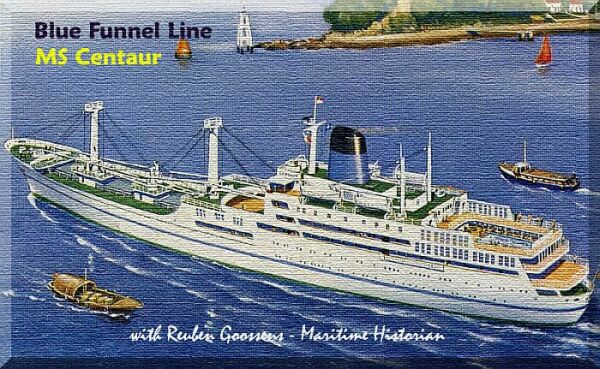
To understand the beginnings of Blue Funnel
Lines we need to start at the beginning, for it started with in
1865 when two brothers, Alfred and Philip Holt of
In the early sixties, Alfred Holt & Co
placed an order with John Brown & Co to build the third ship
to be named Centaur for their
Looking back, the very first Centaur was just
1,900 GRT and she was built in 1895, but was sold four year later
(1899) to North German Lloyd and was renamed “Korat.” I
have no further details regarding her since that time.
MS
Centaur II
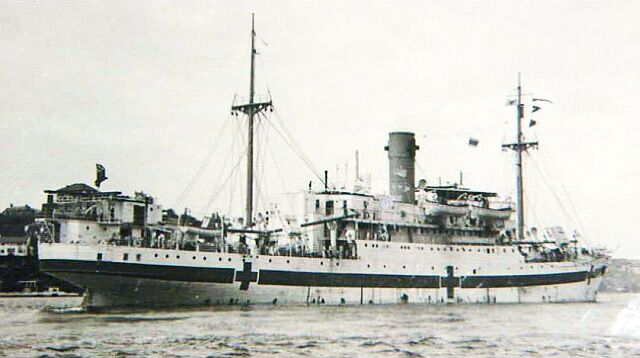
Australian
Hospital Ship (AHS) Centaur built in 1924
From
a subscribers private collection
Early one morning she was brutally torpedoed
near Moreton Island Brisbane by a Japanese submarine at (approx)
0410 on May 14 1943 and apparently the AHS Centaur sank within
minutes with the tragic loss of 268 lives, but thankfully there
were at least 64 survivors rescued. This act was nothing short of
murder at sea by the Japanese, for the ship was clearly marked as
being a hospital ship and not a naval vessel, a ship of war!
Please Note: The MS Centaur II story will be online soon and a LINK will then be located at the bottom of this page as well as on the Main Index.
2009/2010
– AHS Centaur News Updates
December 20, 2009. The Director for the
Search for the AHS Centaur, Mr. David L. Mearns, who also located
HMAS Sydney off the West Coast of Australia, this morning
confirmed that the location of the Centaur has been now been
confirmed. Thus, after 66 years the mystery has finally ended!
The Centaur is located approximately 30 nautical miles due east
of the southern tip of
January 10, 2010. During the night Mr. David Mearns and his associates sent down their remote controlled submarine to take the first ever footage of the wreck of this Australian hospital ship. What happened next was nothing short of a miracle, especially for the surviving families of those who perished. Excellent images were taken of the Centaur starting from 2.50 AM and she is seen lying on a sandy ocean floor at a depth of about 2059 meters and listing some 25 degrees to the port side. Amazingly her paintwork is in reasonably good order, her white hull is clearly visible considering the time she has been on the seabed, as are the Red Crosses on her sides denoting that it was a hospital ship, for they are clearly visible, as is her thick green band painted around the ship. On her bow, the distinctive star could also be seen on the bow’s company crest (which had been painted over during the war) along with the corroded identification number 47 on the front sides of the bow. Rolex Replica Watches
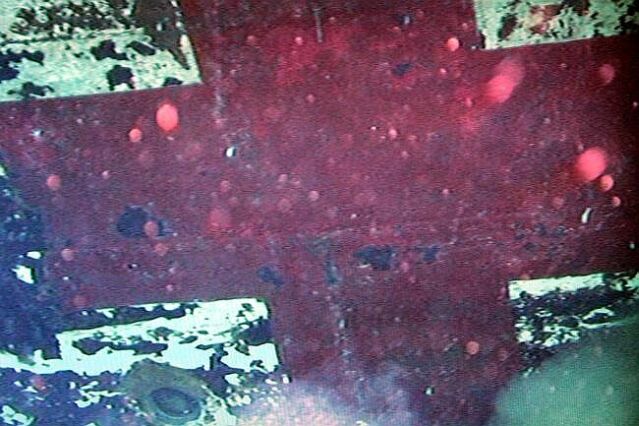
The
Red Cross seen on the side of the AHS Centaur on January 10, 2010
Photograph
AAP Bruce Long
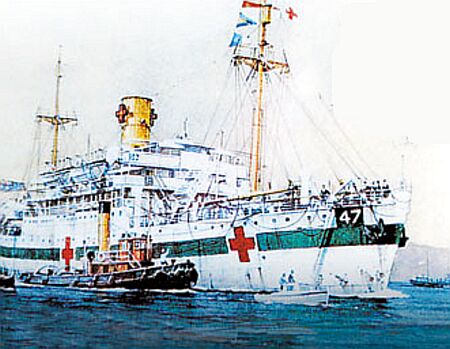
A
full colour artists impression of the Australian Hospital Ship
Centaur
Artist
unknown – *See photo and credit details at bottom of
the page
--------------------------------------------
Other
Blue Funnel Ships
MS
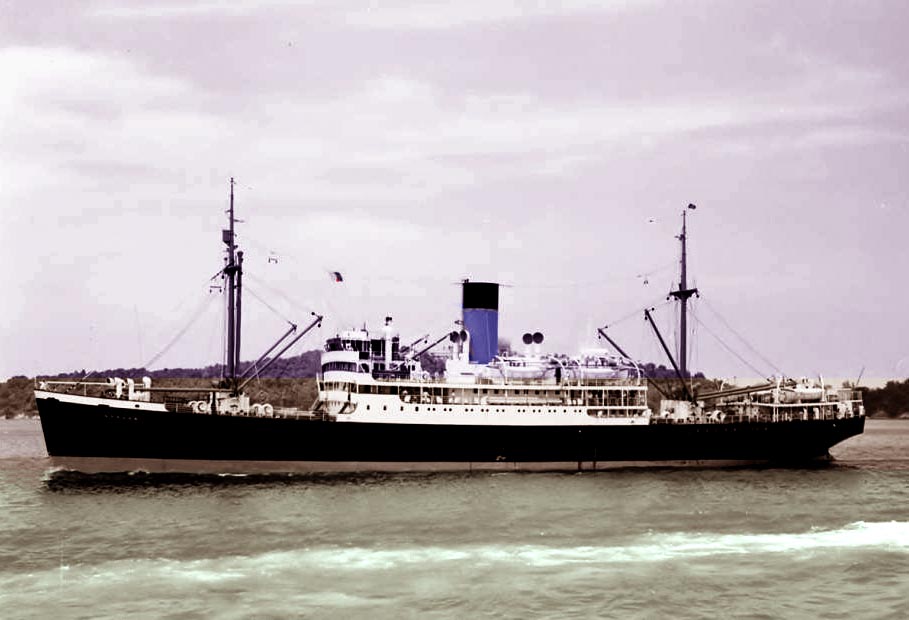
Gorgon and Charon
MS
Gorgon
Although there were the older sister ships in service such as the MS Gorgon and Charon, which had been operating a successful service, but now a newer and a more modern ship was required to operate from the East Coast of Australia and thus superior passenger facilities were required and the modern MS Centaur III would fill the role perfectly! Replica Omega
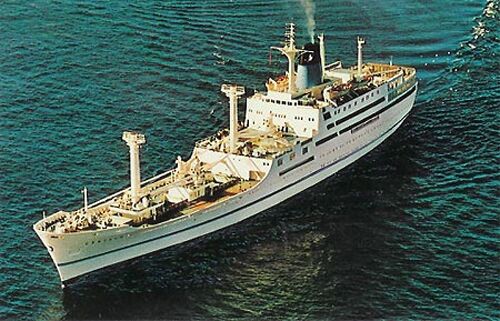
There was no doubt that she proved to be one of the most attractive passenger-cargo liners to be built. In the past, all combination liners before her, were built in a “three island configuration,” however the new Centaur featured an extended and a long forward freighter section with a beautifully high aft superstructure perfectly designed for her passenger facilities and accommodations. This, combined with her tall streamlined funnel gave her an unusual, but an extremely attractive profile.
Note
the vitiated air discharge outlets on the two forward masts
Centaur had many unique features, whilst having
excellent passenger accommodations; she also carried general,
refrigerated and liquid cargoes. In addition, Centaur, like the
ships she replaced, carried up to 700 head of cattle or some
4,500 sheep in her ’tween decks. Livestock was loaded both
in Broome or
Her Decks were as follows, starting from topside; Sports Deck, Verandah Deck, Promenade (A) Deck, Bridge (B) Deck, Shelter (C) Deck.
Built for ?1? million sterling, MS Centaur
was launched on June 20, 1963 by
Originally Centaur was registered under the
ownership of Ocean Steamship Co. Ltd, part of the Alfred Holt
Group. She was then transferred to another Alfred Holt
subsidiary, the China Mutual Steam Navigation Co. In 1973 she was
re-registered in
Centaur
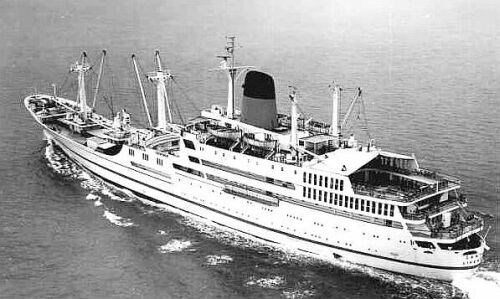
was blessed with spacious decks, both aft and on the forward
superstructure
Centaur offered excellent accommodation for 196 one-class passengers. Promenade (A) Deck had two luxury suites with private facilities located forward flanking the far forward Library. Amidships were ten twin cabins with private facilities. Far aft was a spacious Lounge with a Bar overlooking the Sun Deck and the ships swimming pool having glass enclosed sides. The pool was surrounded above by Verandah Deck which was partially glass enclosed. There was a deck above on what could be called Boar Deck, but it was called Sports Deck. Decks B and C had seventy-seven 1-2-4 bedded/berth cabins, of which twenty-three 1 and 2 bedded cabins on B Deck had private facilities. B Deck also facilitated the Children’s facilities and a paddle pool, whereas the Dinning Room, Cinema and the Music Room were located on C deck.
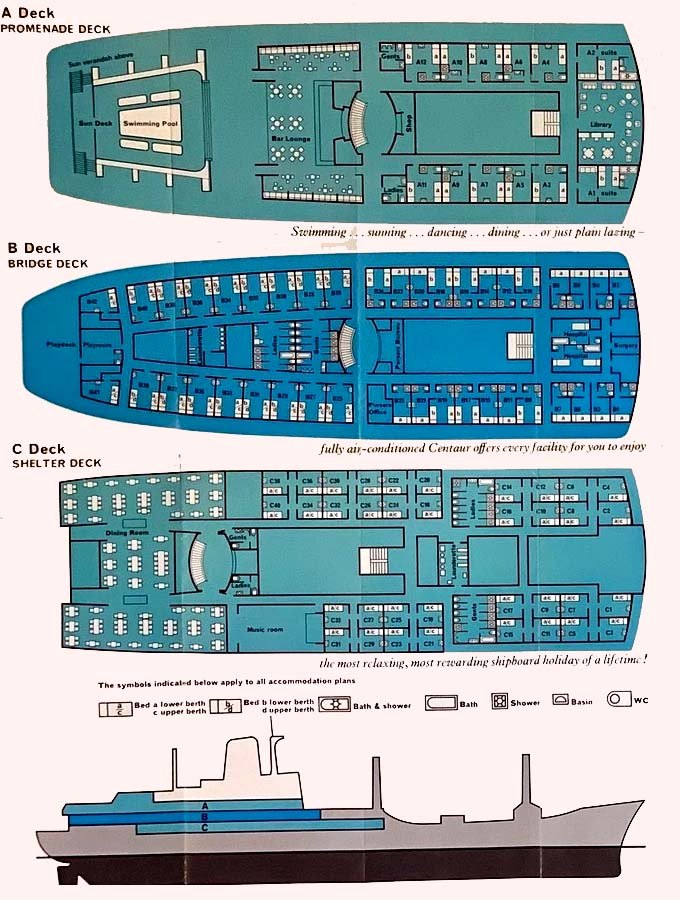
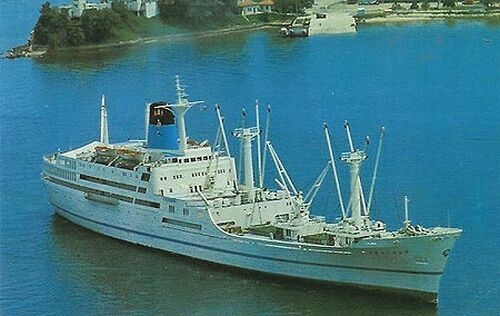
Centaur was designed to offer her passengers a
cruise-like voyage, rather than a liner service between Fremantle
and
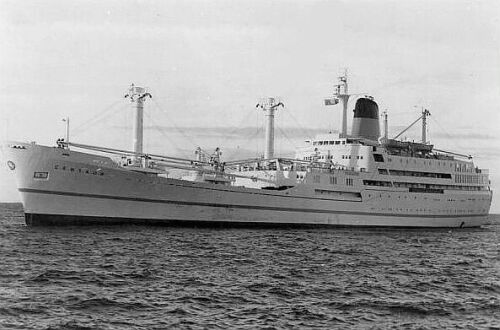
In 1979, Blue Funnel Line placed her on a new
service, a 25 day circle voyage from Fremantle to
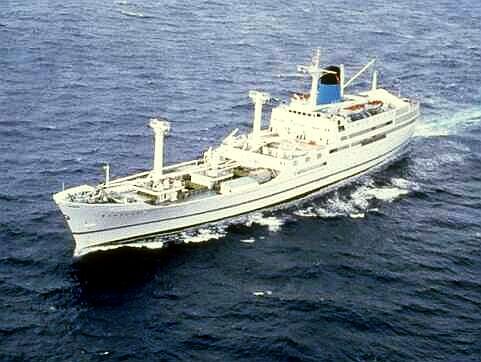
After her arrival in
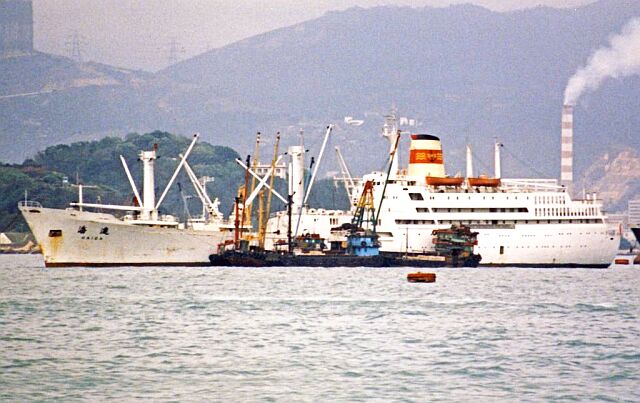
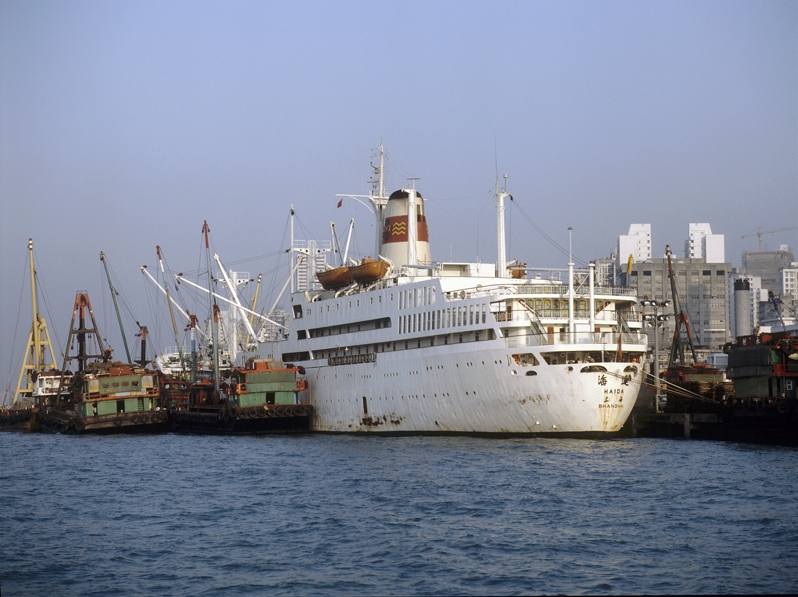
MS
Hai Da seen around April/May 1986
Photographer
unknown – see photo notes at bottom of page
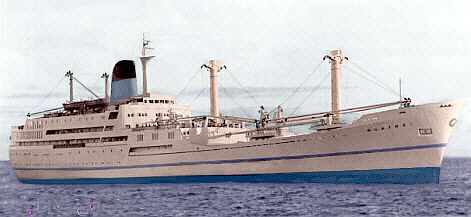
The
MS Hai Da is seen here in
Photographer
unknown – see photo notes at bottom of page
In 1986 she was renamed Hai Da and continued
service, In February 2006 MS Hai Da was finally sold to ship
breakers at
Built
by:
John Brown & Co.,
Launched:
June 20, 1963
Inaugural
voyage:
January 20, 1964 -
Tonnage:
8,262 GRT (Gross registered tons)
Length:
146.6m - 481ft
Width:
20.1m - 66ft
Draught:
7m - 23ft
Engines:
2 B&W diesels - 16,500 BHP
Screws:
Two
Service
speed:
20 knots
Passengers:
196
Passenger decks: 6.
Crew:
109
Livery:
All white hull and superstructure and a blue and black funnel.
With
images & Cabin Plan kindly provided by Mr Stan Evans
Many
Australians will have fond memories of this unusual
passenger-cargo liner
********************
“Blue Water Liners sailing to the
distant shores.
I watched them come, I watched them go and I watched them
die.”
****************************
Visit our ssMaritime
Main INDEX
Where
you will discover over 1,365 Classic Passenger &
Passenger-Cargo Liners!
ssMaritime.com & ssMaritime.net
Where
the ships of the past make history & the 1914 built MV Doulos
Story
The
Author has been in Passenger Shipping & the Cruise Industry
for well over 60 years
In
addition he was the founder of “Save the Classic Liners
Campaign” in 1990.
Please
Note: ssmaritime and associated sites are 100% non-commercial and
the author does not seek funding or favours and never have and
never will.
Photographs
on ssmaritime and associate pages are either by the author or
from the author’s private collection. In addition there are
some images and photographs that have been provided by Shipping
Companies or private photographers or collectors. Credit is given
to all contributors, however, there are some photographs provided
to me without details regarding the photographer or owner
concerned.
ssMaritime
is owned & ? Copyright by