Italia Line’s M.S. Giulio
Cesare in 1952 to 1974
Please Note: Firefox and some other search engines may not suitable
Please
use Google Chrome for this page to load perfectly!

Click the
logo above to reach the ssMaritime FrontPage for News Updates
Please Note: All ssmaritime and my other related ssmaritime sites are 100% non-commercial and privately owned sites. Be assured that I am NOT associated with any cruise or shipping companies or travel/cruise agencies or any other organisations! The author has been in the passenger shipping industry since May 1960 and is now sadly rather old and very ill and completly disabled and was forced to retire!
Page One
“Italia
di Navigazione S.p.A.”
M.S. Giulio Cesare
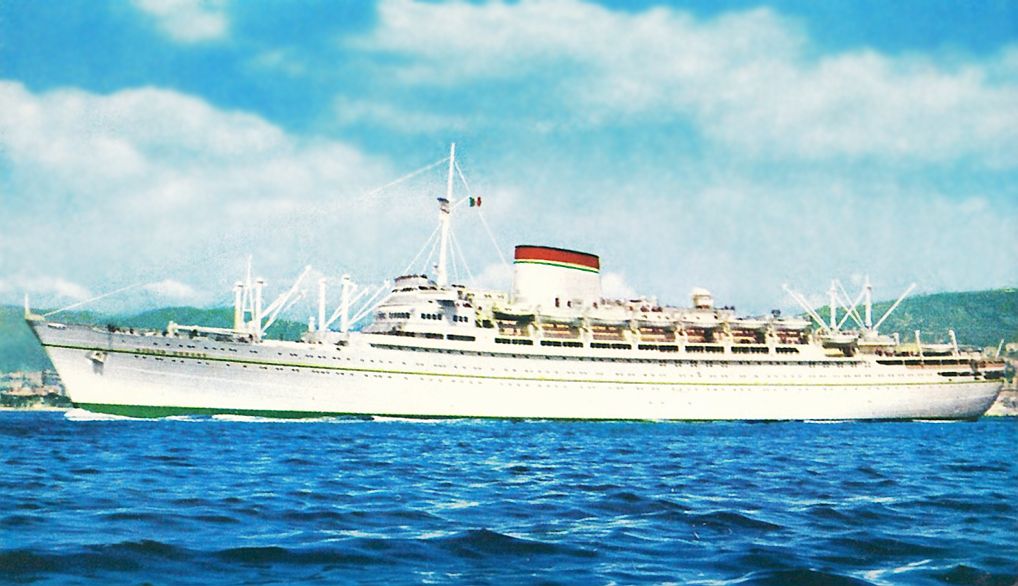
The
graceful M.S. Giulio Cesare
Please Note: All images are from the author’s private collection, unless stated otherwise.
Most
onboard images are from a 1954 brochure and other photos from postcards or
other sources
Introduction to two Great Italian Liners:
M.S. Giulio Cesare was the identical sister to the M.S. Augustus, and
both were built for “
Design wise these ships were without doubt revolutionary and even though they were built as three class liners, amazingly each class had some of the finest passenger facilities to be found at sea of their days. In addition a very rare feature was that each class had their very own swimming pool. It was said that lounges and facilities in Tourist Class, which was the equivalent of third class, was as good as in Cabin Class (second class) on most Trans-Atlantic liners, if not as good as on some First Class ships! Some of the greatest architects and designers were used to create an ambience that was not just elegant, but besides being Italian, there were even touches of Scandinavian influences on board, and all provided an atmosphere that was a delight to the senses in every possible way! These ships were beyond beautiful and both ships offered the ultimate in Ocean going travel with the M.S. Augustus sailing with Italia line for twenty four years before she was sold to an Asian based Company.
Although I originally commenced these pages almost exclusively regarding the M.S. Augustus, but also cover the Giulio Cesare, but very much in a lesser degree, as you can see I have now decided to completely rewrite and update the entire feature, which in reality came about due to the tragic sale of the M.S. Philippines, ex Augustus in September 2011, and her departure under tow bound for Alang, India, thus I felt the need to rewrite this feature as well as that of this superb ship the M.S. Giulio Cesare, for I believe that she should also have a greater role, even though she had a shorter life in comparison to her sister. Thus this page, I trust will rectify my previous short comings and I* trust that on this page you will discover that there will be a complete history as well as many fine interior photographs of this great liner. All these images are from my personal collection and I hope that you will enjoy the new feature more than ever - for there will be so much more for you to enjoy and to relive memories for all those who have had the privilege to sail on the M.S. Giulio Cesare or even just to have had the opportunity to see her in one of the many ports she visited. Enjoy!
Reuben
Goossens.
Design, Building and History:
M.S. Giulio Cesare was one of the most luxurious ocean liners to be
built for the Italian Line, especially considering she was the very first after
World War II. We already know that she would soon be followed by her identical
sister the M.S. Augustus, which was launched in the same year but commenced
sailing in 1952. The
Tragically during World War II, the Italian
Line had lost some of their finest liners, including the grand 51,062 ton SS Rex and the superb 48,502 ton SS Conte di Savoia, thus the Company
quickly had to plan to build two revolutionary new 27,000 GRT liners to replace
their lost ships, as well as their surviving ships had to be refitted and
repaired quickly and returned to passenger service as soon as possible after
the war to keep the companies head above water. But, their ships such as the M.S. Saturnia and her sister the M.S. Vulcania
and the SS Conte Grande with her sister the SS Conte Biancamano, were only able to carry small passengers
numbers. And that was the reason for the urgency for the Italian Line requiring
these two new liners for their South American service quickly! They placed an
order with
There was no doubt that during the fifties
became a time when it had become what many will call “a new era for the
Italian Line,” as they built some fine new ships,” for not long
after the M.S. Augustus entered into service, the TN Andrea Doria on her maiden
voyage on January 1954, and her sister the TN Cristoforo
Colombo on July 15, 1954. Then in 1958, these ships were followed up followed
by SS Leonardo da Vinci.
M.S. Giulio Cesare was built by the famed Italian shipbuilder at Monfalcone, “
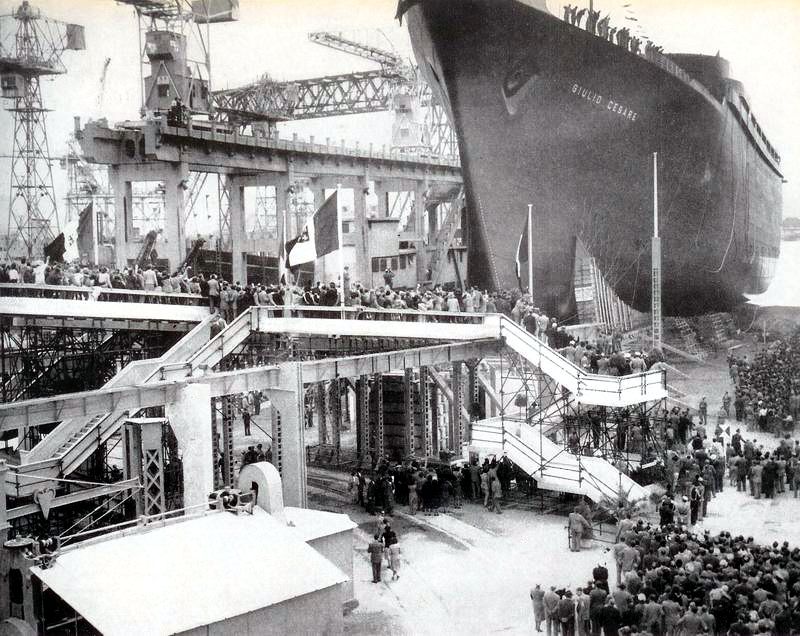
The first of the sisters is ready to be launched May 18,1950
With the M.S. Giulio
Cesare having been completed at the builders fit-out
berth, and undertook her speed trials, etc, she was completed in September 1951
and made her maiden voyage on October 27, 1951 from
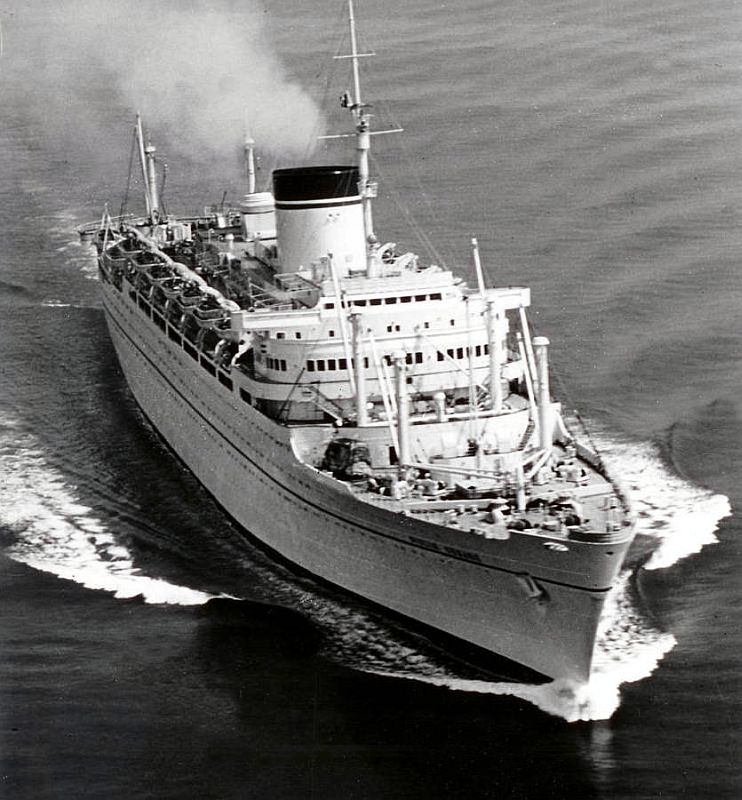
A fine aerial photograph of the M.S. Giulio Cesare, also note her “Robot” “ventilator” located further aft of the funnel
The exterior design of Giulio Cesare and her sister attracted many passengers as the M.S. Giulio Cesare and the Augustus were to become the impression of power and of great beauty, being ships that had superbly rounded bows, beautifully curved superstructures, no mainmasts but just six kingposts and a slender tall radar mast atop their Bridge. In addition there was a rather large stately looking funnel, and a graceful stern. Although there were also a few strange and evocative items, such as the nape the aft of the funnel base, and that strange looking tall trademark “ventilator” located further aft of the funnel, that was given the nickname “Robot” due to its strange shape and the top looked like a robot’s head – see the photo above and it is quite clear.
She had a vast range of accommodation available. First Class offered a great deal of passenger space as possible that was well achieved in the ships public rooms as well as her staterooms. She offered four elegant deluxe suites complete with private lounges and spacious bathrooms, each having every possible comfort imaginable. Other accommodations were either single bedded rooms or two bedded all with ocean views, and all having private facilities and a telephone! Cabin Class offered from single, two beds, to four berth cabins. All had private facilities as well as a telephone, and remember phones in cabins were rather new on board ships and a novelty in those days. Whilst Tourist Class offered from two, four to six berth cabins as well as some dormitories for migrants. There were no phones in Tourist cabins and all cabins and dormitories had shared facilities.
Having operated on the South American trade
from 1951 to September 1956, the M.S. Giulio Cesare was given a new Trans-Atlantic schedule due to the
recent sinking of the great Italia liner
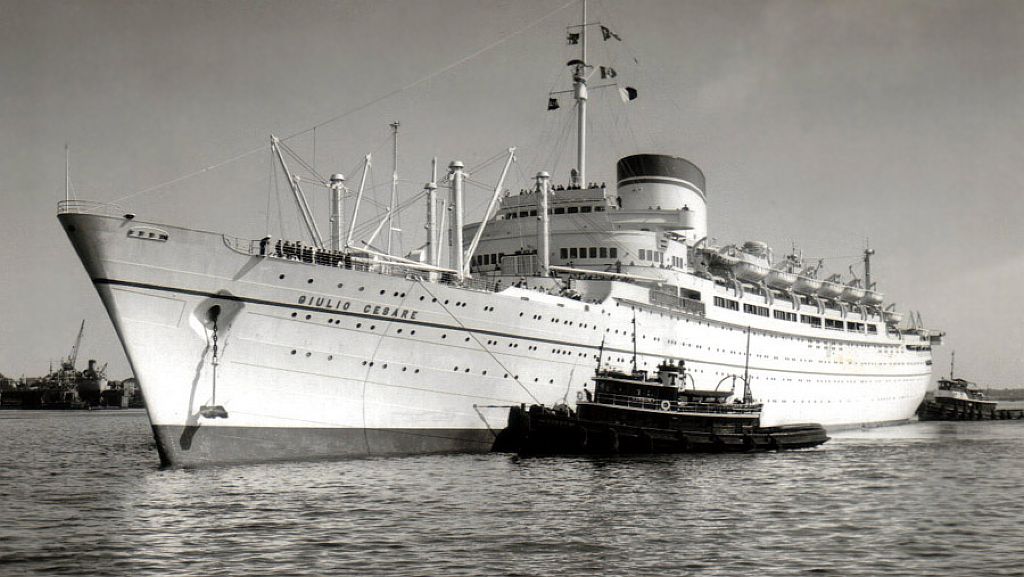
Giulio Cesare
is seen in
Photo Album
First Class
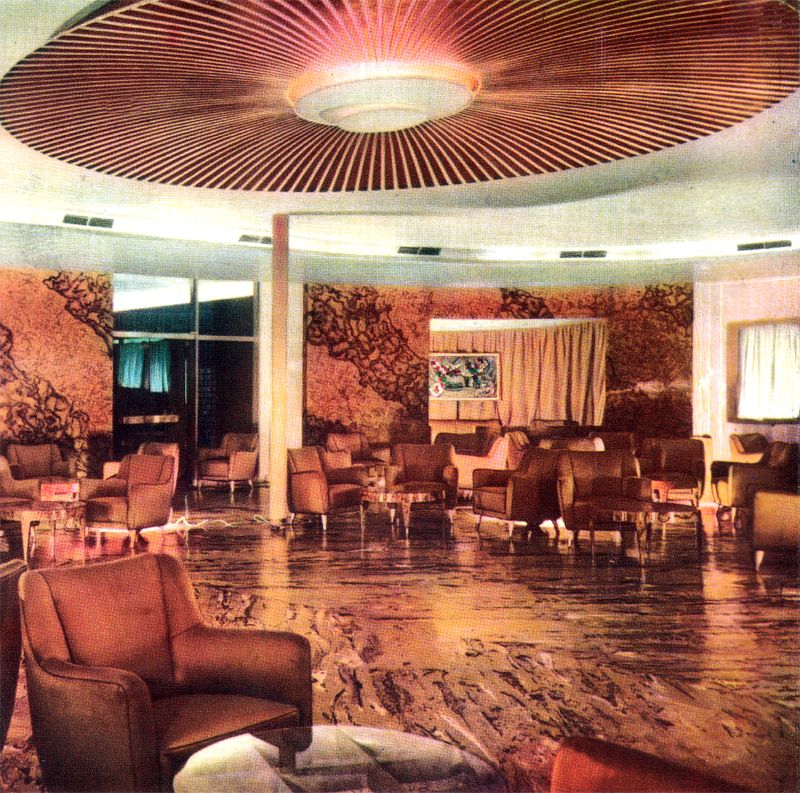
The
Social Hall
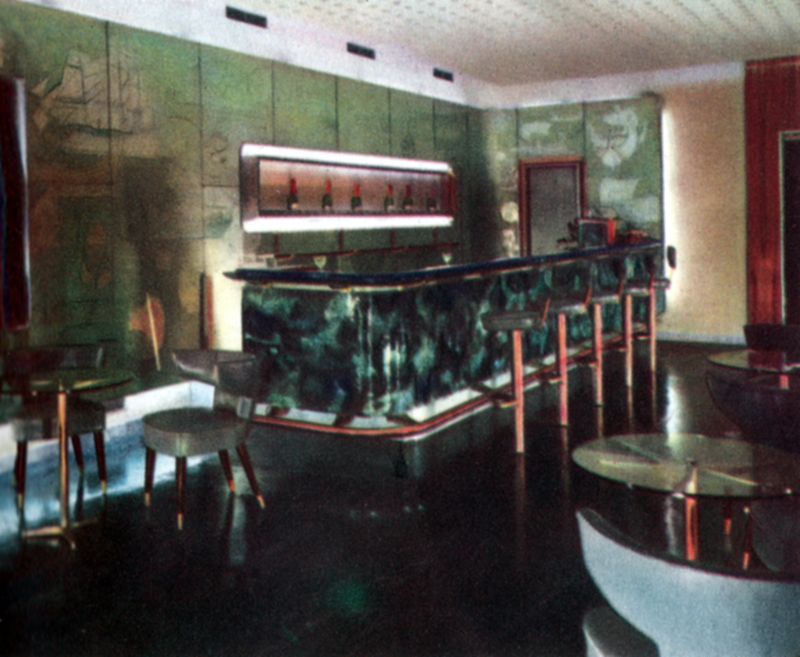
The
Bar
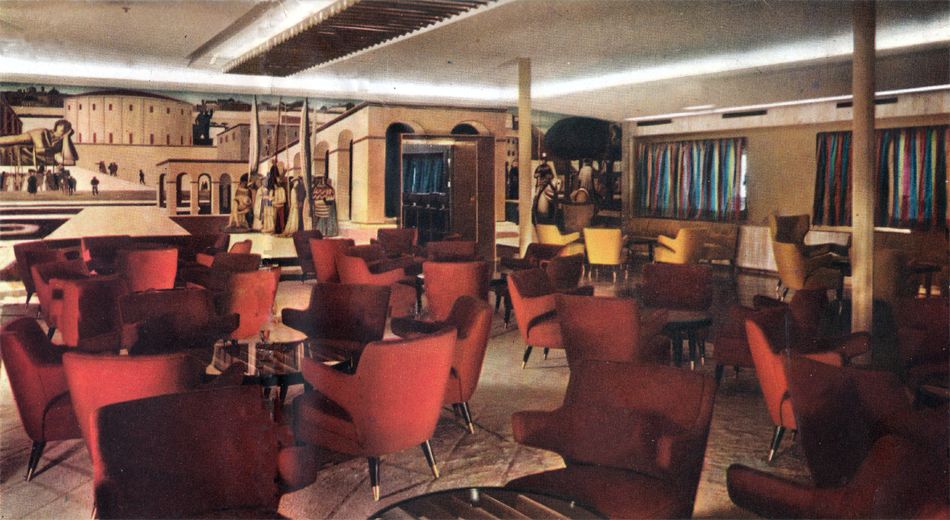
Main
Lounge and Ballroom
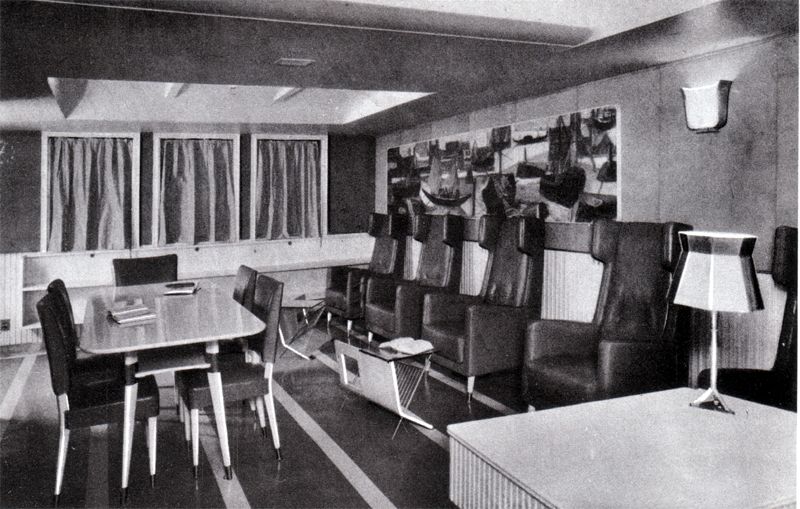
Reading
Room
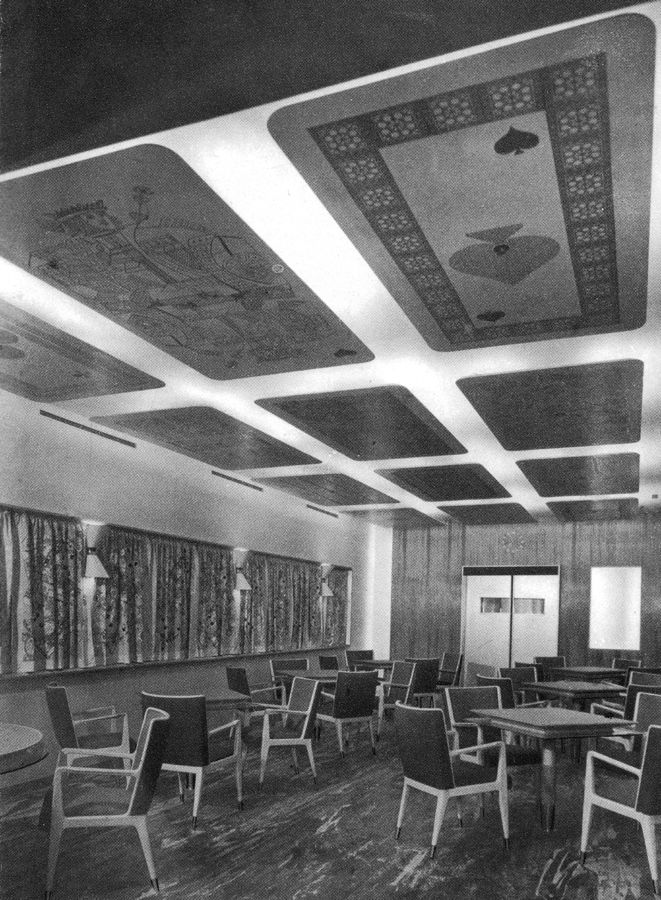
Card
and Games Room
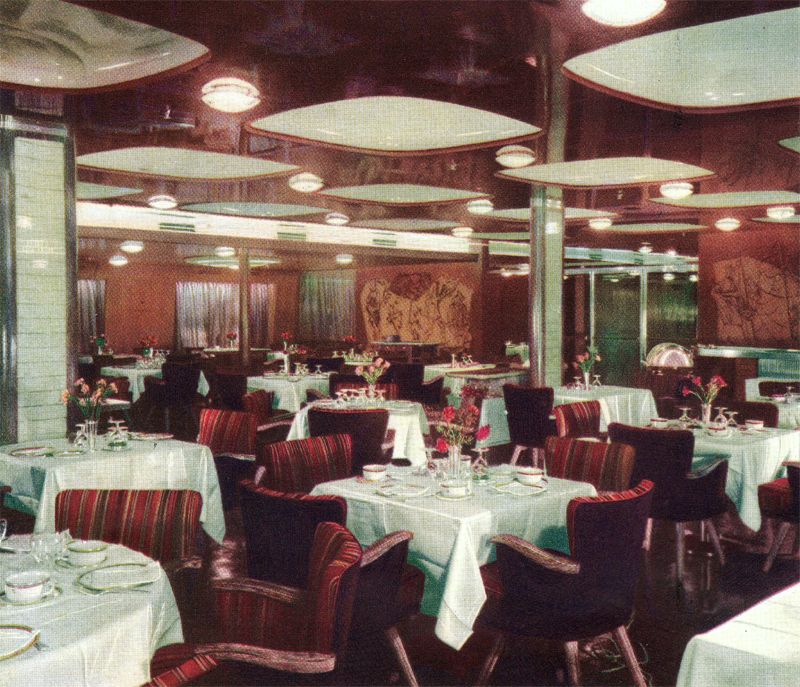
Dining
Room
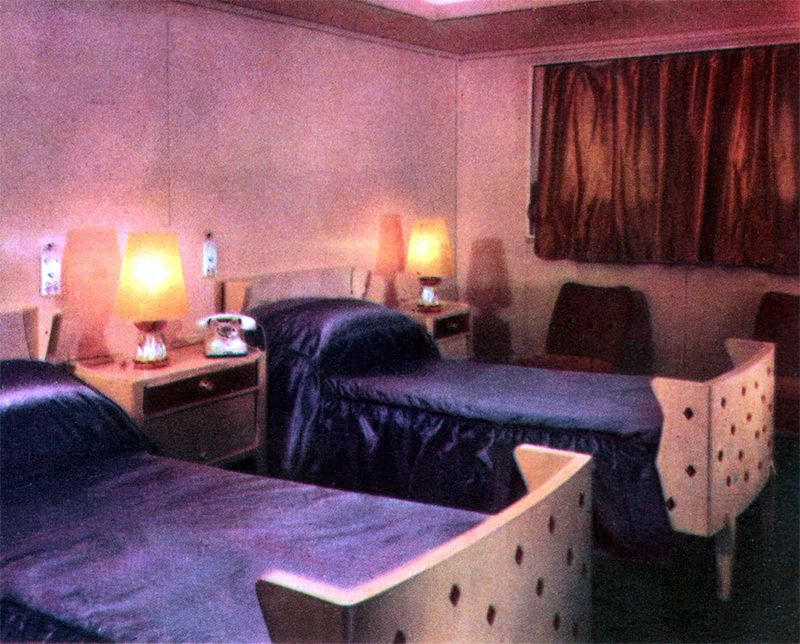
Twin
bedded stateroom
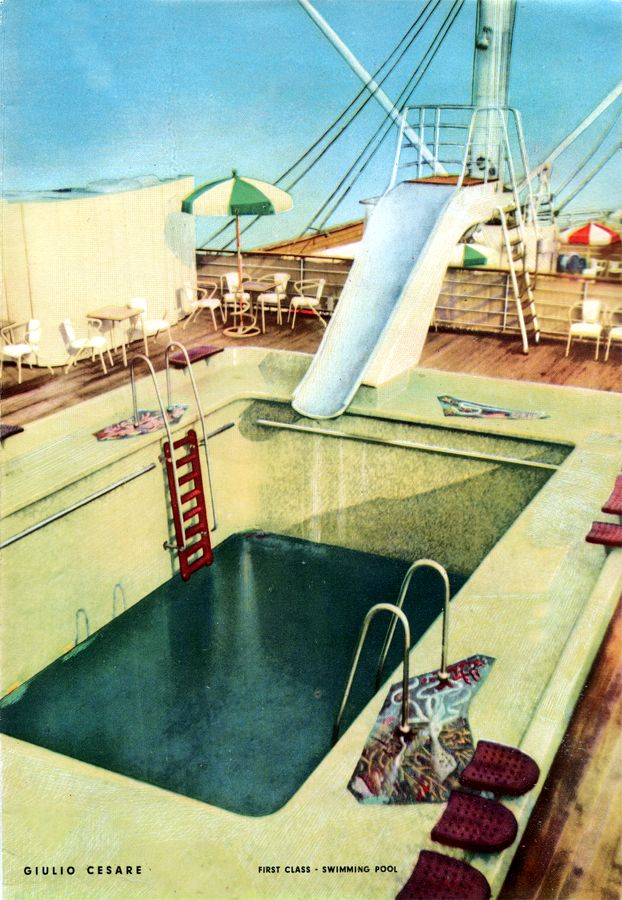
The
pool
Cabin Class

Main Lounge and Ballroom
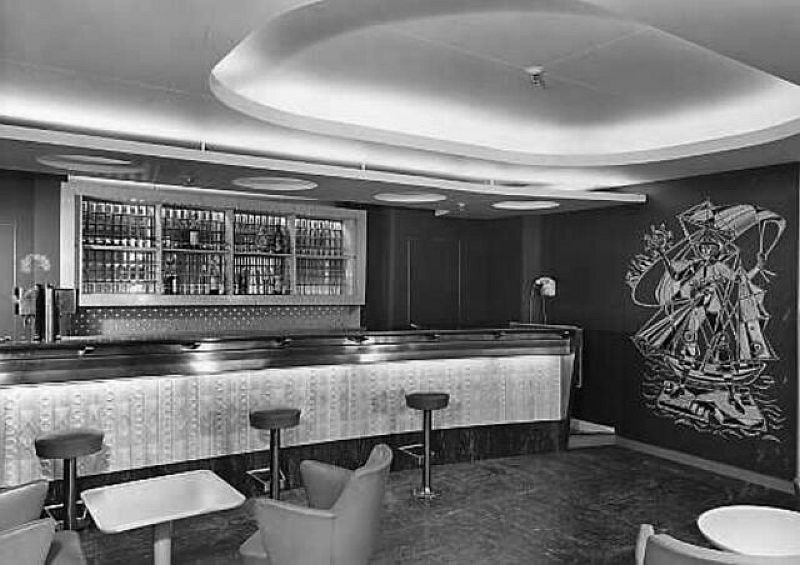
The Bar
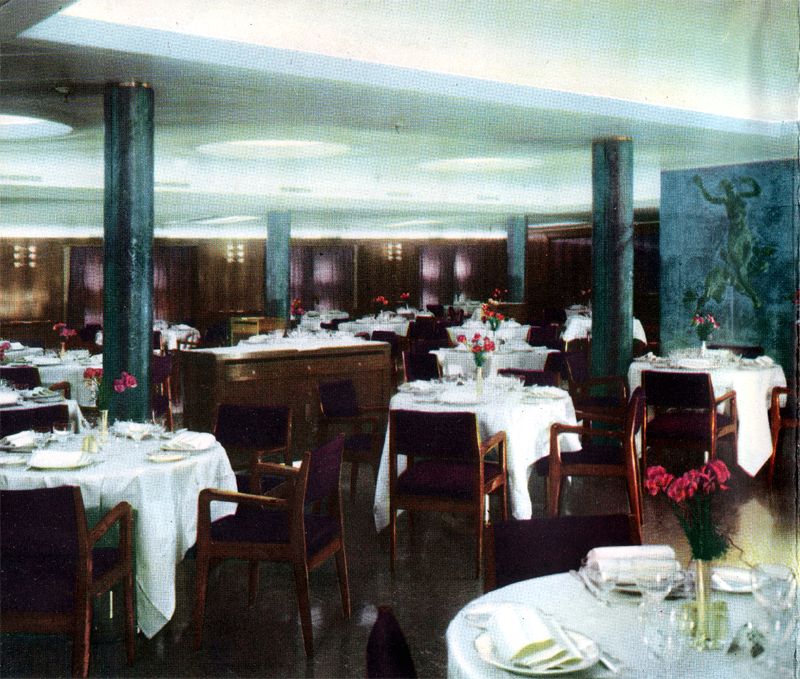
Dining Room

Cabin Class four berth cabin
Tourist Class
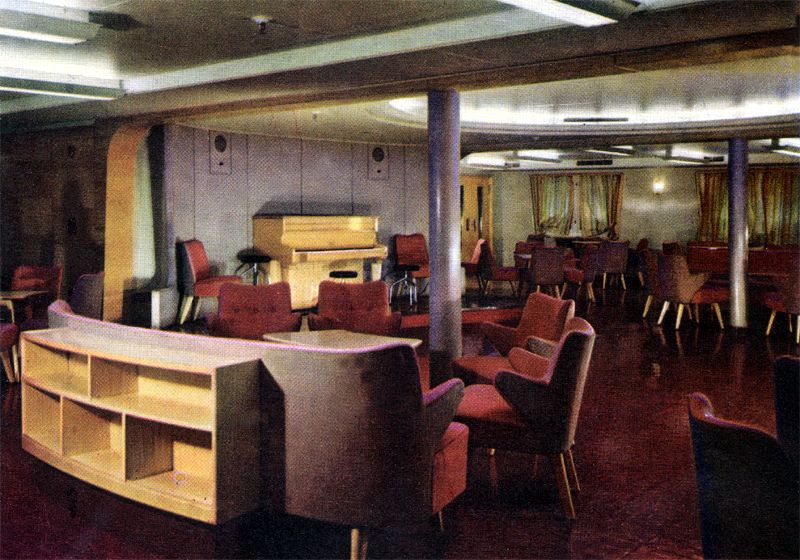
Main Lounge and Ballroom
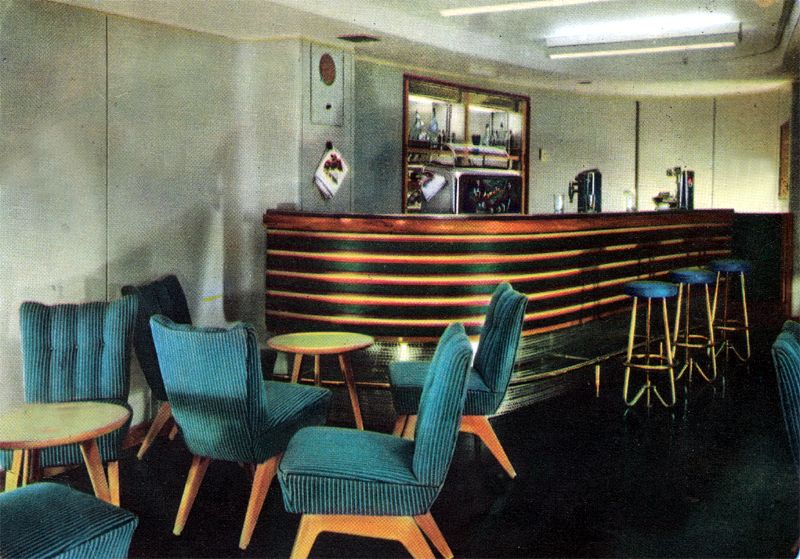
The Bar
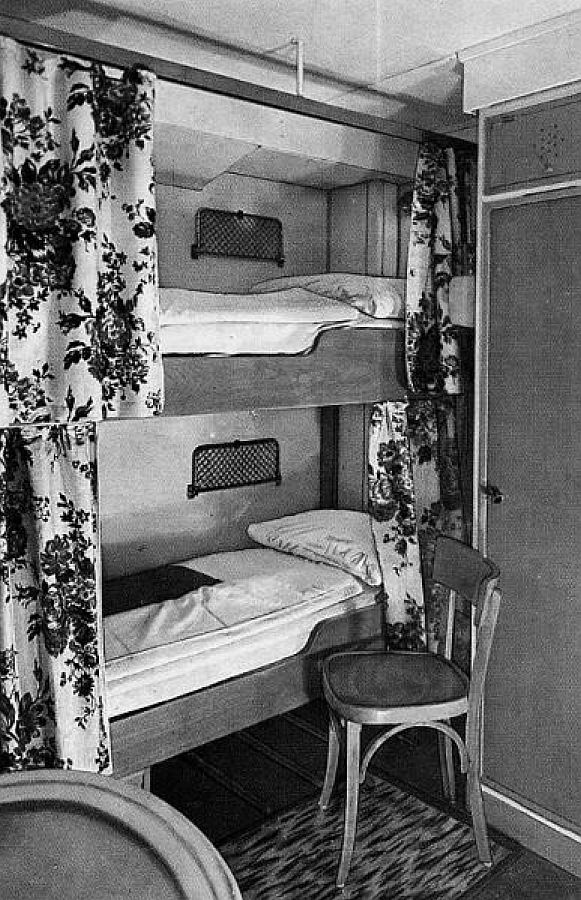
Tourist Class two berth cabin
Refit and her latter years:
She remained on this service for the rest of
her working life, being some thirteen years. However in 1964 she received a
comprehensive refit. After the refit, sadly the magnificent First Class Social
Hall was torn out and replaced by a new auditorium/cinema. In addition she
became a two class liner. Therefore they combined her Cabin and the Tourist
Class dining rooms, thus now she operated with a First and Tourist Class having
a passenger capacity as follows: 325 First and 858 Tourist Class passengers,
although many cabins were interchangeable, the size in each class could vary
from sailing to sailing. Many new bathrooms were installed into cabins that
previously were without and facilities were improved throughout, in order that
the old Tourist Class cabins were of a much higher standard! But for some
reason passenger numbers for both M.S. Giulio Cesare and the
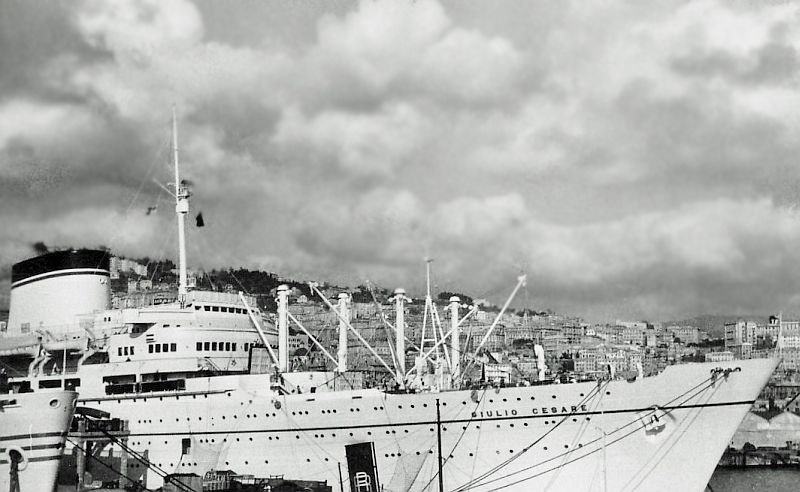
The
elegant bow of the M.S. Giulio Cesare
is seen in the
The end is near:
On January 14, 1973, she suddenly developed
problems with her rudder and was forced to return to
A
two berth cabin a section from a 1954 Italia Line brochure
Visit the & M.S. Giulio
Name: Giulio
Cesare - 1952 - 1974
Built
at: Cantieri
Riuniti dell’ Adriatico,
Yard
Number: 1756.
Owner: Italia Line.
Registered
at:
Launched: May 18, 1950.
Maiden
Voyage: October 27, 1951.
Tonnage: 27,078 GRT.
Length: 681ft - (207m).
Beam: 87.2ft – (26.6m).
Draught: 28ft – (8.5m).
Engines: Two 12 cylinder “Societa Anonima Fiat”
Diesels 37,000 BHP.
Screws: Twin.
Speed: Service speed 21 knots - max
23.31 knots.
Passengers: 178 First Class, 288, Cabin Class, 714 Tourist Class.
From
1964: 325 First Class and 858
Tourist Class.
Ship
is: Fully Air-conditioned.
Crew: 493.
Routes
served: Three Main services.
1
… 1951 –
1956 –
2
… 1956-1960 -
3
… 1960-1973 -
. Departed
In Conclusion:
Obviously the M.S. Giulio Cesare did not last the same kind of distance as her sister, which continued until late in 2011, that is a good 59 years in and out of service, but remember, the years that the “Giulio” did serve, she did so with great pride and distinction and she was greatly loved by those who sailed on her, and I know this from the countless emails I have received over the years I have been writing on classic liners, which now account to some 420 ships!
With the recent sale of her sister the Augustus, which seems to be her end, unless a last minute reprieve comes to hand, which I doubt, this will be the end of an end to a great era of a fine chapter of Italian passenger shipping, and we should all be very sad indeed!
Farewell old girl, as we remember both the
Reuben Goossens - originally wrote this article.
Liner with Let us Remember this Fine Liner with Great Fondness!
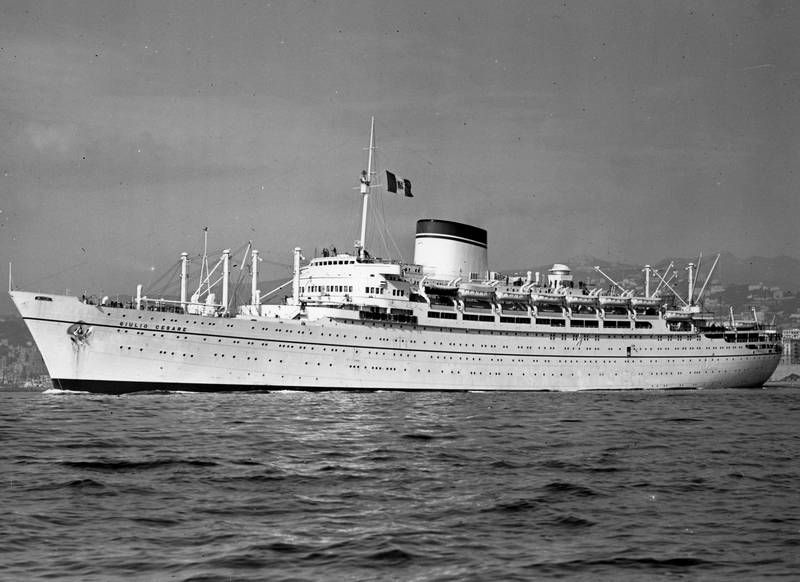
A fine photo of a suburb Italian liner, even if you sailed in Third Class it was as you were sailing of most First Class ships
From
the author’s private collection
Page One … M.S. Giulio Cesare.
Page Two … M.S. Augustus.
Page Three … M.S.
Giulio Cesare &
Augustus
Page Four … M/S
Philippines.
Page Five … M/S
Philippines – Photographs taken whilst she was for sale.
Also Visit … S.S. Michelangelo
& Raffaello Feature
***********************************
Email the author: rg@ssmaritime.com
Use the Back button on your browser or Close the
Page to return to the previous page
or
go to our ssMaritime
MAIN NDEX
Amazingly; ssmaritime.com has received 7.57
billion visitors to date
Last update: January 24, 1922
Where you will discover over 1,550 Classic Liners & the 1914 built MV Doulos Feature
Photographs
on ssmaritime.com, & .net and associate sites are: 1.
By the author. 2. From
the author’s private collection. 3. Or as provided by Shipping
Companies and their Publicity Companies as well as by private photographers or
collectors. Credit is given to all contributors. However, there are some
photographs provided without details regarding the photographer concerned.
ssMaritime is owned and © Copyright -
Reuben Goossens - All Rights Reserved