
‘
Please Note: Firefox and some other Search Engines may not be suitable
Use Google Chrome for this Web Page to load perfectly!
Please Note: All ssMaritime and other related maritime sites are 100% non-commercial and privately owned, thus ssmaritime is NOT associated with any shipping company or any other organisation! Although the author has worked and been involved in the passenger shipping industry for well over 60 years, but due to his old age and poor health, he was forced to retire. Yet, he has completed well over 1,435 Classic Liners, Passenger-Cargo Liners as well as humble converted C3 converted Migrant Liners, which has transported countless thousands of folk to the new world, as well on vacations’. Amazingly, ssmaritime.com has received 573.4 million visitors to date I trust the features online will continue to provide Classic Liner and Ship enthusiasts both the information they are seeking, but more so provide a great deal of pleasure and relive many happy memories!
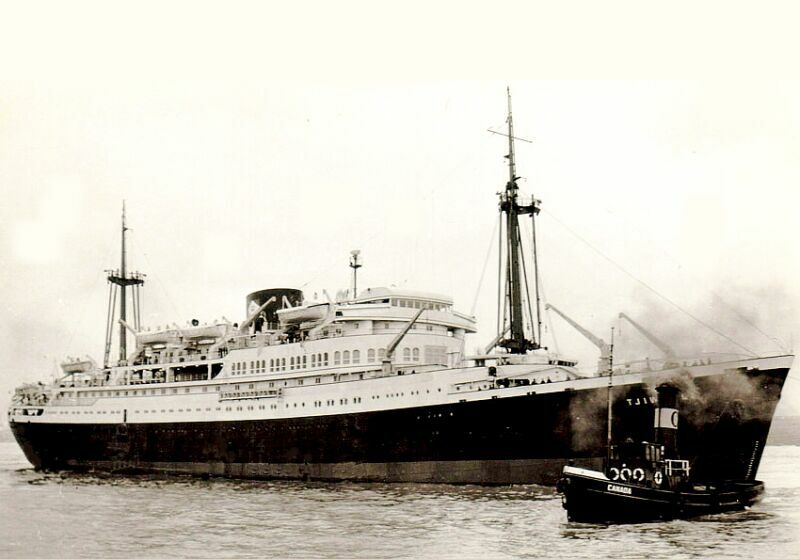
M.S. Tjiwangi
was the first of an identical pair of ships to enter service
Please Note: All images are from the author’s private collection, unless stated otherwise
History
of the two Remarkable Ships
With
RIL from 1950 to 1974

The “Royal Interocean Lines” RIL flag
These two compact liners were considered the
most beautifully proportioned passenger-cargo liners ever seen in
Australian waters and they became the most popular ships to sail
between
The long established Dutch shipping company
“Java-China Line” and the “Koninklijke
Java-China Paketvaart Lijnen” - (KJCPL), which from the
late 1950’s merged to become the “Royal Interocean
Lines” - (RIL) but they always had their headquarters in
In 1948 KJCPL decided to build two intimate
9,000 GRT passenger cargo liners, and these ships were built by
Van der Giessen at Krimpen. Their keels were laid as follows:
M.S. Tjiwangi in 1949 and M.S. Tjiluwah in 1950, and they were
launched April 29, 1950 & April 28, 1951 respectively.

Above & below: M.S. Tjiwangi is seen during her launching on April 29, 1950
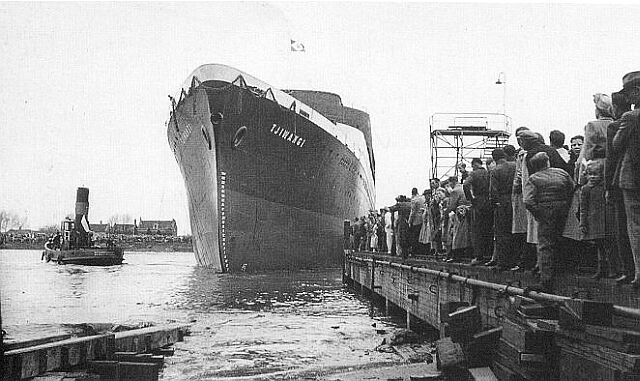
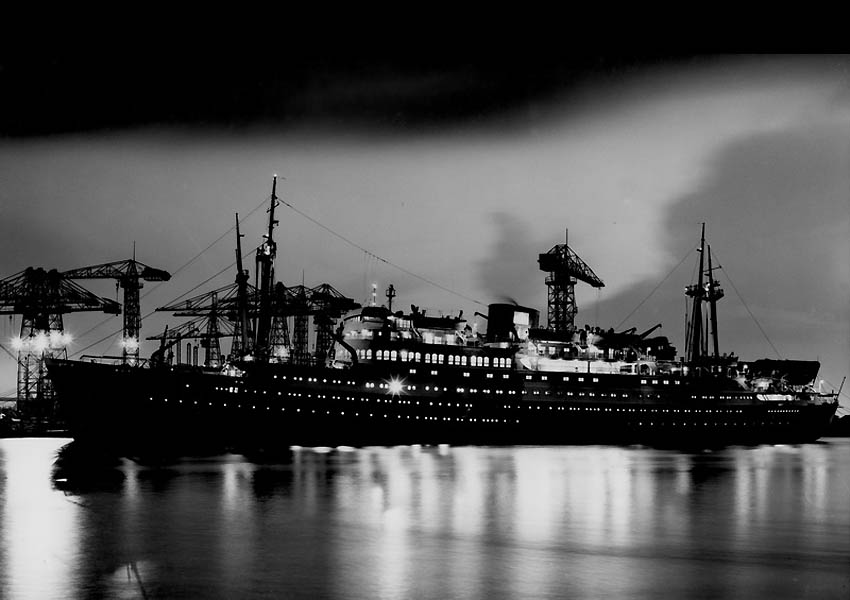
Here we see a
superb photograph of the Tjiwangi at her Fit-Out berth fully lit
at night
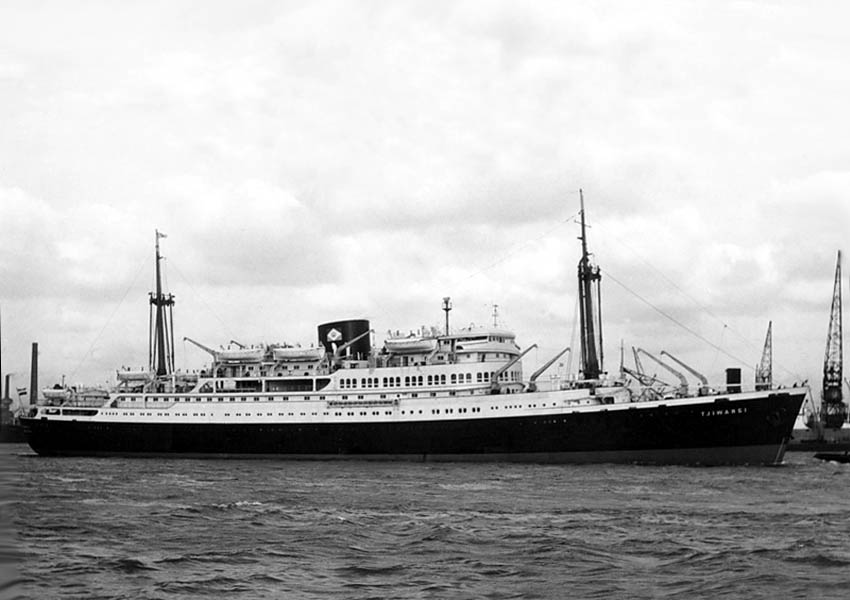
The Tjiwangi
is seen here heading off on her Sea Trials which were successful!
With the M.S. Tjiwangi having undertaken her sea trails she was delivered on December 24, 1950.
After her sea trials the Tjiwangi was delivered
to her owners in
Her sister the M.S. Tjiwangi was delivered on
November 9, 1951 and likewise she also headed from

M.S. Ruys, built for KJCPL, but now operating for RIL, one of their larger passenger liners Ruys
For the next ten years, Tjiwangi and Tjiluwah
operated on the Dutch East Indies to
In 1960 a decision was made to change these
sister services and place them on the

M.S. Tjiluwah
a beautifully proportioned small passenger liner - a KJCPL
postcard from 1956
The M.S. Tjiwangi arrived in

A KJCPL postcard of the M.S. Tjiwangi - 1958
Ports of call:
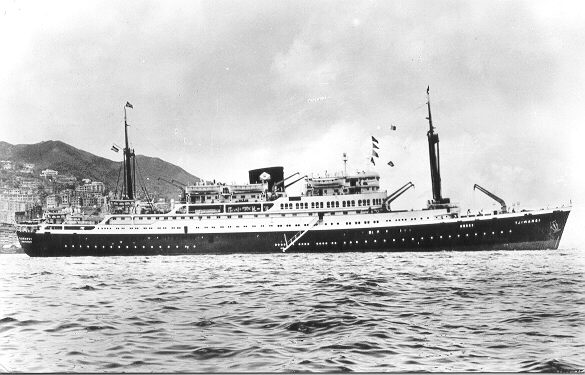
RIL Postcard
of the Tjiwangi after 1960
Accommodations on the Tjiwangi and Tjiluwah as
built: All cabins were outside with one or two portholes.
Tourist Class cabins were located on C Deck and comprised of 40 four berth cabins all having shared facilities. Tourist Class had Gyro fan-forced air-cooling.

First Class Public Facilities was simply opulent, with the Main Lounge located forward on Promenade (A) Deck and it was surrounded by my much loved, the wonderful Wintergarden. The Lounge was sumptuously furnished and the walls covered with the finest of timbers, masking it a warm and a stylish venue. Just aft on the portside was a delightful Bar, and on the starboard side was the Library and Writing Room. Outside further aft was the exterior Verandah out on the deck, which was popular at night as an entertainment venue where we would dance as well enjoying other entertainments, although the main lounge also had a more intimate dance floor! One deck up, on Boat Deck was the First Class Swimming Pool!
In addition, these fine ships had a traditional ocean liner style Promenade Deck, lined with comfortable deck chairs with stewards constantly at your call. Then there was one very special and an unusual feature for a ship of this intimate size, for both these ships featured a magnificent Restaurant being a full two stories in height with a fine balustrade on the upper deck looking down on the Restaurant below, each having a fine grand sweeping staircase down into the restaurant just like the great ocean liners of yesteryear!
The Tourist Class public rooms were equally decorative but having a more modest restaurant. Both classes offered ample deck space for relaxing, sun baking and sports activities, and each class had their own swimming pool.
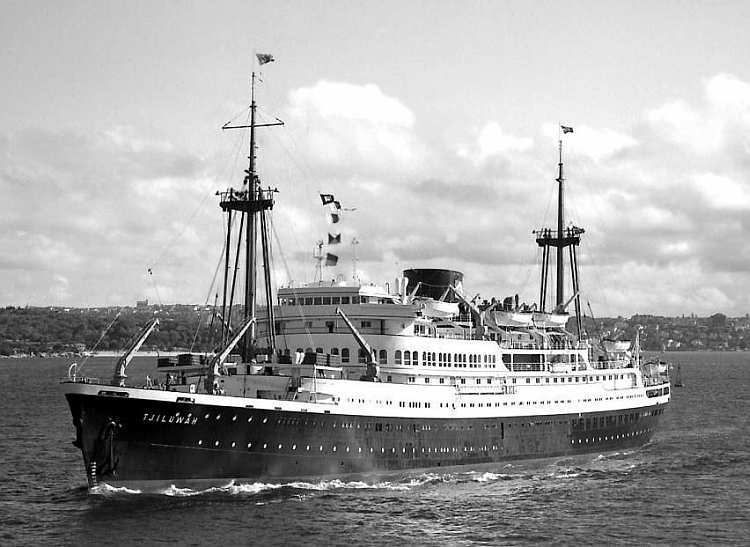
The delightful
Tjiluwah is seen arriving in

Above
& Below: The elegant
were
different


The wonderful Wintergarden
surrounded the Main Lounge - starboard looking aft

The Bar was
located on the Portside just aft of the lobby
(At the same
location starboard was the library/card/games room)

The First Class Restaurant was for a small ship, quite extravagant
Note the
differences between the décor above and below

The staircases
differed on the two ships as one was placed forward & the
other aft of the Dinning Room

Twin
bedded cabin with a sofa that converted to a third bed
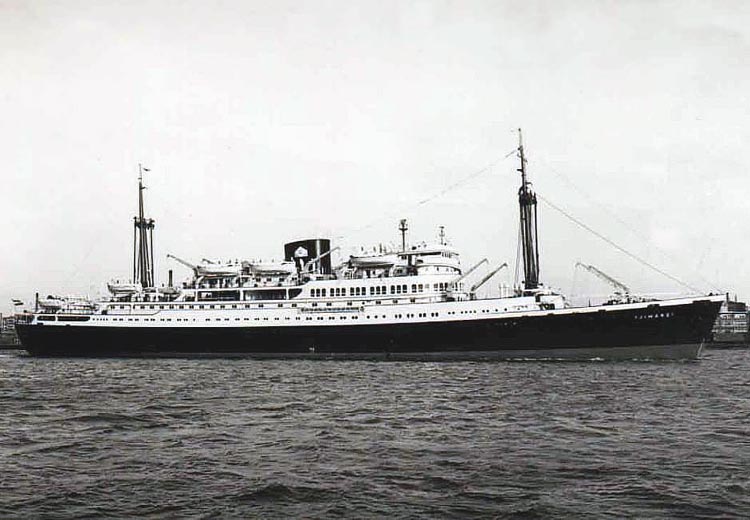
And here is
the wonderful M.S. Tjiwangi in the early 1960s
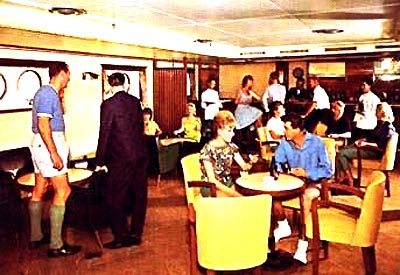

Lounge was
installed on the starboard side of Promenade Deck

The Library

The swimming
pool

Outside Twin
Tourist Class Cabin

See the
official Deck Plan link at the bottom of the page
Specifications:
Tonnage:
Tjiwangi: 8,679 GRT - Number 751.
Tjiluwah: 8,675 GRT - Number 752.
Length: 479 ft – 146m.
Beam: 63 ft – 19.2m.
Draught: 23.7 ft – 7m.
Engines: Werkspoor Diesels.
Screws: Two.
Service speed:
16 knots.
Passenger Decks:
Four.
Passengers:
Crew:
200.
Livery 1950/1963:
Black hull / white superstructure with red boot topping.
.
black funnel Dutch flag with white triangle & gold crown.
Livery
1963/1972/74:
White hull & superstructure.

M.S. Tjiluwah
seen in 1963 after her refit – Such a graceful and intimate
liner
In 1962/63, both ships received a refit, and
had their hulls painted white, after which they became known as
the “Elegant White Yachts.” The after end of the
starboard Promenade Deck was glass enclosed creating the
delightful Tourist Class Verandah Lounge.
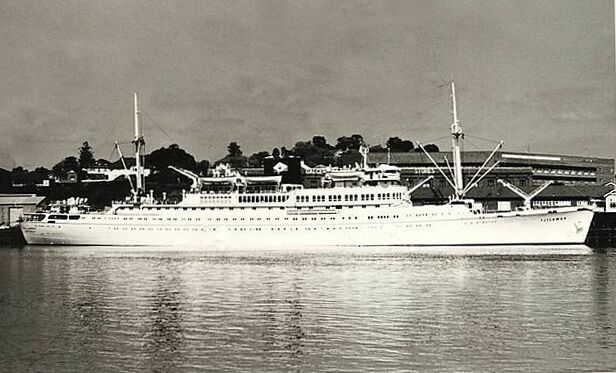
Tjiluwah, seen
here in
Today these
wharves have now been rebuilt as upmarket apartments, boutiques,
cafes
and
restaurants,
Photograph by Reuben Goossens & © ssmaritime.com
The
To replace the Tjiluwah, RIL had obtained
another Dutch ship the 13,568 GRT M.S. Randfontein and they
renamed her ‘Nieuw Holland’. After an extensive refit
she departed Hong Kong for her first voyage to
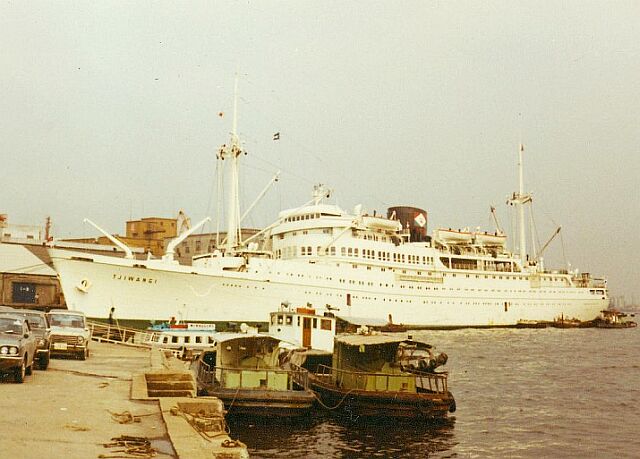
M.S. Tjiwangi
seen in
Photograph
by & © Graham-Emery
With the sale of the two popular “Elegant
White Yachts” as ship lovers called the ‘Tjiluwah’
and ‘Tjiwangi’,

M.S. Nieuw
Many of today’s vacationers would not
enjoy this style of elegant cruising as the preference these days
is to be entertained all day and night, private balconies,
towering atriums, rock climbing walls, ice skating rinks, etc,
etc, and sailing with a herd of 2,000 to 6,500 passengers on a
floating hotel/resort which can hardly be described as ships.
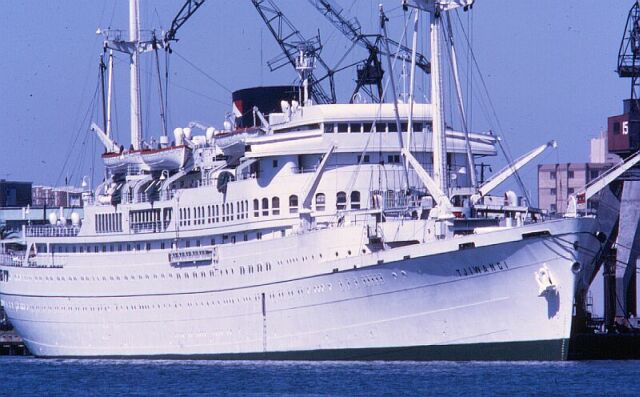
A superb
looking M.S. Tjiwangi seen on one of her rare visit’s to
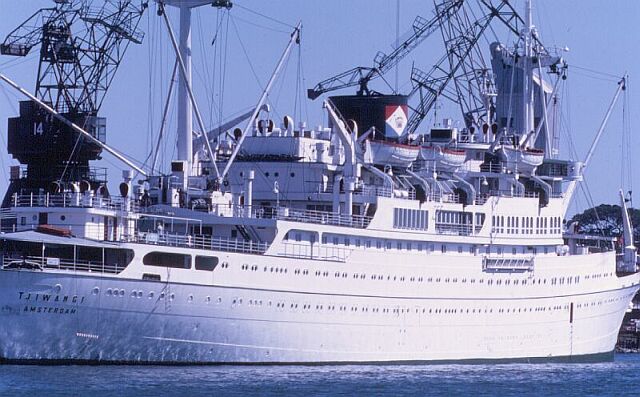
A stern view
of the pristine M.S. Tjiwangi in
I trust that you have enjoyed this article on
these two remarkable small and elegant ships, and that is just
what ssmaritime is all about, bringing back happy memories!
…
remembered as the “Elegant White Yachts”
Page One: Tjiluwah – Tjiwangi History Page (This Page).
Deck Plan: Tjiluwah – Tjiwangi.
Page Two:
Kota Singapura, ex Tjiluwah - Kota Bali, ex
Tjiwangi.
Page Three: RIL Memorabilia – A host of RIL memorabilia items.
“Blue Water Liners sailing to the
distant shores.
I watched them come, I watched them go and I watched them
die.”

Featuring over 1,435 Classic Passenger Liners, Passenger-Cargo Liners & Classic Cruise Ships!
Or ENTER HERE
For interest: Sadly an email service to ssMaritime is no longer available, due to the author’s old age and chronic illness as well as being disabled, etc. In the past ssMaritime received well over 120 emails per day, but Mr. Goossens can no longer handle same. He sincerely regrets this!
*********************
ssMaritime.com & ssMaritime.net
Where the ships of the past make history & the 1914 built M.S. Doulos Story.
The Author has been in Passenger Shipping & the Cruise Industry for well over 60 years
In addition he was the founder of “Save the Classic Liners Campaign” in 1990.
Please Note: ssmaritime and associated sites are 100% non-commercial and the author seeks no funding or favours of any shape or form, never have and never will!
Photographs on ssmaritime and associate pages are by; the author or from the author’s private collection. In addition there are some images that have been provided by Shipping Companies and private photographers or collectors. Credit is given to all contributors. However, there are some photographs provided to me without details regarding the photographer/owner concerned.
This notice covers all pages; although, and I have done my best to ensure that all photographs are duly credited and that this notice is displaced on each page, that is, when a page is updated!
ssMaritime is owned & © Copyright by Reuben Goossens - All Rights Reserved