TSS
Awatea (1936 to 1942) of the Union Steam Ship Co., of New Zealand
Note: iPhones, iPads, Firefox & some other Search
Engines may not be suitable
Use Google Chrome for this Web Page to load perfectly!

Click
the logo above to reach the ssMaritime FrontPage for News Updates &
“Ship of the Month”
With Reuben
Goossens
Maritime
Historian, Author, Lecturer & Cruise‘n’Ship Reviewer
Please Note:
All ssmaritime as well as my other related maritime & cruise sites are 100%
non-commercial and privately owned sites. Be assured that I am NOT associated
with any shipping or cruise companies or agencies or any other organisations!
The author has been in the passenger shipping industry since May 1960, but
although retired and unwell, I occasionally attempt to write an article now and
then, in order to bring enjoyment and pleasure to ship enthusiasts past
passengers and crew.
Please Note:
Images on this page are from the author’s private collection, unless
stated otherwise. Some of my
photographs were badly damaged when I came to Australia
in the 1960’s, when the box that transported them by sea was dropped and
many were badly damaged. However, I have given many of these some Photoshop
attention and restored them as much as is possible, and they look quite good
again. I hope you will agree!
Introduction:
One of the most beautifully designed compact
liners to be built in the mid thirties was without doubt a ship that became
known as the most famous Trans-Tasman Express Liners, being the Union Steam
Ship Company (USSCo) TSS
Awatea
(Maori for “Eye of the Dawn”).
There was something special about this ship, for she had something in common
with one of the great liners of her day, being the famed Holland America (HAL)
Liner that was launched just a year after the Awatea. This HAL ship became
known not only as being a revolutionary ship, but also as “The most
beautiful passenger liner ever to be built”, and some may ask “What
was that ships name?” Many ship lovers will know it well, for it was the
36,287 GRT, SS Nieuw Amsterdam. Although the Nieuw
Amsterdam was very much larger, what was the connection between these two
ships?
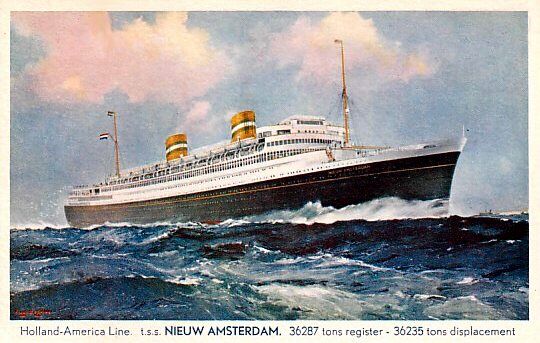
Original
postcard of the SS Nieuw Amsterdam
The connection was very much in
the ships design, for there were certain similarities. There is no doubt that Awatea’s USSCo’s designers had done a unique
job and they had managed to design a ship that was pure maritime perfection!
Her 545 ft long green hull, red boot topping with a thin gold band surrounding
her slender and perfectly balanced hull was designed for speed and superior
stability. In addition she had a rolled bow, which was gently raked (rather than
the knife-edge bows such as the Monowai). Awatea’s
hull was in total balance with her elegant low slung long superstructure,
topped with two perfectly raked red and black funnels, as well as her two tall
raked masts, which made her look very much like a grand “Ocean
Liner,” be it on a smaller scale!
Another factor was that her public rooms
certainly matched the perfection of her exterior. Awatea featured some of the
finest lounges imaginable and many of these were built on a grand scale indeed,
especially considering she was designed to operate a two and a half day
Trans-Tasman Express service from New Zealand
to Australia
and return, a voyage that would be at least one day shorter than any of her
competitors! The truth is Awatea would have been perfect as a Trans-Atlantic
Liner. During her far too short commercial life the TSS
Awatea
operated all her services with great dignity, as well as being known for a ship
that broke a few nautical records!
Reuben Goossens.
*************************************
Her Beginnings:
The Union Steam Ship Company (USSCo) canvassed
idea of building a new super fast ship for the Trans-Tasman Express service in
July 1930, mostly due to the fact that the American Oceanic Steam Ship Co,
better known today as Matson Lines, had already ordered several grand 22 knot
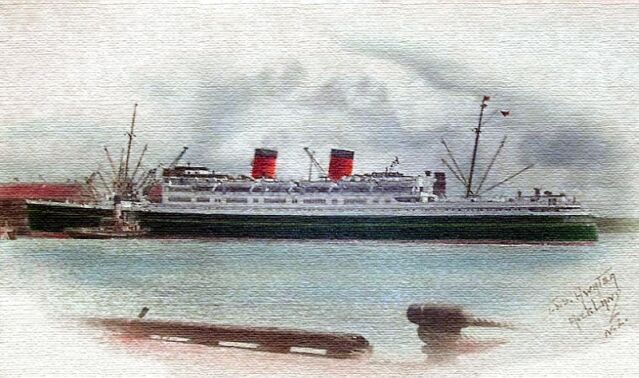
ships, being the 18,000 GRT, SS Mariposa (1931) and her sister the Monterey
(1932) to operate on the South Pacific, and thus the Tasman service.
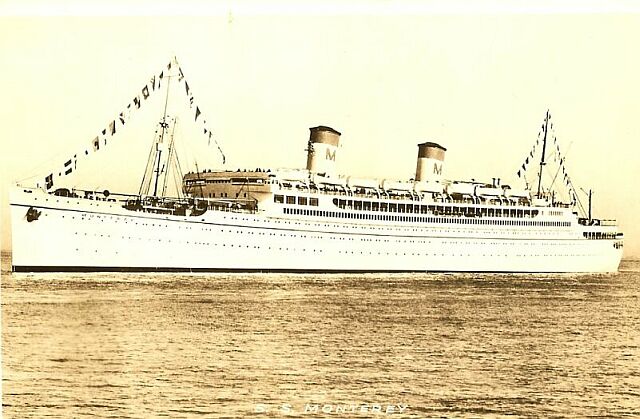
The Matson liner SS Monterey
In addition there was the soon arrival of the
Australian Huddart Parker luxury liner, TSS
Wanganella that
would be competing with the USSCo liner that was already operating on the Tasman, the
11,000 GRT, SS
Monowai.
But the Monowai could hardly compete with ships of such a high calibre and thus
a new superior ship was obviously in the minds of the executives of the USSCo.
However, due financial restraints at the time the project was shelved until a
year later when it gathered speed again, for the company realised there was an
urgent need for a new vastly superior liner or they would simply loose the
market, but their new ship would need to have a great deal of new thinking and
technology behind it.
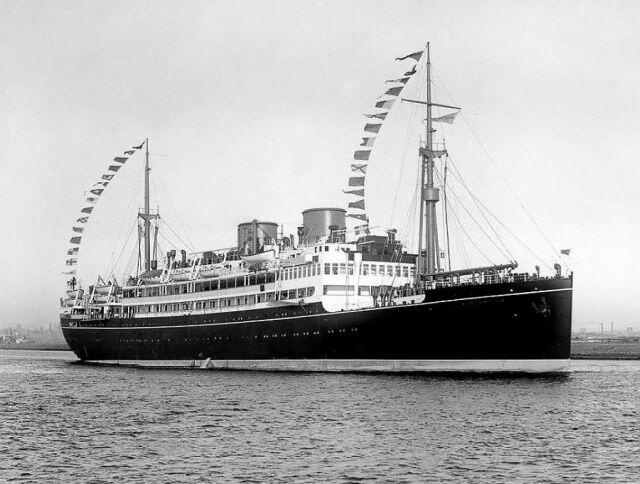
The
Huddart Parker TSS Wanganella looking superb as she is seen here fully dressed
with flags
Note:
This ship has a “knife edge” bow
Union Steam Ship’s own
designers had commenced working on a new design whilst taking on board new and
advanced influences from around the world. By now they had already decided that
their new ship would be equipped with steam turbine engines as they needed a
ship that was capable of high speeds and the more economical motor ships were
just not up to the job at that time. What they conceived with was one of the
most beautiful compact sized liners imaginable, and as I said earlier, she was
very much in the style of a mini Nieuw Amsterdam.
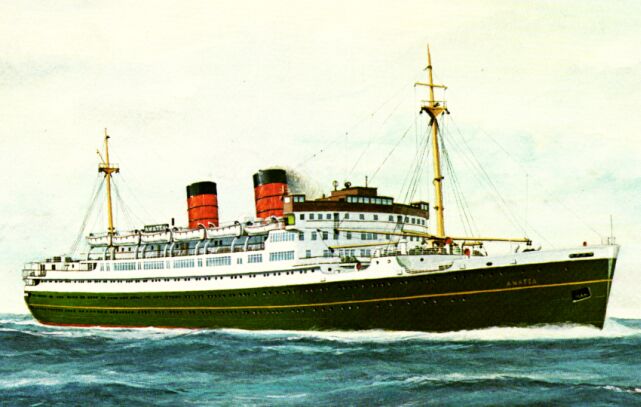
A
painting of the Awatea
Artist
unknown - *See Photo notes at the bottom of the page
Then in December 1933, USSCo
officially announced that they had decided to build their new Trans-Tasman
Express Liner and that this new ship would not only be their flagship, but that
she would also be capable to make the Tasman
crossing in just in two and a half days. Thus, combined with tight turnarounds
at each port, the ship could do a complete round voyage to and from Australia
each week. This would mean that she would require a minimum speed of 20 knots
however she would end up with a greater speed available to her.
In November 1934, USSCo officially announced
that their new ship would be named Awatea, being a Maori word meaning
“Eye of the Dawn.”
Towards the end of the very next month a contract was handed to
Vickers-Armstrong at Barrow-in-Furness for them to build the turbine steam ship
and her keel was laid down at yard number 707 and building progressed until
1936.
Then came the big day for USSCo, for on a
thick foggy morning on February 25, 1936, just after 11 AM, the Awatea was
launched by the wife of the New Zealand Governor-General, Lady Elaine Bledisloe, and the ship was then moved to her fitting out
berth at the Buccleuch Dock where her interiors and
other fixtures would be worked on.
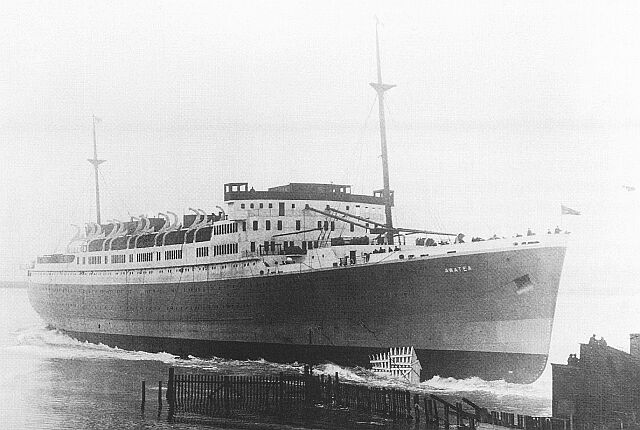
We see the Awatea going
down the slips on a foggy morning, just after 11 AM
On July 22,
1936 with work as required finished the Awatea departed Barrow in Furness and
sailed for the Mersey
River
where she would be dry docked at the Liverpool Cammell Laird shipyards at
Birkenhead where her hull would be cleaned to be made ready for her voyage to New Zealand.
On July 25, 1936, Awatea departed for the Firth of Clyde and undertook her sea
trials. Two days later she reached 22.5 knots using only four of her boilers,
thus the builders knew that she could do very much better. On July 28 she was
officially handed over to her owners.
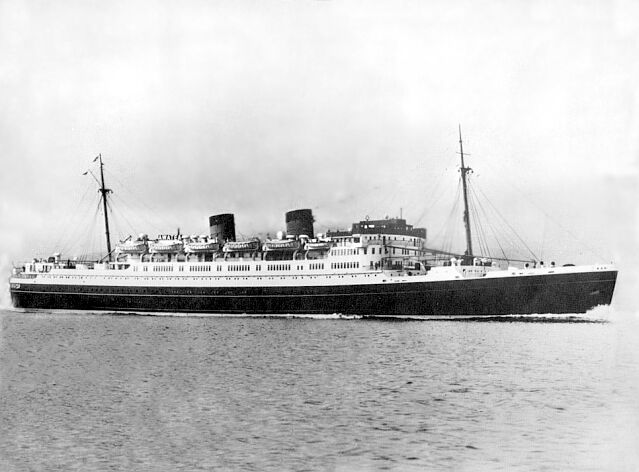
TSS Awatea seen here during her sea trails
Awatea departed Greenock on
August 5, 1936, for her voyage to her new home and sailed via the Panama Canal
to Wellington New
Zealand.
Amazingly during her this voyage the Awatea broke the all-official records for
a voyage from the United Kingdom
to New Zealand
sailing via the Panama Canal.
It took her just 28 days, six hours and 33 minutes to be precise, and we need
to note that this was achieved with her using only three of her six boilers
throughout the voyage, making this an amazing record indeed! Awatea arrived in Wellington
exactly to the minute as what Awatea’s most
famous Captain, Captain A.H.
Davey’s
had predicted upon departure, on September 3, 1936.
Her arrival in Wellington
proved to be a huge event with great fanfare, and soon enough this new liner
became a much loved and a popular ship. The very first sight of her made a big
impression on the people; as one of my readers (Geoff)
wrote me:
“The Awatea was a sight to behold, for I had never seen
a ship of such great beauty before. My wife and I had seen many fine overseas
liners visiting Wellington
before and we had sailed on several, and they were marvellous.
But now the Awatea, as soon as we saw her, we knew that she was sheer
perfection, and her design was in perfect harmony. I recall saying in the
excitement to a person standing next to me, ‘She is like the perfect
woman, having all the shapes in all the right places!’ Then I realised that person was my wife, but that is OK for she is
beautiful and had a good laugh! Also we said, ‘We can’t wait to go
to Australia.’”
Geoff and his dear lady did go, and he continued …
“It was the experience of a lifetime, my wife and I had
a spacious two bedded cabin with a bathroom on the portside on A deck two
located just forward from the Pursers office, and it was simply superb having
all the mod cons. The Lounges were wondrous and the Main lounge was two decks
high and had a gallery on both sides. We loved the promenades, both the
enclosed and the one above where we strolled under the lifeboats. The service
and the meals could not be faulted, and we soon discovered that New Zealand
finally had a ship that we could be proud off and could match the rest of the
world! We intended to do a voyage across the Pacific, but, this became
impossible as tragedy struck, for we all know that the war had come upon us and
the Awatea had to become a troop ship and she would not ever come home and
return to active duties. We finally had the ship we deserved, and we lost her
to the German and Italian warplanes, a tragedy! But at least, we managed to
spend two crossings on her to and from Sydney!”
Geoff
Spencer - Palmerston
North,
NZ.
On September 13, 1936, Awatea
departed Wellington and sailed north to Auckland, and she departed in the
afternoon of September 15 for her maiden Tasman crossing to Sydney, arriving
there on the morning of September 18 and came in passing the Sydney Harbour
Bridge as she headed for her berthed at a sundrenched berth at Circular Quay to
yet another great fanfare as her arrival had been well publicised in the
Newspapers and on radio.
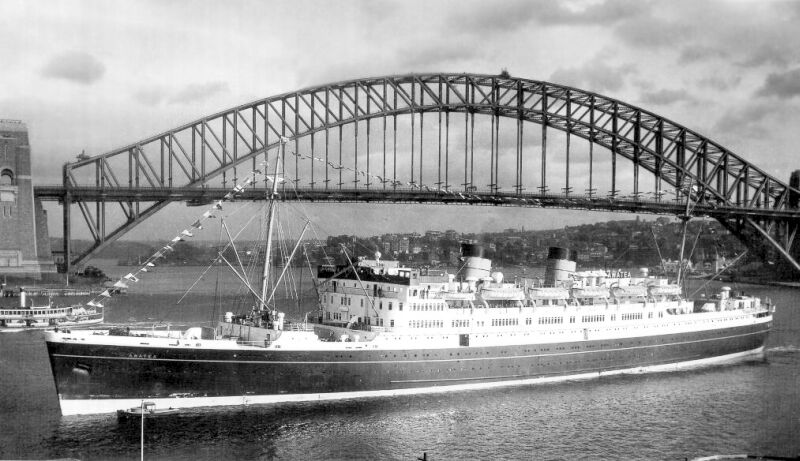
The
sleek new liner TSS
Awatea
is seen arriving in Sydney
on September 18, 1936
TSS Awatea accommodated a
relatively small number of passengers, with 377 in First Class, 151 in Tourist
Class and just 38 in the budget 3rd Class section; a total of 566 passengers in
all, who were attended to by a crew of 242, Thus although not a large ship at
13,482 GRT, she was certainly a spacious ship and she offered fine meals and
her reputation for service on board was of a very high standard!
*************************************
Engines, Tasman
Crossings & Specifications:
Originally USSCo
had thought build a modern motor ship, for at that time this seemed was the
trend of many of the competitors, and it was common knowledge that motor ships
were certainly far more economical.
However, USSCo realised that they could corner
the market if they made their new ship a fast ship, and to accomplish this they
needed her to have powerful engines, and thus they chose Vickers-Armstrong to
build geared turbine steam engines, with twin screws operating at 22,500 SHP.
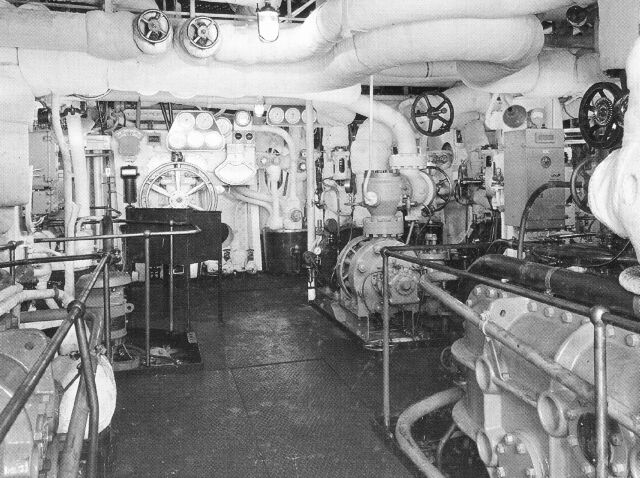
A
view of the engine room looking towards the control section
During her trails she operated around
23 knots, but her service speed was generally 21 knots. Her local competitors
were the two superb fast American liners as well as the new Huddart Parker TSMV
Wanganella, which operated at 15 knots and the USSCo own ship, SS Monowai
operating at a good 18 knots, they both operated a three and a half day
crossing of the Tasman. Thus, the Awatea would cut a full day from their
sailing time and save considerable time, whilst still providing a superb mini
vacation on a luxury ship!
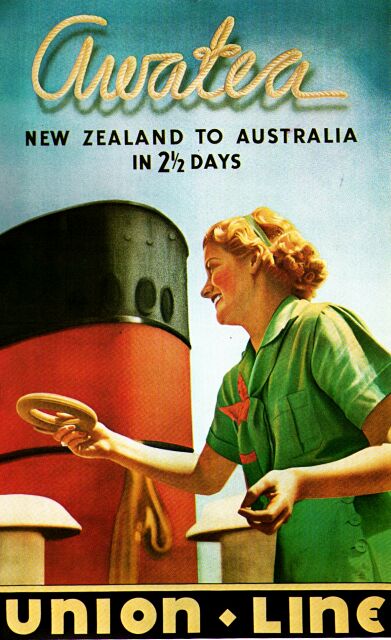
A bright and colourful USSCo brochure
promoting the TSS
Awatea
Combined with the ships fast crossings of the Tasman and the
high standard of service and cuisine on board, this made her a popular very
ship. During the summer of 1937 the Awatea made 11 Tasman crossings in just 41
days in addition she was able to bring the times for the Auckland to Sydney and
Sydney to Wellington voyages to just under 56 hours. According to her
record’s, her best day’s run was 576 miles, being an average speed
of 23.35 knots.
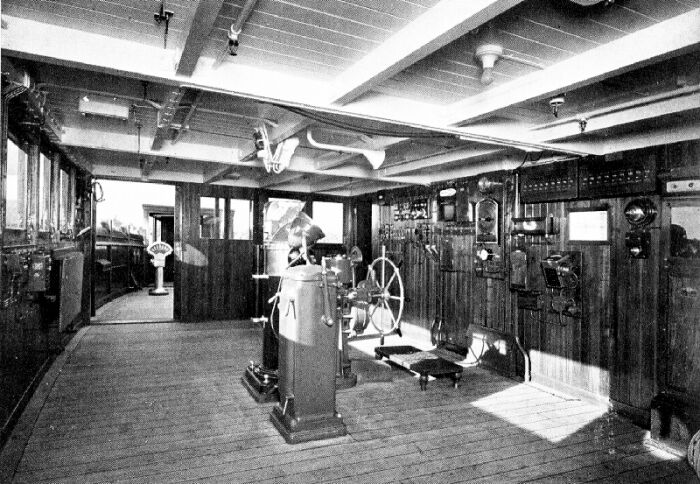
This
was the heart and soul of the Awatea, where good men of the sea guided her on a
good course
Captain Davey was a remarkable seaman and he made the Awatea a name to be
remembered and she became a ship to be well known to the entire maritime world.
The reason for this was not just due to her excellent speed, but for the fact
that he was able to manoeuvre the ship to her berth without the aid of any tugs
in all ports, and did so with amazing accuracy! We need to consider that this
was achieved long before side thrusters had come on the scene, but then again,
those were the days when there was great some really seamanship around!
Today, it is all automated and even computerised.
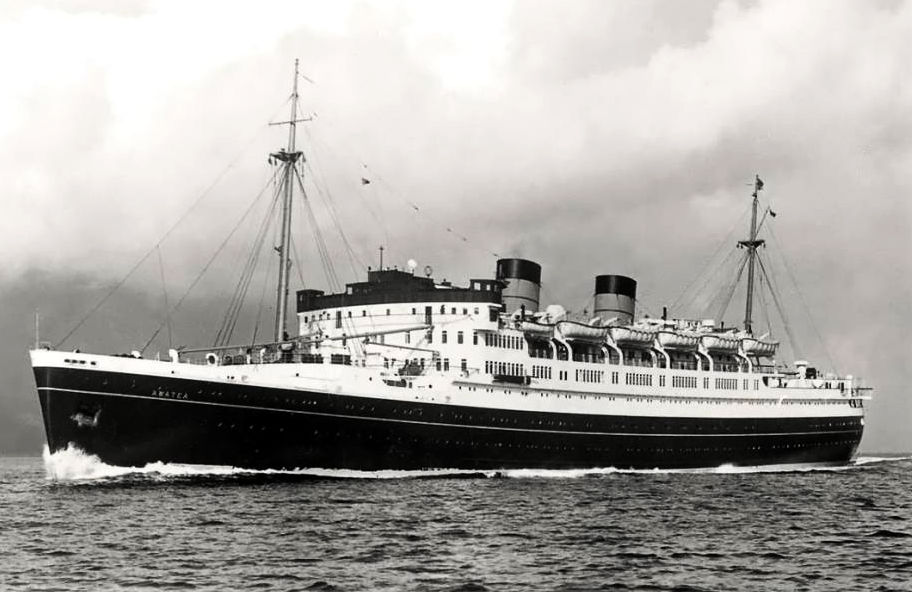
Looking
grand as she is seen at full steam ahead at sea
There was no doubt that the
Awatea was had become much loved and by this time she became known on both
sides of the Tasman;
“Queen of the Tasman Sea.”
Having been in operation for just six months
her engineers realised that there was a need to rectify her turbine gearing,
and under the builders guarantee she was withdrawn from service between May and
July 1937 and the work was undertaken at the Cockatoo Dockyards Sydney, whilst
the company’s older ship the SS Monowai took over her service on the
Tasman.
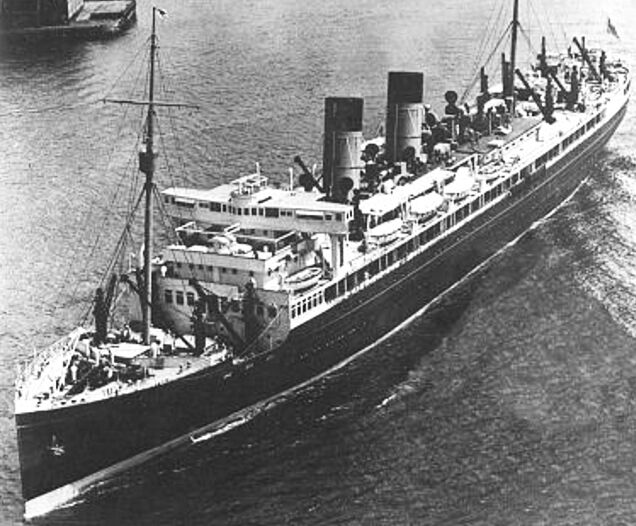
Union
Steam Ships older liner, SS
Monowai
Whilst at the Cockatoo Dockyards,
her accommodations we also upgraded, and atop the ship her funnels were
heightened by some nine feet. The reason for this was an obvious one; it would
assist to better disperse the smoke away from her aft decks. She was completed
and departed for her sea trails July 27, and during this trail she reached a
remarkable speed of 26 knots.
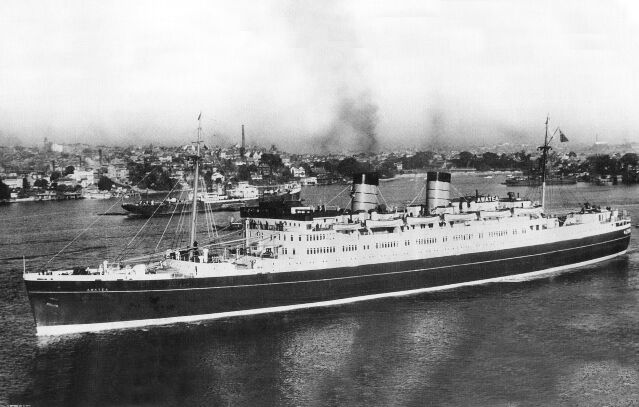
The
Awatea is seen here leaving Sydney
after her refit and the heightening of her funnels mid 1937
To this date the large Matson liners
still were still the fastest ships on the Tasman by a small margin, however
that was about to change very soon!
When the TSS
Awatea
arrived in Sydney
on October 4, 1937, she had finally set a new Trans-Tasman record between Auckland
and Sydney
(1,281 Miles) of just 55 hours, 28 minutes, having sailed at an average speed
of 23.1 knots, beating the SS Monterey by 2 hours and 44 minutes.
In addition during this voyage, she again had not used all her boilers, making
it even more remarkable!
For this special occasion Paramount Film
Corporation presented the ship with a special framed certificate which was
placed in Captain Davey's
cabin, as well as an especially created 45-ft long blue pennant, representing
the “Tasman Blue Riband.” This pennant was flown from the main mast
just above the Company House Flag.
In addition, USSCo commissioned a polished
stainless steel greyhound shown in racing mode. It was 5ft, 7 inches long.
After it was presented to the Captain, it was mounted high atop on the ships
foremast as a symbol of the ship’s new status as the “Greyhound of
the Tasman Sea.”
When Captain Davey
retired in 1941 due to health reasons, the greyhound was taken down and the
USSCo presented it to him in appreciation of his long service with the company,
and not just for establishing this ship on the Tasman, but
also having achieved greatness for this superb liner! Captain Davey
installed the greyhound above the door of his home in Auckland.
In addition the pennant was given to the Captain as a memento. After his death
in 1966, both the pennant and the greyhound were presented to the
“Auckland Institute and Museum” but it was relocated to the new “National
Maritime
Museum”
in 1993, when the new museum opened. Today you can visit it these precious
memories and be reminded that the TSS
Awatea
was indeed - “The fastest ship in the Antipodes.”
PS: Awatea’s Trans-Tasman record was not be broken for
another 21 years, but finally in 1960 the great and very last “Orient
Line” liner ever to be built, the SS Oriana, sailed from Auckland to
Sydney in a mere 47.5 hours, averaging at an incredible speed of 27 knots.
TSS Awatea operated a single cruise during her entire commercial career. She
departed Auckland
on January 19, 1937, for a four-day cruise visiting Whangaroa,
the Bay
of Islands,
Port Fitzroy and Great
Barrier
Island.
TSS Awatea –Specifications:
Built: Vickers-Armstrong at Barrow-in-Furness
1936.
Yard: 707.
Launched: February 25, 1936.
Completed: July 1936.
Tonnage: 13,492 GRT.
Length: 161.1.3m / 545ft.
Width: 22.5m / 74ft.
Draft: 7.9m / 26ft.
Engines: Six Steam Reduced Geared
Turbines - by the builder.
Screws: Twin screws
-
Speed: 22 knots, Max 26 knots
Passenger Decks: Six, all lift accessible.
Passengers: 151 First
Class, 151 Tourist Class & 38 Third Class.
Crew: 242
*************************************
Awatea’s Facilities:
First Class
Public Rooms & Sports Deck
The Awatea had six
passenger decks, with First Class having two lifts, one forward and amidships,
these serviced all passenger decks. Her public rooms were certainly the
ultimate for the day. On Promenade Deck forward was the Glass enclosed
Observation Deck that surrounded the elegant Music Room that had its walls
panelled in superb timber veneers, fine furnishings and a grand mirror on the
aft wall, luxuriant carpets and a grand piano, as well as subdued hidden
lighting with one lighting fixture that was a central feature.
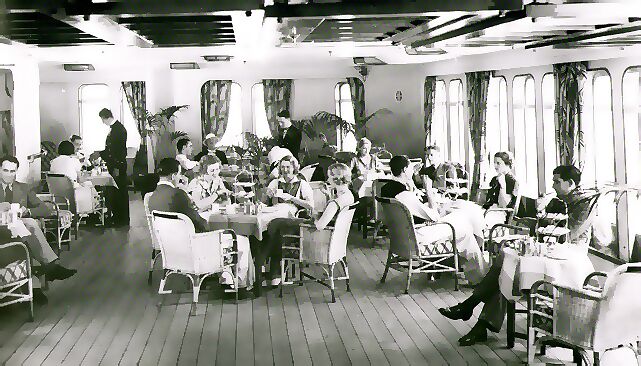
This
is officially called the Observation Deck, but is also known as the Wintergarden forward on Promenade
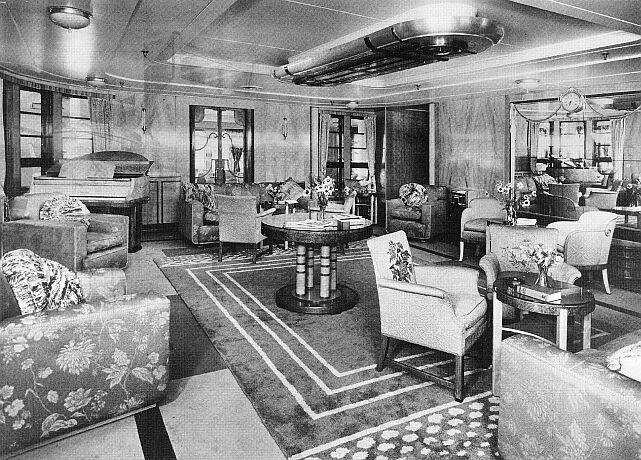
The Music Room forward
on Promenade deck, followed by the Library and reading & Writing Room
The
Music Room was followed by the combined Library and Writing Room, followed by
the Main Lobby and then amidships one would read the Grandest venue on the
ship, the towering two deck high Main Lounge. One of the features of this room
was a large movie screen on her aft wall, which was covered by a series of
decorative sliding panels, and up on the upper level on her two sides were
Galleries with seating that had decorative stainless steel railings and rounded
ends, that looked more like theatre balconies. The furnishings and fittings in
this venue were of an international standard and would have been at home on the
Queen Mary.
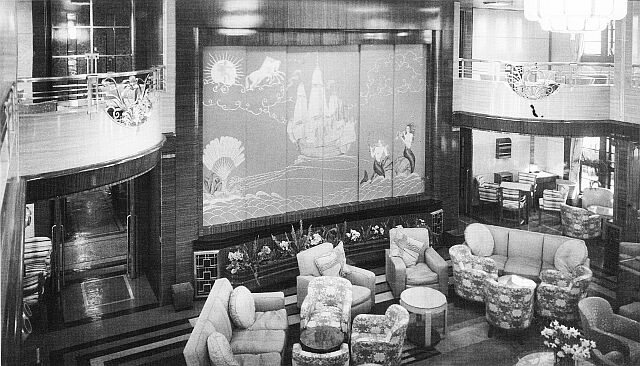
The
Main Lounge looking down from the upper level with the lights dimmed to reveal
a more demure feel
The Main Lounge
furnishings were in rich floral tapestries, as well as a less bold style
covering on the seating, which gave the room a sense of traditional style.
Whilst the coffee tables in the room were in a light colour there were some
dark timbers used in the lounge to embellish this room in a small way, such as
the surround of the large forward mirror, the massive movie screen, the door
surrounds, as well as the lower balcony edge surrounds. The rest of the room
was much lighter than any of the other lounges in First Class and thus upon
entering this room looked rather grand in every sense of the word, it was huge
for a ship of this size! However, with all of its grandeur, this room’s
elegance was combined with a remarkable casual and a joyful ambience!
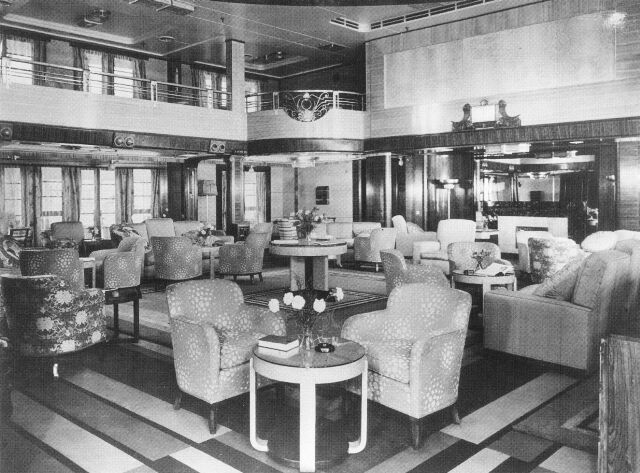
The
two decks high Main Lounge had a Gallery on each side of the ship, this was a
stunning venue indeed
And
well befitting any great Trans Atlantic liner of her time
The Main Lounge was followed by two Club
Rooms, one for Men (port) and the other for Ladies (starboard). Then came the
superb and heavily timbered, very traditional Smoke Room and Bar, a venue that
had the traditional English Fire place that was heated by electricity. Although
not a big room it had that cosy and a very nautical feel, as in the window
there were even portholes for effect!
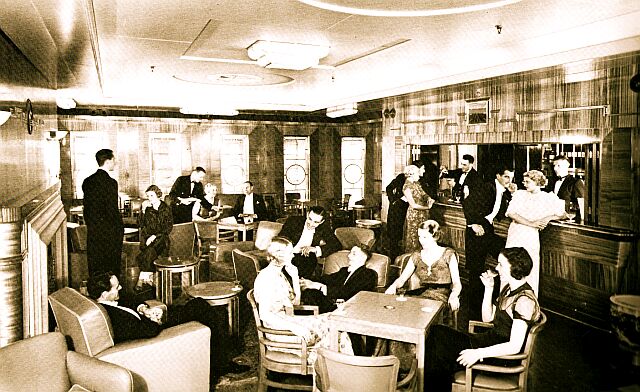
The Smoke Room with its Bar and a traditional
- ever so British fireplace that was electric
The last room on Promenade Deck was the ever popular
and delightful Verandah Café, also being the main dance venue and nightclub on
board. The room was light and bright with large
windows overlooking the aft decks and modern style murals on the forward walls.
The flooring was teak decking, thus perfect for dancing, this combined with
wicker chairs and small round tables the venue offered that casual and relaxed
feel.
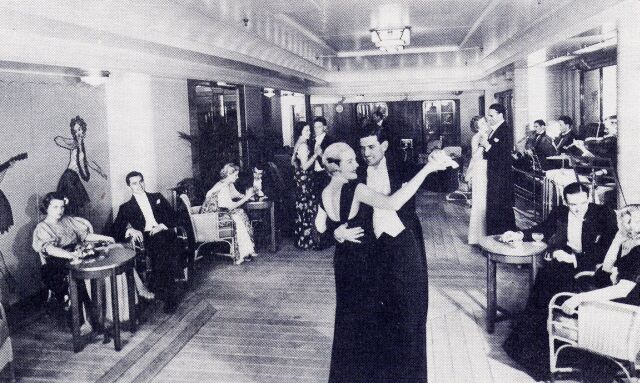
The
Verandah Café and Night Club
Amidships on B Deck was the
location of the large First Class Dinning Room that stretched the full width of
the ship and was 80 ft in length. The middle section of the room was raised
somewhat giving the Dinning Room a somewhat grander look, which worked well
with the art deco style décor found around the room with silver metal finishing
touches on the forward and aft walls, as well as the frosted glazed windows
covering the portholes, which were also back-lit. The walls were covered in
dark timbers, which was said to be Nigerian cherry wood. The middle raised
section had a balcony (the stairs can be seen in this photo) on the forward
wall where the ships orchestra would play. Although a very formal looking room,
it had rather modern style furnishings as this photograph also shows.
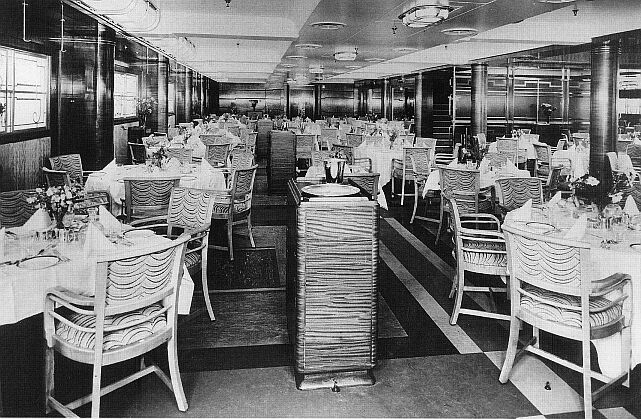
The
magnificently panelled dinning Room had delightfully subdued lighting and at
the main entrance
there
were elegant silver metal polished steel and glass doors
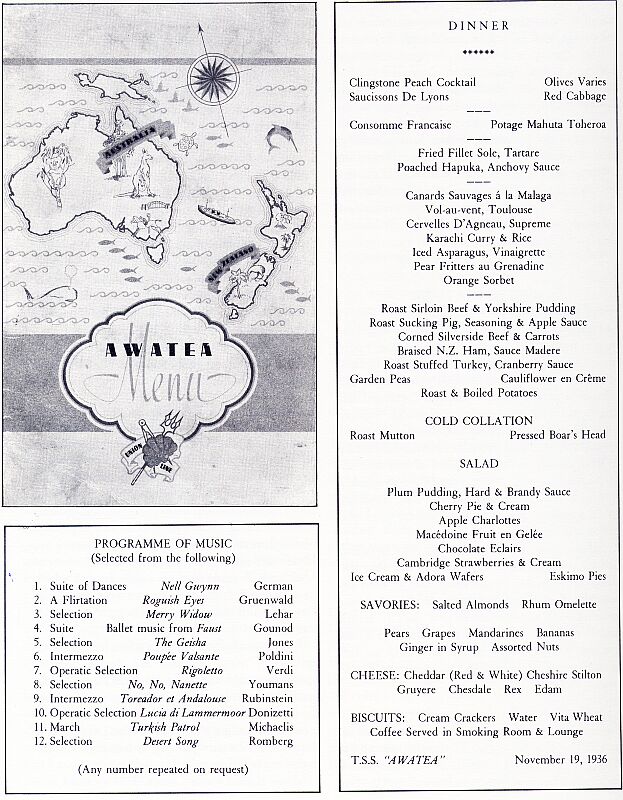
This
is a 1936 menu & containing a programme of music to be played by the ships
orchestra up in the balcony
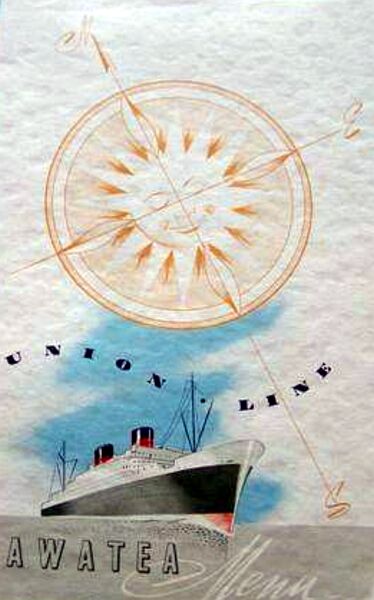
An
Awatea Dinner Menu cover from 1939
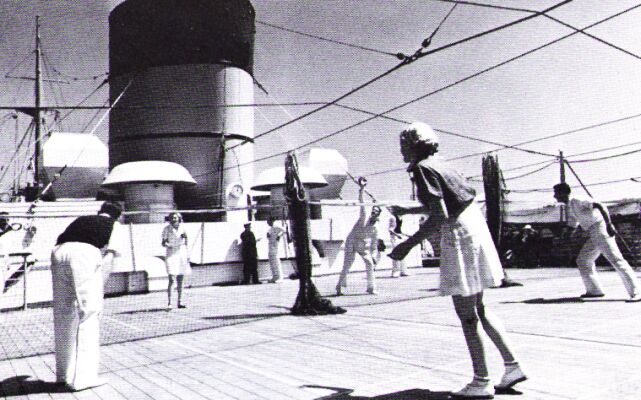
Sports
Deck
Awatea’s First Class passengers were accommodated in luxury cabins, and all
were equipped with telephones, hot and cold running water, heating and fan
forced ventilation, dressing table, Table and chair, wardrobes, and many having
private facilities.
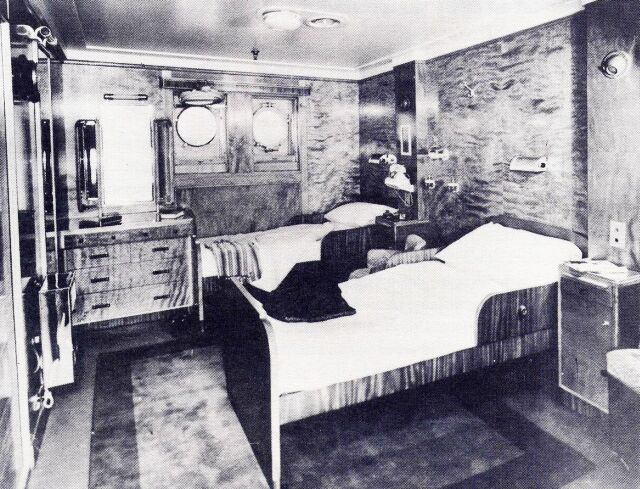
A
twin bedded cabin - As can been seen these cabins were superbly appointed and
richly panelled
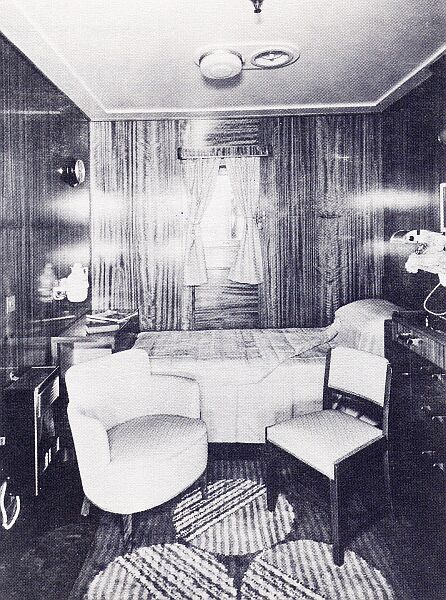
A
singled bed cabin – Note the electric heater o the left wall
*************************************
Tourist Class Facilities
Awatea’s Tourist Class public rooms were all located on A Deck aft. The most
forward one was the delightfully decorated Smoke Room that had all the
traditional features of a room such as this with timber panelling and a bar.
Next came the Writing room and the Library, followed by the elegant, but low
key Main Lounge, which features a light colour scheme with dark oak timber
columns, fire place surrounds panels next to the windows and the entrance
doors, all giving this room a touch of elegance.
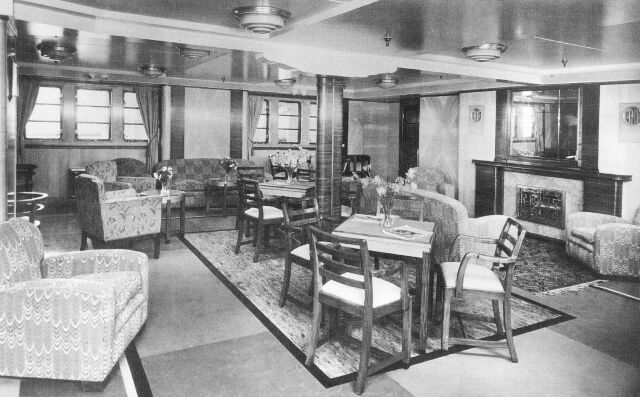
The
Tourist Class Lounge was without doubt an elegant room and would have suited
first class on many ships
The Tourist Class Dinning Room
was located aft on B Deck as the large galley separated the two. This room was
heavily panelled with dark timbers and it offered a variety of table sizes.
Although not as grand as the one just forward, it still was quite elegant and
it had a warm atmosphere.
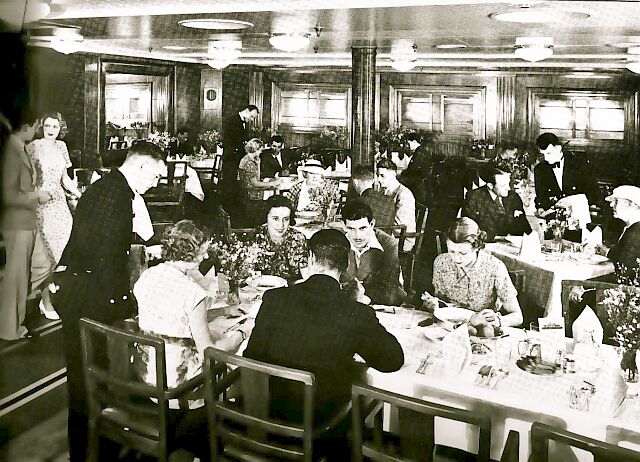
The
Tourist Class Dinning room although quite elegant, but obviously more low key
than first class
 .
.
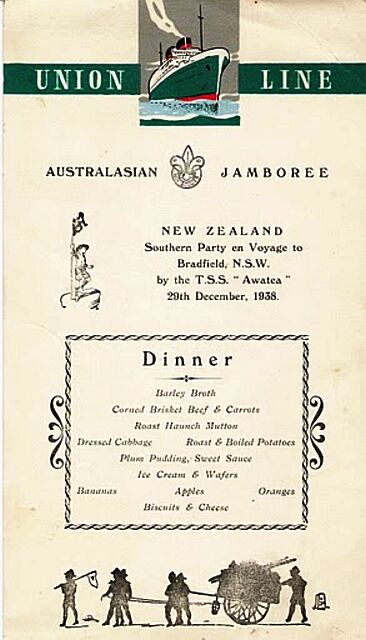
This
was a special menu for the Jamboree voyage
Tourist Class offered
comfortable accommodations, all having hot and cold water, heating and ample
fan forced ventilation and ample wardrobes, seating and storage space, etc.
I have no photographs available of Tourist Class accommodations.
Tourist had ample open and covered deck spaces
as well as sports facilities, for both the Tasman
crossings and the longer Pacific voyages.
*************************************
Third Class
Facilities
Third Class was
relatively small for just 38 budget passengers, and there was a main public
facility, and dinning room on C Deck aft. Third Class had their open Promenade
Deck aft on A Deck. Their cabins comprised of just three dormitories having 20,
10, and 8 bunks each.
I am sorry, but there are no images available
for this class.
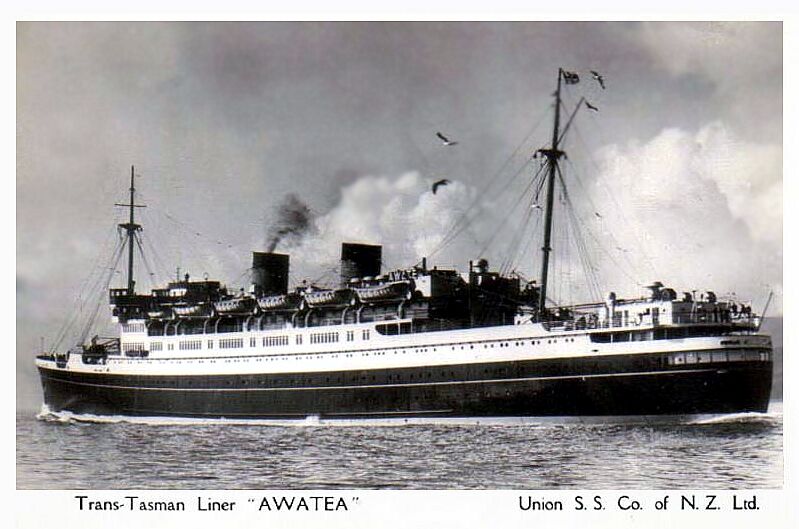
This
id a beautiful postcard of the Awatea, which was badly damaged when the author
moved from NZ to Australia
in
the 60’s, however it has
received some love and it looks great again, as do some of my other images
*************************************
Awatea’s AWA Radio.
Prior
to World War II, there were only two ships in Australasian waters that were
well known in the international radio scene. One was the McIlwraith McEachern Ltd, TSMV Kanimbla, a famed and the very last
Australian coastal liner, with its radio station “VK9MI.” Whilst
the other liner being the TSS Awatea, which had electronic equipment on board
that had been made by AWA in Australia.
This system had been installed during the time of her construction by
Vickers-Armstrong. Transmitters on Awatea were licensed by the New Zealand
authorities as “ZMBJ” and for long distance communication it
operated with 400 watts on 8840 kHz. Yet Awatea did not have a Radio Studio as
such and when the station was on the air with programme broadcasting, the
communication equipment was diverted for this purpose.
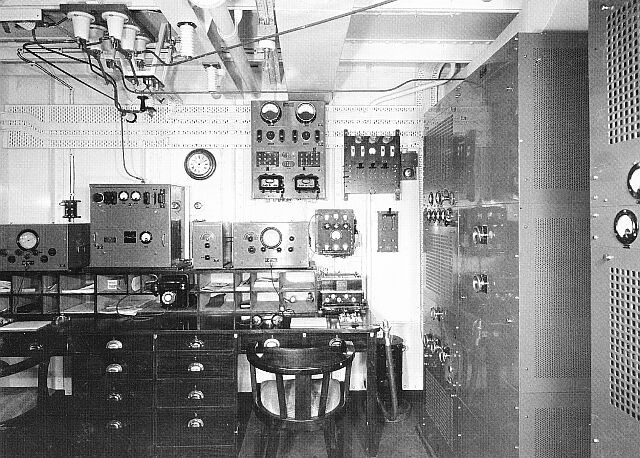
Awatea’s Radio Room
The Australian Prime Minister, Mr
Joseph
Lyons
was on board Awatea in September 1936, and he made a broadcast to the
Australian public on “ZMBJ.” This
broadcast was relayed Australia-wide on the Australian “ABC”
network by the medium wave station 3LO in Melbourne.
Although with the outbreak of World War II broadcasting of general programmes
from the Awatea came at an end.
Ham Radio enthusiast contacts the TSS
Awatea:
However Ham Radio enthusiasts were able to
contact the ship and on May 15, 1938, Mr.
Ted
Serafin
had radioed the TSS
Awatea
and he was sent a *QSL card in
recognition, and this is his story.
On October 22, 2019, I received an email that
contained the details re the above from …
“Hello! My fiancé’s great grandfather was a ham
radio enthusiast back in the late 1930’s. We have in our possession
hundreds of his QSL cards from across the world. A specific few of his QSL
cards were framed by her father some 20 years ago.
One these framed QSL cards is from the TSS
Awatea.
I was interested in learning about the ship and Google perfectly landed me on
your site. Your article and documents are perfect and thank you so much
for your dedication to maritime history.
Attached is the front side of the card. Being that the
card is tightly pressed behind glass we cannot access the back side of the
card. Regardless, if you have/or have not seen a TSS
Awatea
card, I hope you find use for and enjoy the attached one!”
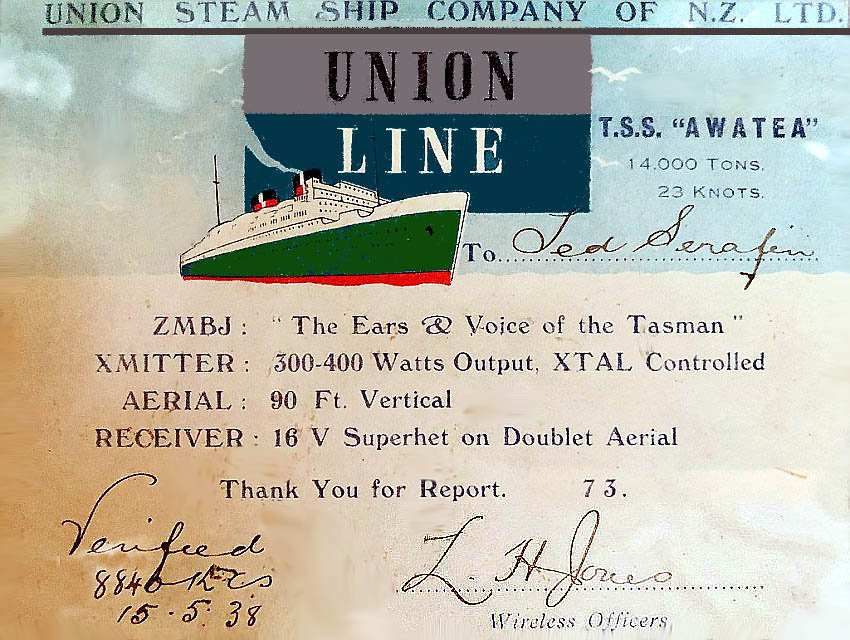
Above we see
the front of the card, however as we were told, there is a message on the back,
but due to it having been framed a very long time ago, it cannot be removed and
viewed.
*QSL Cards are widely exchanged
between ham radio operators to confirm contacts between two radio stations. The
term QSL comes from the radio "Q" code meaning “I confirm
reception”, and the purpose of a QSL card is to confirm contact. The
cards themselves are normally post card sized and many are colourful and most
attractive. Quite a few have photographs or artwork by the ham radio operator.
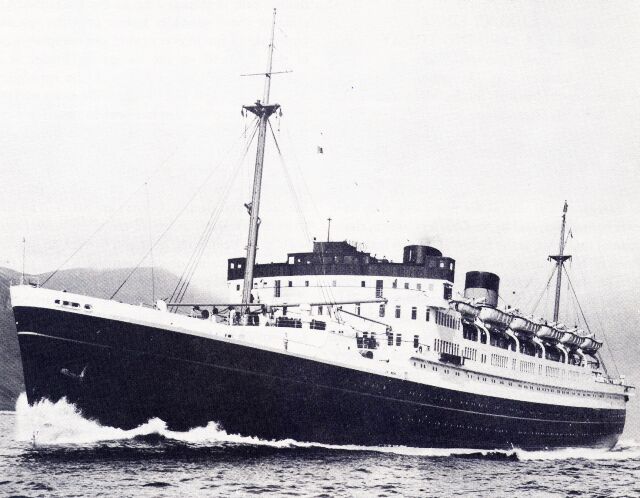
The
sleek looking TSS
Awatea
is seen here at full speed ahead
Image
Provided by Stan
Evans
*************************************
World War II & the Pacific Service:
World
War II commenced in September 1939 whilst the Awatea was under going a refit in
Sydney.
Whilst undergoing her annual refit it had been decided that a 4-inch gun would
be placed on her aft deckhouse.
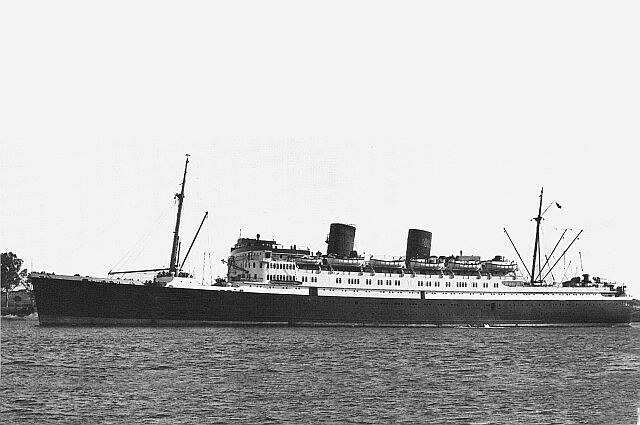
Above
and below: We can clearly see that after the 1939
refit the Awatea had her 4 inch gun fitted up on her deckhouse far aft.
In addition we can see that many of her promenade windows had been covered
in. Obviously this photograph was taken prior Captain Davey’s
retirement for the Greyhound can still be seen atop the forward mast. The
story regarding the captain and the greyhound is located below under the
heading “Trans-Pacific Details.”
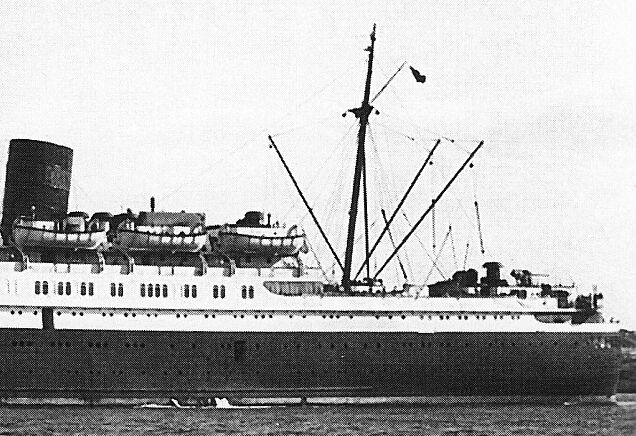
Note
the gun aft
When completed she first
returned to her regular Trans-Tasman services. Then with the loss of the USSCo
Trans-Pacific liner SS Niagara on June 19, 1940, it was decided for the Awatea
take over her Pacific service, sailing from Sydney,
via Auckland
and Hawaii
to Vancouver
Canada. However, before she headed for Canada
she was first sent to Manila
to transport a 1,000 women and children who had been evacuated from Hong Kong.
Trans-Pacific
details: She finally
departed on her first Trans-Pacific Voyage from Auckland
on September 10, 1940, with Australian and New Zealand
airmen all bound for Vancouver.
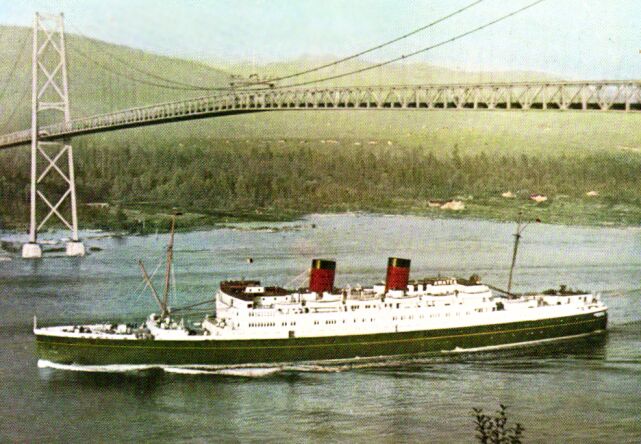
The
TSS
Awatea
is seen passing under the relatively new Vancouver
Gate
Bridge
However, soon after commencing
the Pacific service Captain Davey
decided to retire, which was mostly due to health problems as he was suffering
badly from arthritis in his legs. USSCo decided that the famed Greyhound would
be presented to him at his farewell, and he placed it above his door of his
home.
Awatea made two
more return Pacific voyages, after which she made a voyage transporting with
troops to Ceylon
(today’s Sri Lanka).
This voyage was in a convoy that included a good number of famous ships, such
as the grandest of all the “Grey
Ghost”,
being the Cunard Liner, now the troopship Queen Mary, as well
as the ultra luxury Shaw
Savill
liner Dominion Monarch and the superb Aquitania,
thus the Awatea was in good company. Having completed this voyage she made two
further voyages to Vancouver,
with the last being a one way to Vancouver
for she would remain there being requisitioned into the war officially.
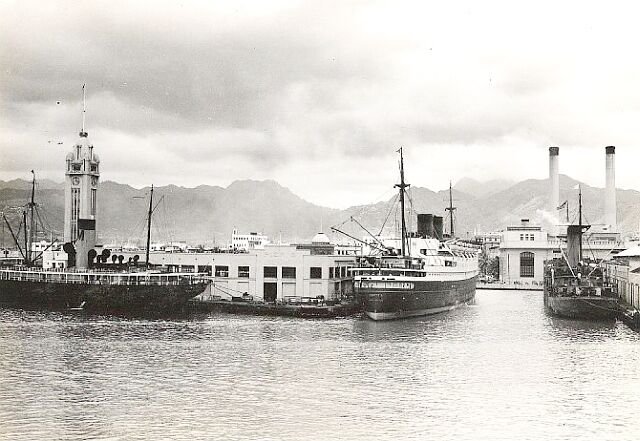
The
Awatea (middle) is seen here in Honolulu
in the shadow of Aloha
Tower
– but berthed at Pier 8
Note
her aft gun
Whilst in Vancouver
on September 1941, the TSS
Awatea
was officially requisitioned by the British Ministry of War & Transport and
she was ordered to sail for Britain
where she would be converted to become a troopship. Before departure she was repainted
in the traditional wartime grey.
Having departed Vancouver
on September 11, and only six hours after departure, she had the misfortune to
suffer considerable damage to her portside when she was rammed very early in
the morning by the 5,000-ton American tanker Lombardi just
off the Victoria British Columbia. This collision cased three
long gashes on her portside, one of which had quite a large hole, but all were
thankfully above the waterline.
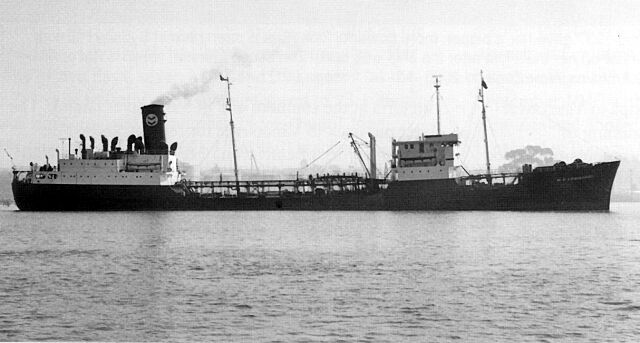
The
American tanker Lombardi
Photographer
unknown - *See photo notes at bottom of the page
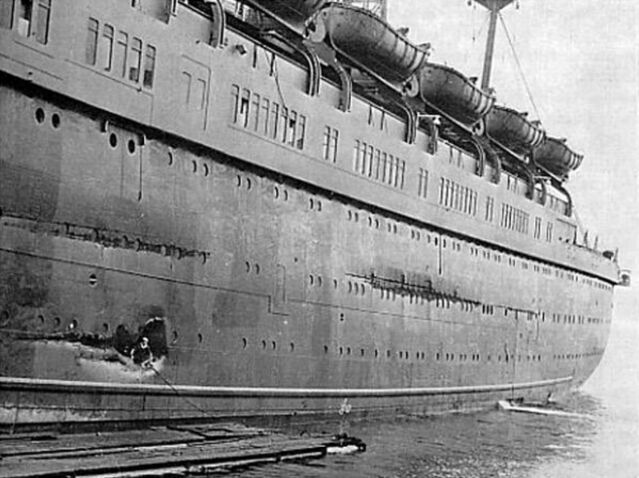
Damage
can be seen along her portside after the collision
Photographer
unknown - *See photo notes at bottom of the page
Awatea headed back to Vancouver
in order to make repairs and it was decided by the Ministry of War to complete
her conversion into a troopship in Vancouver
in order to save time and obviously cost.
Her New Zealand
crew had already decided to remain on board their much-loved ship for the war
effort.
It was announce that her first task would be
to take two battalions of Canadian troops to join the British and Indian
garrison which was based in Hong Kong, and with her conversion completed she
departed Vancouver
bound for Hong Kong
on October 27, 1941, with troops of the Winnipeg Grenadiers and the Royal
Rifles of Canada. For this voyage the Awatea was accompanied by
another former liner that had been converted as an Armed Merchant Cruiser, the HMCS Prince Robert
that in addition to other duties also transported a company of the “Royal
Rifles.” Both ships arrived safely, but sadly out of the 1,975 Canadian
troops that disembarked in Hong Kong on November 16, 1941, some 250 would die
in a horrific two week battle for the city, and another 300 more would lose
their lives in the prisoner of war caps due to the extreme brutally that was
experienced by the hands of the Japanese in the time of their captivity.
Awatea continued on a number of voyages, most
of which were in convoy and considered unremarkable.
Sergeant Ronald
Leslie
Barton:
I received an
email from Clive Barton who lives in Hertford in the UK, who told me that his
late Father, Sergeant Ronald Leslie Barton from Wivenhoe
in Essex, sailed on the HMNZS Awatea, which departed from the in UK in March
1942 and sailed via Cape Town and Durban to Bombay as he was to be stationed in
Palam India for the next few years as a Military
Policeman in the RAF.
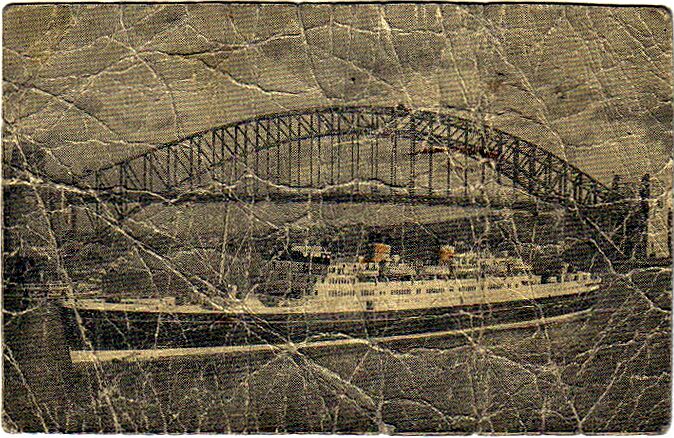
This
(crumpled) postcard was sent home by Sergeant Ronald
Leslie
Barton
on his way from the UK
to Bombay
in April 1942
Provided
by his son Clive
Barton
Whilst on
the way to India,
he sent home a colour postcard of the Awatea whilst the ship was in Durban.
Written on the back of the card is “Awatea Durban, April 1942.”
Although when Clive
discovered the card, it was terribly faded and very crumpled. Therefore upon
receipt of the faded image I used Photoshop and restored some of the original
colour, but left the crumpled effect, but I did remove some badly damaged
sections at the bottom right corner of the card.
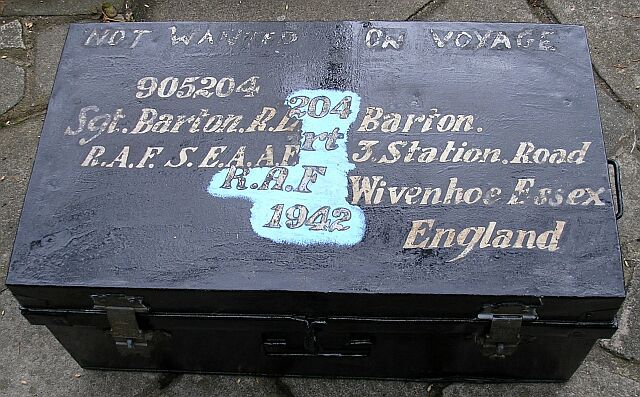
This
is Sergeant Ronald
Leslie
Barton
cabin trunk, which has been retained by the family to this day!
Provided
by his son Clive
Barton
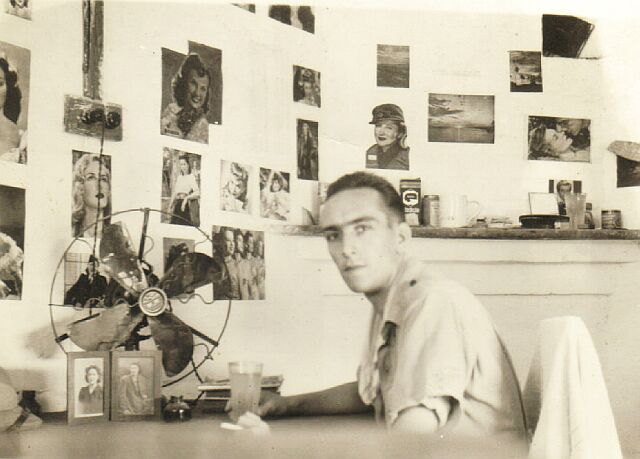
Sergeant Ronald
Leslie
Barton having glass of cool lemonade made with limes
On
the back of the photo it reads “Taken in my bunk (room) at Palam (India)
Sept, 1944”
Provided
by his son Clive
Barton
Collisions
at Sea:
On
August 22, 1942, the Awatea was on her way to Greenock,
Scotland
from Halifax,
Nova Scotia
as part of Troop Convoy AT-20, when she was involved in a terrible accident.
The convoy was proceeding in thick fog, when one of her escorts, the American
destroyer the USS Buck, accidently crossed too closely in front of the Awatea,
causing the USS Buck to be almost sliced in two. The American destroyer USS Ingraham was sought to come and assist and investigate,
however, believe it or not, this ship also crossed in front of yet another
ship, being the navy fleet fuel ship, USS Chemung
causing her to be rammed and this accident cost hundreds of lives. All this
certainly does not say much for US Navy efficiency, does it?
God help us if we have to rely on the USA
in a war situation?
The USS Ingraham
capsized and exploded and tragically 250 of her crew were lost, with only 11
men surviving. Another 7 men died from the USS Buck died. Both the Awatea and
the Chemung were damaged in the collisions, and the
USS Chemung had also caught on fire, however her crew
fought the fire valiantly during night and were able to control it.
The next morning, USS Chemung
took the helpless USS Buck in tow and they headed back to Halifax
in the company of two escorts, being the USS Bristol and the USS Edison. The
New Zealand liner Awatea, although being damaged and with a hole in her side,
the crew first emptied fresh water from their tanks to make her ride higher in
the water, and she had to leave the scene as directed by the US Navy as Awatea
had over 5,000 troops on board. However this meant that left the safety of the
convoy in order to head back to Halifax,
thus during the first stage of her voyage, Awatea was left completely alone,
unlike the American ships, which were given escorts. Thus the Awatea became a
“sitting duck” for any German U-boat that patrolled the Pacific.
Thankfully, in due course the Royal Canadian Navy corvette, the HMCS Kamsack became the first escort to come to escort the
Awatea, thank God for the Canadians! But even then Awatea’s
situation was still dangerous. All on board were very relieved when further
escorts arrived and escorted this great New Zealand
liner safely into port to be repaired, after her second collision at sea!
Awatea Final Days:
In
November 1942, the Awatea was one of the troopships that took part in one of
the most dangerous operations that was named: “Operation Torch.”
This would include landings in North Africa.
The first two days of these extensive landing operations would be extremely
risky for all the merchant ships involved, and this was due to insufficient Allied
air cover to protect them. And this fact became very obvious when it came to
the New Zealand
liner Awatea, which received little to NO protection whatsoever!
Tragically this once great liner Awatea was about to become one of Operation
Torch’s victims at sea on November 11 1942, being the first day of the
landings at Bougie Algeria.
This story and photographs will cover her
final days.
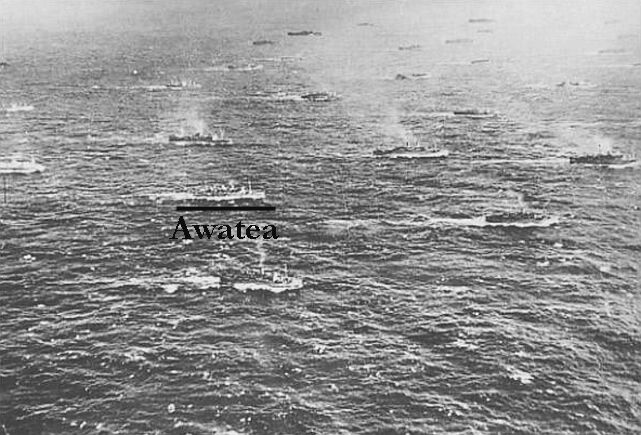
The
final voyage of the Awatea
Photographer/source
unknown - *See photo notes at bottom of the page
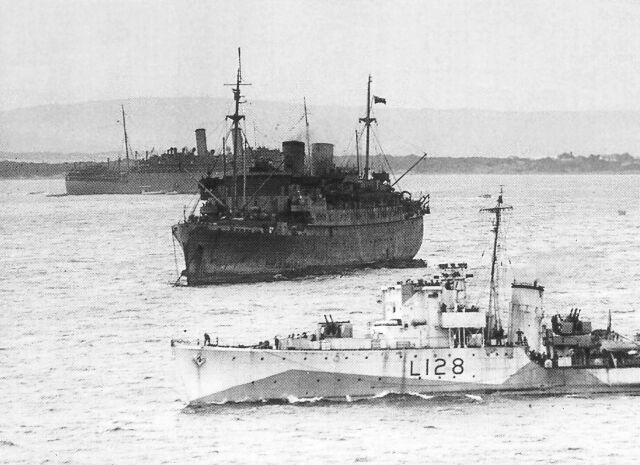
This
is the very last photograph ever to be taken of the Awatea. It was taken three
days
before the tragic day, when she was
bombed and torpedoed by the Germans and Italians
Photographer/source
unknown - *See photo notes at bottom of the page
Regarding the photograph
above: In front of the Awatea we see the HMS Wilson,
which is a “Hunt Class” type 2 Escort Destroyer. Behind Awatea we
see the Orient Lines 20,000-ton RMS
Oranto.
Other ships that were close to her that day by were: HMS Keren,
and the much-loved Australian liner, TSMV Bulolo, which by then had become the
Royal Navy’s first Landing Ship’s Headquarters. All of these ships
thankfully survived the war.
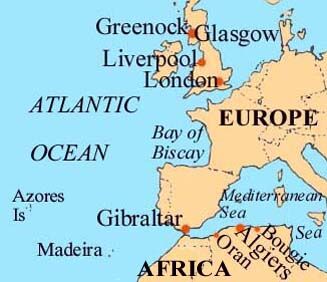
Map
showing the port
of Bougie
in Algiers
On November 8,
1942 the Awatea took part in Operation Torch, which was according to the war
records, a successful Allied invasion of French North Africa. After landing
some 3,000 commandoes near Algiers,
the Awatea ferried more troops further east.
Then on the night of November 11, just off Bougie, the troops had disembarked and stores and equipment
were being discharged when enemy aircraft attacked and dropped two bombs close
by the Awatea. The attack was driven off by concentrated fire from the ships,
but soon afterwards four bombers came in from seaward at low level. One
aircraft was definitely shot down by gunners from the Awatea, and another was
badly damaged by other ships. Having completed discharging, the Awatea was
under heading for the sea when an attack by an unknown number of aircraft
developed. With all her anti-aircraft armament firing the ship had proceeded
about a mile when she was hit in Nos. 1 and 2 hatches by number of bombs which
set the fore end of the ship ablaze.
The helm was ordered hard-to-port with the
object of beaching the ship should it be necessary. But then came two hits by
torpedoes on the port side caused damage and flooding to the after engine room
and put the fire fighting appliances out of action. One bomb, thought to be a
dud, went through the officers' dining room and another struck into the fire
raging in No. 2 hatch. One bomber hit by the ship's gunners crashed into the
face of a cliff and theft fell into the sea. Other aircraft were seen to have
been hit, but did not crash. All guns continued in action till the attack
ceased. By this time the flooding of the
engine-room had caused a list of nearly 40 degrees. The ship carried her way
for a considerable time, but not sufficiently long to reach shoal water. Before
she finally stopped an explosion in the ship was felt. It was thought to have
been caused by the believed dud bomb detonating. The Awatea was now well ablaze
from under the bridge to the bows. When the first bombs hit the ship both the
steel lids of Nos. 1 and 2 hatches were blown into the air, one landing on the
starboard side of the bridge and. the other close to No. 4 hatch on the after
deck. When this hatch lid was in flight one gunner mistook it for a dive-bomber
and opened fire on it. Several near misses by bombs were observed, two of which
shattered much of the forward first class passenger accommodation. The Awatea
was stopped and blazing furiously when she was abandoned. The ship's medical
staff evacuated the sick men from the hospital aft and the crew carried them and
injured men to the boats.
The ship's company were taken off in the five
remaining serviceable lifeboats, and a destroyer which placed herself alongside
the starboard quarter. There was no sign next morning of the ship, as she had
sunk in deep water. Everything possible for the comfort of the Awatea's personnel was done by the companies of several
ships, but especially by those on board the Dutch liner MS Marnix
van St Aldegonda
that had been in the convoy.
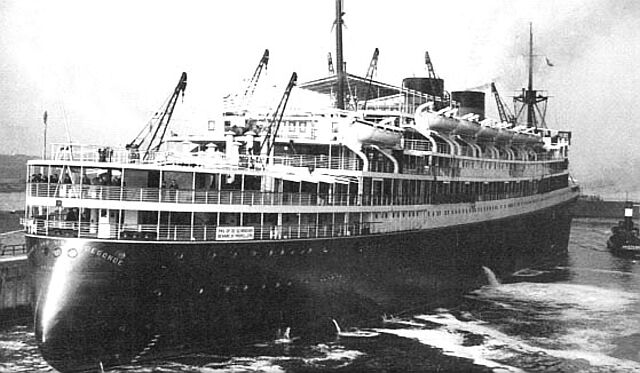
The
Netherland Line - MS Marnix van St. Aldegonde, sister ship to the
MS Johan van Oldenbarnevelt
The survivors taken aboard the
Dutch ship who had been witnesses of another air attack which shook their ship
with a number of near misses. The attack was beaten off by gunners. During the
passage to England Captain G. B. Morgan, D.S.O., D.S.C., master of the Awatea,
presented the master of the Netherlands ship with an illuminated address
recording the appreciation of himself and his crew of the many courtesies and
the great kindness shown them by the Dutch seamen in this the tercentenary year
of the discovery of New Zealand by Abel Tasman.
Later Captain Morgan
and a good number of his officers and crew were awarded decorations for their
bravery and services, whilst others were mentioned in dispatches. It was
certainly remarkable that all on board the Awatea managed to get off the ship
safely, however, as the story is told by those who came home, the ships cat was
killed by a bomb blast.
For all New Zealander’s and
Australian’s alike it was a tragic end for a ship that so has often had
been described as the finest liner ever to fly the New Zealand flag, and to
this day, we can and will attest to this as being a fact!
Memories
of the TSS
Awatea
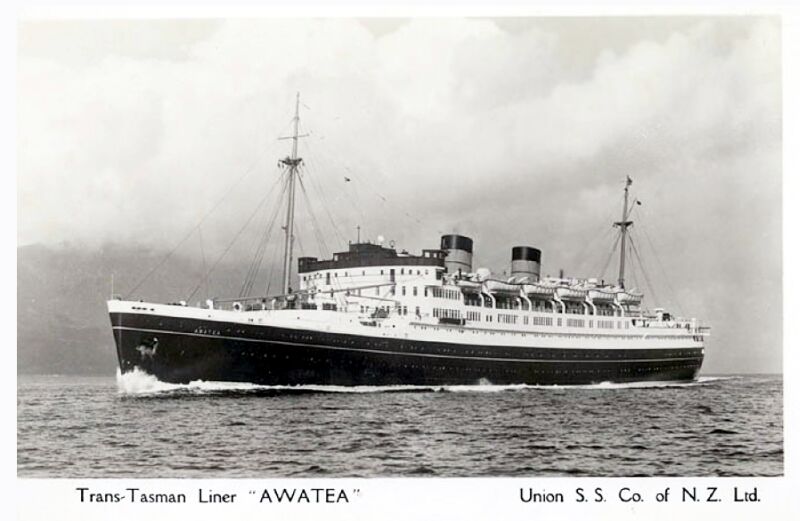
An
excellent postcard of the TSS
Awatea
prior to 1937 and the heightening of her funnels
In Conclusion:
In
all, I can honestly say that the TSS
Awatea
was indeed the finest New Zealand
liner ever to be built. The Awatea successfully delivered countless New Zealand
and Australian air trainees to Canada,
as well as shipping some 2,000 Canadian troops to Hong Kong, and evacuated
civilians from the Philippines
and Singapore.
In addition, she transported British airmen from the UK
to India
and carried several thousand Free Polish troops from India
to South Africa
and during these various missions the ship narrowly escaped German U-boat attacks
in the North Atlantic.
In addition she was involved in several collisions with other ships. Then
finally came that dreaded air attack on November 11, 1942, when she was hit by four bombs, with one bomb causing a fire in
holds No. 1 & 2, and other bombs and torpedoes that followed hit and
flooding the engine-room, causing a list of 40 degrees that finally sunk
her. But thankfully, there was no loss of life!
During her short of life at sea the Awatea
steamed 576,132 miles, slightly more than half during peacetime, including 225 Tasman
crossings. In her day the Awatea provided the “Acme of maritime speed and
comfort” and she will always be remembered with these two quotations:
“Queen of the Tasman”
& “The Greyhound of the Tasman Sea.”
Awatea
seen arriving in Auckland
From
an unknown source - *See photo notes at bottom of the page
***********************************
Also view other USSCo Passenger
Ships online, from oldest to the last ever built
SS Waitaki / SS Moeraki &
Manuka / SS Marama & Maheno / SS Tofua
RMS Aorangi / TSS Monowai / TSS Awatea / MV Matua & MV Tofua
***********************************
Liners sailing to the
distant shores.
I watched them come, I watched them go and I watched them
die.”
Return to the ssMaritime MAIN INDEX
ssMaritime.com & ssMaritime.net
Where you will discover over 1,350 Classic
Liners & the 1914 built MV Doulos
Story
The
Author has been in Passenger Shipping & the Cruise Industry for over 60
years!
Please
Note: ssmaritime and associated sites are 100%
non-commercial and the author seeks no funding or favours of any shape
or form, never have and never will!
Photographs on ssmaritime and associate
pages are by; the
author or from the author’s private collection. In addition there are
some images that have been provided by Shipping
Companies and private photographers or collectors. Credit is given to all
contributors. However, there are some photographs provided to me without
details regarding the photographer/owner concerned. I hereby invite if owners
of these images would be so kind to make them-selves known to me (my email
address may be found on www.ssmaritime.com only),
in order that due credit may be given.
This notice covers all pages; although, and I have done my best to ensure that all
photographs are duly credited and that this notice is displaced on each page,
that is, when a page is updated!
ssMaritime is owned & © Copyright by Reuben Goossens - All Rights Reserved