Please Note: Firefox and some other search engines are not suitable
– Use “Internet Explorer” for this page to load perfectly!

Click the logo above to
reach the ssMaritime FrontPage for News Updates & “Ship of the Month”
With Reuben
Goossens
Maritime Historian, Cruise‘n’Ship
Reviewer, Author & Maritime Lecturer
Please Note: All ssMaritime and other related
maritime/cruise sites are 100% non-commercial and privately owned. Be assured
that I am NOT associated with any shipping or cruise companies or any
travel/cruise agencies or any other organisations! Although the author has been
in the passenger shipping industry since 1960, although is now retired but
having completed around 680 Classic Liners and
Cargo-Passengers Ships features I trust these will continue to provide classic
ship enthusiasts the information the are seeking, but above all a great deal of
pleasure!

Cogedar Lines
MS Flaminia
Ex MS Genova, Capitaine Potie, Belgian Freighter, Empire Swan, Missourian
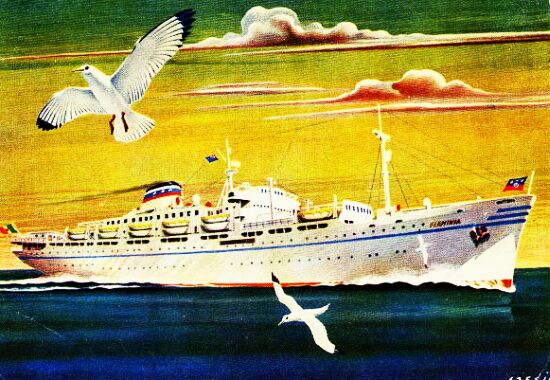
1955 Postcard of the Flaminia issued by Cogedar Lines
*Unless marked otherwise, all
photos/postcards are from the author’s private collection
Page One
One day per email came this request,
“Can you advise me if you have any information on the ss Flaminia
(Cogedar Line) as I sailed on this her - Heaps of stuff on the Aurelia but not
much on the Flaminia.” In response, I decided to add this ship to
ssMaritime and have her story told. It has been said that she was an
“unremarkable and a spartan ship.” This
may be so, but she transported thousands of migrants to
Flaminia was built by the “Merchant
Shipbuilding Corp”
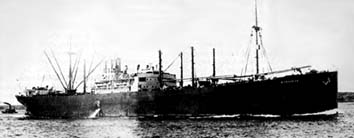
MS
In 1940, she was sold to the British
Government who placed her under the management of Runciman
Ltd who entered her in the British Merchant Navy renamed Empire Swan. In 1942
she was transferred to the exiled Belgian Government based in
In May 1948, Capitaine
Potie was sold to Cia.
Genovese d’Armamento (Cogedar Line) and by the
fact that she was now registered in Genova she was
renamed Genova.
Cogedar sent her to the Monfalcone shipyard in
Trieste for an extensive rebuilding programme seeing holds removed, the
superstructure enlarged, when completed she provided spartan
accommodation for up to 800 third class passengers. In addition, she received a
traditional funnel, certainly making her appearance more pleasing. Ready as a
passenger liner, she commenced a successful service to the River Plate ports in
1949, which lasted for five years.
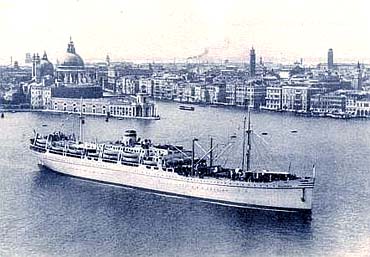
Seen here as Cogedar’s
MV Genova after her first rebuild in 1948/49
In 1954 Cogedar
decided to place her on the Australian migrant service. Again, she received
rebuild at Malfacone Trieste, where her B&W
diesels were removed and replaced by efficient Sulzer diesels. The
superstructure was enlarged even further to accommodate additional public
rooms, deck space and a swimming pool. With additional cabin space, she now
accommodated 1024 passengers in moderate comforts, considering, most cabins had
eight berths. She was renamed Flaminia now being 8,776 ton with a length of
141m, and a breadth of 19m.
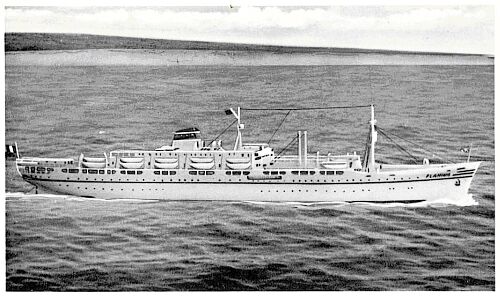
Postcard with an artist impression of Flaminia’s
new forward extensions to be completed in 1955
She departed
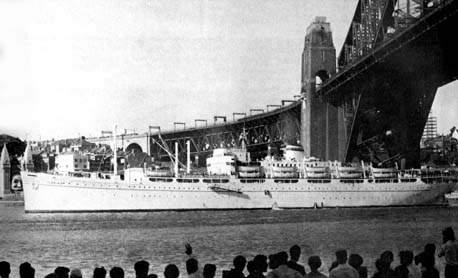
Then, in December 1958, she commenced a new
service, collecting migrants from the
Australian,
Mr. Geoff Archer wrote and told the author that the MS Flaminia transported the
3rd Battalion of The Royal Australian Regiment from Penang (
Flaminia served on the Europe to
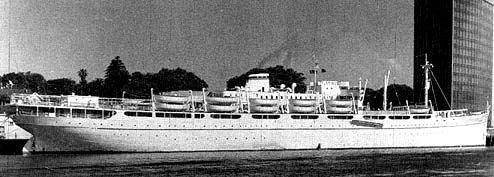
Flaminia berthed at Circular Quay Sydney towards the
end of her Australian service
On her return to
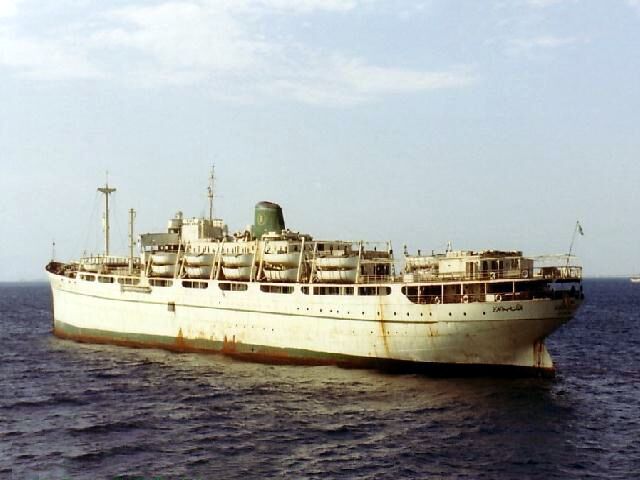
Seen here as the Pilgrim ship MS King Abdelaziz
Photograph by P.W. Hobday
She was used on the pilgrim trade from Jedda, but she ran aground an Algaham
Reef, off Jedda on 30 April 1965. After being
re-floated, she returned to
The Flaminia may have been a modest ship, but
for many of those who sailed on her, most had a happy experience. She took them
to a new land
Cogedar retained the popular Aurelia and the
sleek Flavia on the Australian trade, until
Page One: MS Flaminia History Page
Page Two: A
Holocaust Survivor sails to Australia
Page Three: Lifelong
friends sail to Australia in 1958
Page Four: Ingolf Schreiber’s Voyage in 1960
Also visit:
“Blue
Water Liners sailing to the distant shores.
I watched them come, I watched them go and I watched them die.”
****************************
Visit our ssMaritime
Main INDEX
Where you will discover around 680 Classic
Passenger & Passenger-Cargo Liners!
ssMaritime.com &
ssMaritime.net
Where the ships of the past make history & the 1914 built MV Doulos Story
Please Note: ssmaritime and associated sites are 100% non-commercial
and the author does not seek funding or favours and never have and never will.
Photographs on ssmaritime and associate pages are
either by the author or from the author’s private collection. In addition
there are some images and photographs that have been provided by Shipping
Companies or private photographers or collectors. Credit is given to all
contributors, however, there are some photographs provided to me without
details regarding the photographer or owner concerned. Therefore, I hereby
invite if owners of these images would be so kind to make them-selves known to
me (my email address can be found at the bottom of the page on www.ssmaritime.com),
in order that due credit may be given.
ssMaritime is owned & © Copyright by Reuben Goossens - All Rights Reserved