
Please Note: Firefox and some iPad’s
or iPhone’s, etc are not suitable
Use Internet Explorer or Google
Chrome for this page to load perfectly!
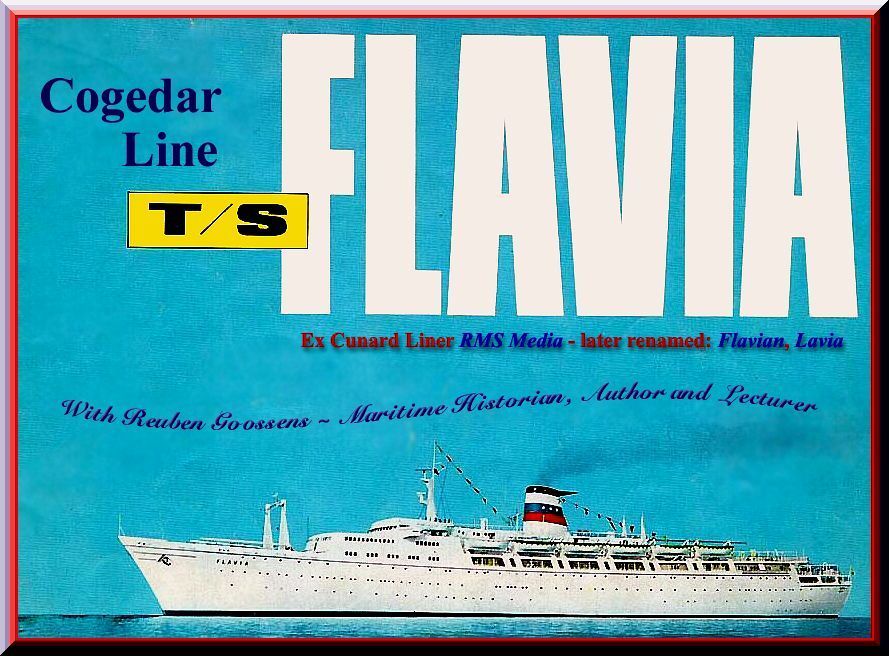
Part
Two
Please Note: If you have arrived here via a Search Engine to see and learn about the T/S Flavia that is great, but if you wish to learn more about her Cunard days, I suggest that you first visit Part One that covers the Cunard Liner RMS Media that was rebuilt to become the T/S Flavia, as well as her sister the RMS Parthia.
The RMS Media had
been sold for £740,000 pounds to “Compagnia Genovese
d'Armamento S.p.A.,” or Cogedar Line in July 1961 but she
continued to her planned Trans-Atlantic schedules until September
30, 1961. She was then “destored” and was officially
handed over to Cogedar Line in
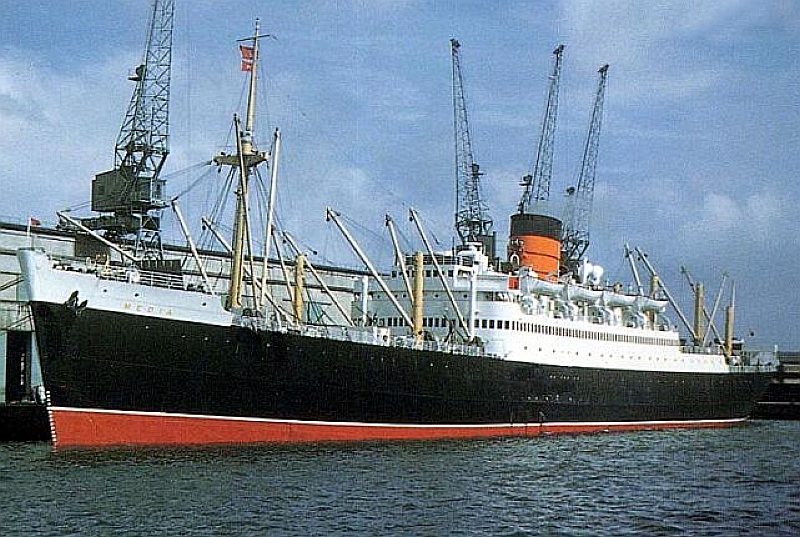
Here we see
the Cunard liner, the RMS Media prior to her being rebuilt
into the
ultramodern looking Cogedar liner T/S Flavia
Photographer
unknown - *See photo notes at bottom of page
Part
Two
The
transformation of the RMS Media
Into
the ultramodern liner … T/S Flavia
The Media arrived
at the “Officine A & R Navi Shipyards” at
This well built passenger cargo liner received
one on the most extensive rebuilding programmes ever seen on any
liner to date that took around ten months. The Flavia
had gained an amazing 26ft - 7.92m in length for her new superbly
raked bow had been completely reshaped and lengthened. In
addition she received a modern new funnel with a large aft fin
being her crowning glory, combined with a shapely radar mast just
aft of her Bridge. All of her previous accommodations had been
scrapped and her cargo holds were completely rebuilt into
passenger decks with new cabins.
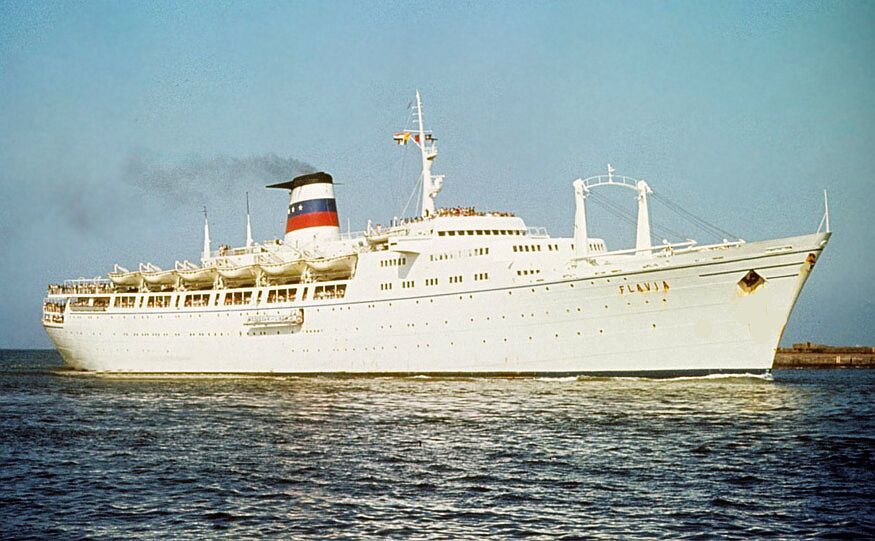
The elegant
T/S Flavia
The completed ship now accommodated up to 1,224 passengers on a One-Class configuration. She offered 153 two-berth cabins, 220 four-berth cabins and five eight-berth cabins; in addition there were some 100 folding bed-settees for children. The majority of cabins had private facilities and each cabin was comfortably furnished in warm timber tones and the floor and wall colours combined with the soft furnishings were all most peaceful!
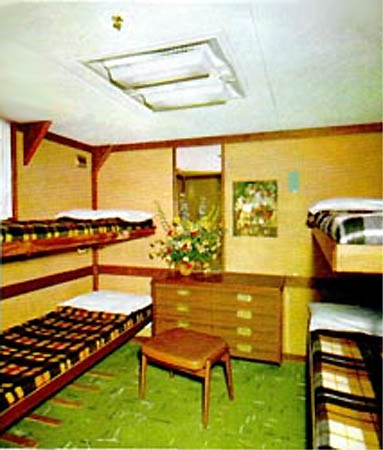
A typical
four-berth cabin, be it one with a porthole or not
Her public rooms extended the full length of
She had been officially been renamed the
Flavia, she was registered in Genoa, and as being 15,465 GRT, and
she departed Genoa on her maiden voyage for Australia on October
2, 1962 sailing via the Suez Canal across the Indian Ocean and
there was no doubt, but as she steamed towards Australia she was
an impressive sight, for she was a beautifully streamlined, a
gleaming white perfectly balanced liner. She arrived in Fremantle
on October 30, then arriving in
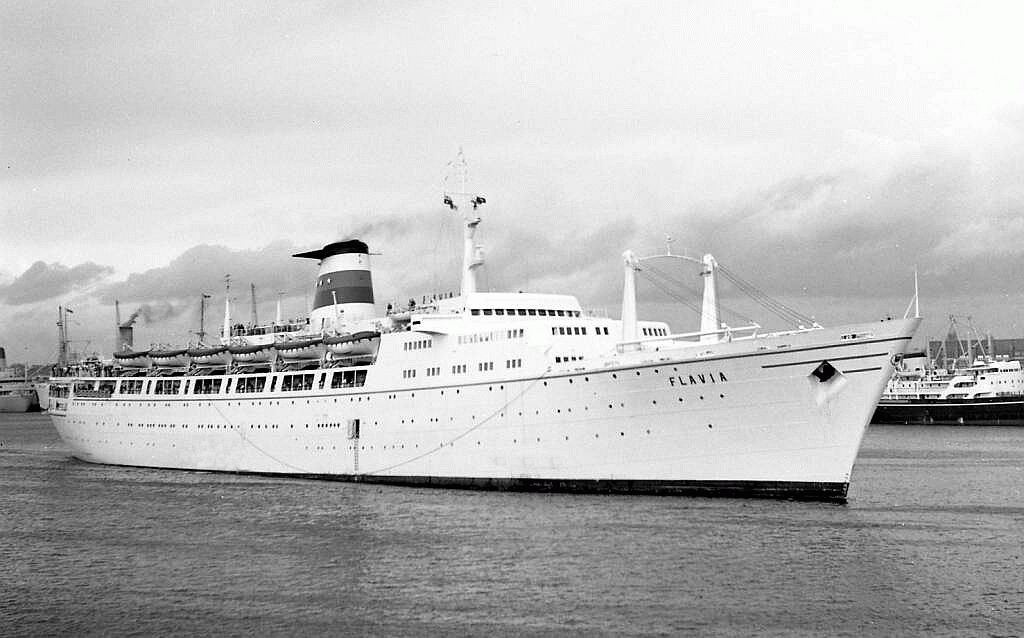
The T/S
Flavia is now a fully operating liner and will be kept busy for
some time
Photographer
unknown - *See photo notes at bottom of page
In 1963 the Flavia commenced her around the
world service and the author sailed on her in February 1965 and
was booked to
The ever popular T/S Flavia also made
a number of cruises out of
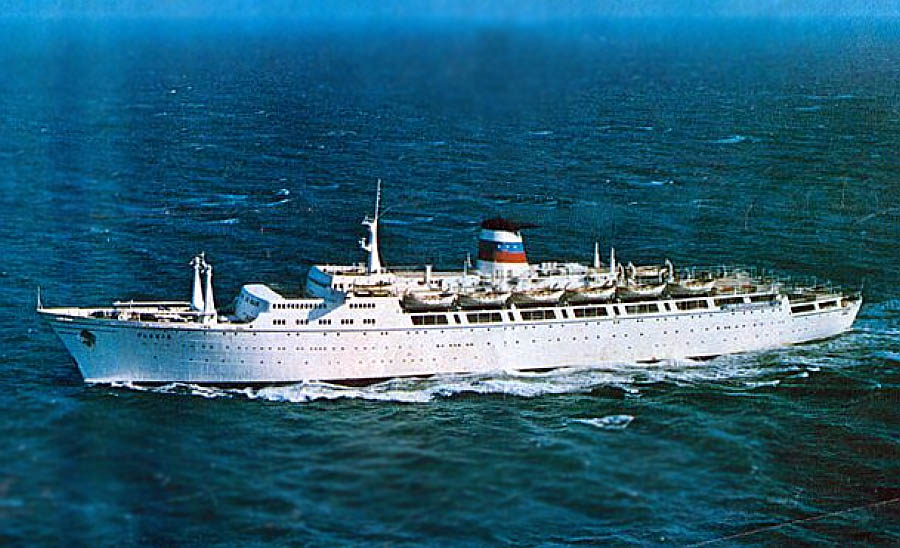
A wonderful aerial photograph of the T/S Flavia
A link to our Photo album is located further down the page
However, the popular Flavia was
withdrawn from the Round the world service in 1968, due to
changes of the migrant contract. She made one final cruise out of
In that same year the Flavia was sold to the giant Italian shipping Company Costa Line. Costa was one of the first companies to operate full time cruising with the historic MS Franca C.
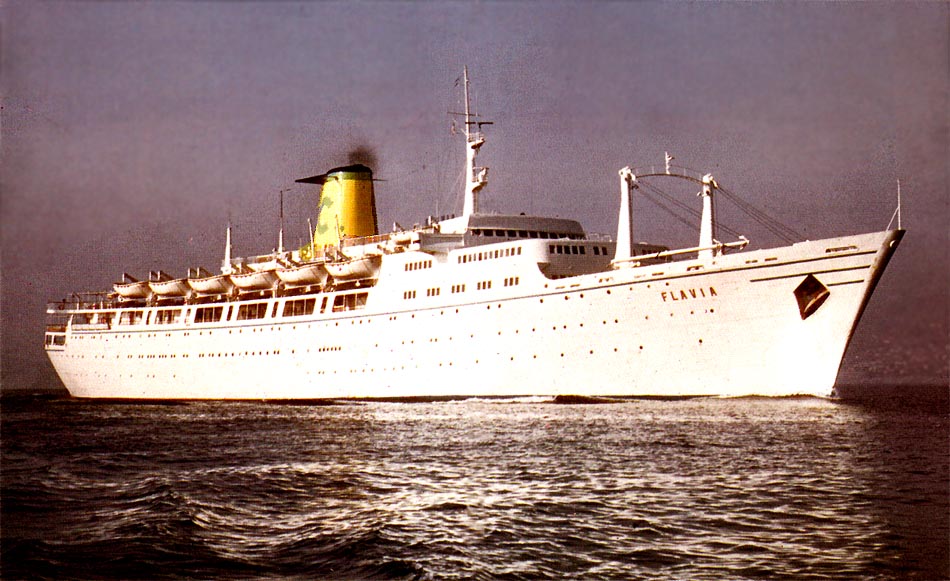
Costa C
Lines image of the T/S Flavia
The Flavia’s accommodation was dramatically upgraded and her passenger capacity was reduced to just 850 passengers, in addition her public venues also received a beautification!
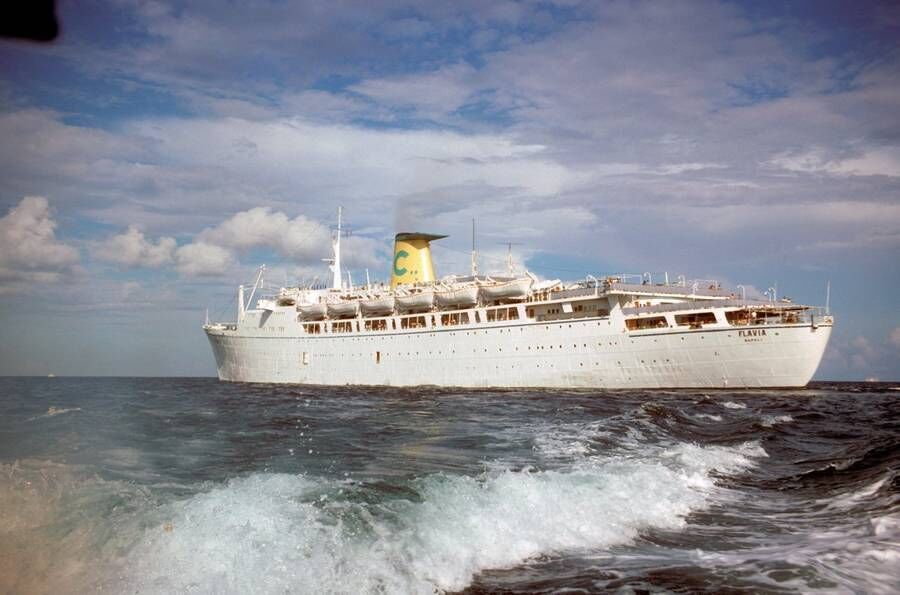
Here we see
the Costa C cruise ship the T/S Flavia that had just departed
This
photograph was taken by a
T/S Flavia began a new and a very
successful career, operating a year round, three and four day
cruises from
However, in 1982 the Flavia was
ultimately withdrawn as Costa was obtaining new ships and
therefore sold her to the well-known
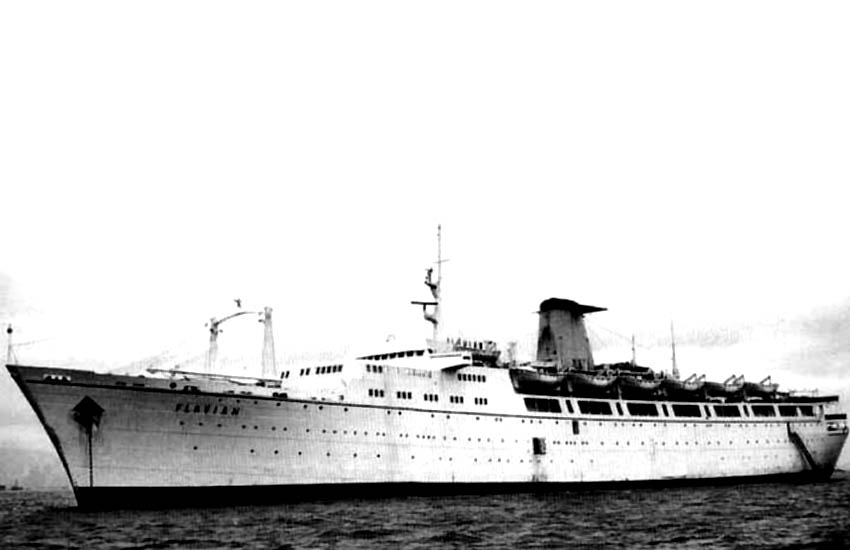
The Flavian was internally well maintained, but she was loosing her external elegance
The SS Flavian was again sold in 1986 to
another
Tragically, this once proud Cunard liner, the
magnificent and elegant looking Cogedar Liner and fine Costa
Lines Cruise Ship, remained at anchor near
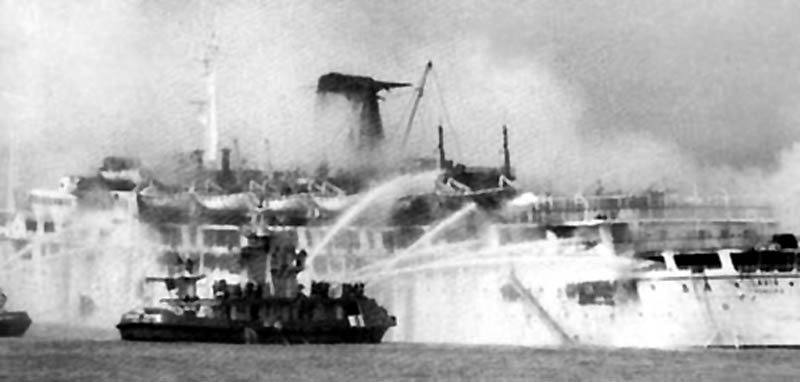
Then, what we may call the inevitable occurred, for on January 7, 1989, the badly neglected SS Lavia caught fire and because she was at anchor away from the shore, it took time for the fire fighter boats to reach her, thus by then she was already almost completely gutted.
When the fires had eventually died out, her sad
blackened hulk was rapidly sold to a Taiwanese ship breaker. For
genuine ship lovers, it was indeed a tragic end for such a
remarkable ship that had such an amazing history!
As I stated earlier, I sailed on this wonderful
ship from
Reuben
Goossens.
Maritime
Historian, Author, Lecture
Commenced
in the Passenger Shipping & Cruise Industry in 1960!
****************************************
RMS
Media & the RMS Parthia
Part
One:
RMS
Media & Parthia and the ship that would become the
Cogedar liner, T/S Flavia.
Part One - B: RMS Parthia. This is a completely separate but related feature that covers the RMS Parthia that became the SS Remuera and later the SS Aramac.
Part
One - C:
SS Remuera Malcolm Walker sails on
Remuera’s final voyage to the
Cogedar’s
T/S Flavia
Part Two: T/S Flavia - History Page
Part Three: The Author’s Voyage in 1965 & Photo Album
Part
Four:
Passenger
Photographs & Menus
Part
Six:
Original Brochure
Other
Cogedar Ships featured on ssMaritime
1: MS Flaminia
2:
MS
Aurelia
“Blue Water Liners sailing to the
distant shores.
I watched them come, I watched them go, and I watched them
die.”
************************
This notice covers all pages, although,
and I have done my best to ensure that all photographs are duly
credited and that this notice is displaced on each page, that is,
when a page is updated!
ssMaritime
is owned & © Copyright by Reuben Goossens - All Rights
Reserved