Orient
Line / P&O RMS / SS Oronsay 1951 - 1975
Please
Note: Firefox & Google Chrome other search engines may not
suitable
Please
use Internet Explorer - Google for this page to load perfectly!

Click
the logo above to reach ssMaritime FrontPage & “Ship of
the Month”
With
Reuben Goossens
Maritime
Historian, Author, Cruise‘n’Ship Reviewer and Maritime
Lecturer
Please Note:
All ssMaritime and other related maritime/cruise sites are 100%
non-commercial and privately owned. Be assured that I am NOT
associated with any shipping or cruise companies or any
travel/cruise agencies or any other organisations! Although the
author has been in the passenger shipping industry since 1960,
although is now retired but having completed well over 700
Classic Liners and Cargo-Passengers Ships features I trust these
will continue to provide classic ship enthusiasts the information
the are seeking, but above all a great deal of pleasure!
Orient Line / P&O Lines
R.M.S. Oronsay
NEW
Features - Fully updated with additional pages
See
the New INDEX at the bottom of the page
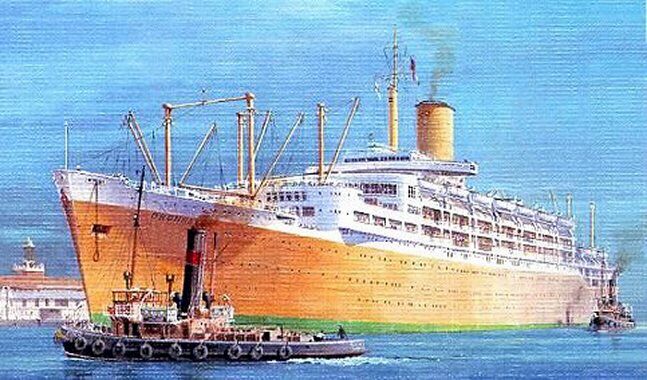
A painting
of the Oronsay
A delightful
painting by an unknown artist
RMS (later SS)
Oronsay was the second Orient Line ship built after World War II,
her earlier sister RMS Orcades was built in 1948. She was named
after an island off the West coast of Scotland, which also
influenced her décor. To enhance her Scottish identity she had a
“Targe and Broadsword” insignia located aft of her
funnel and on her bow. She had the typical Orient livery of a
Corn coloured hull, white superstructure and a black topped
yellow.
Built by
Vickers-Armstrong Ltd at Barrow-in-Furness, especially for the
Australasian service, her accommodations set a new standard, both
in first and tourist class. With the final cost of building
coming in at £4,228,000, she was considered the epitome of
post-war British shipbuilding. Her decor was by Brian O'Rourke
who was also the interior designer for what was called the
“new look” of the Orion, as well as the Orcades.
However, her exterior differed from the earlier Orcades (and the
newer SS Orsova and the last Orient Line ship ever built, the SS
Oriana) having been fitted with a thick mast set atop her Bridge.
Like other passenger liners, Oronsay had considerable cargo
facilities, with space for 370,000 cubic feet, accommodating both
dry and refrigerated cargoes.
Please
Note: Photographs and images on this page are from the
author’s private collection unless otherwise stated!
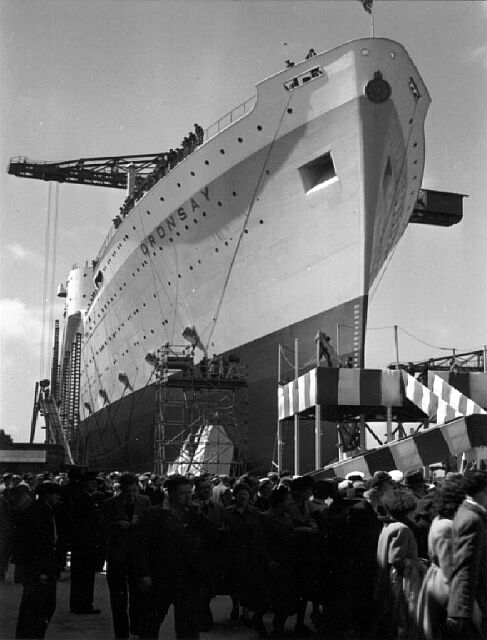
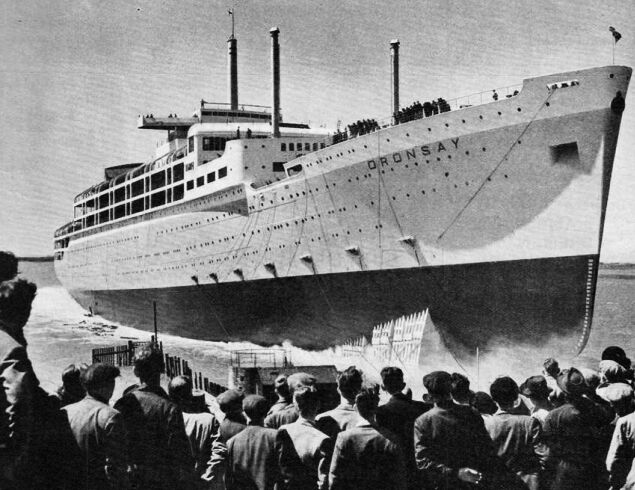
Above
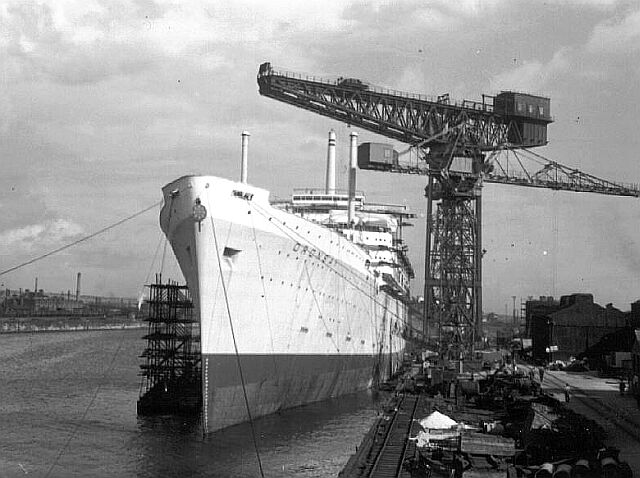
and below: The launching of the Oronsay
Originally issued
by Orient Line – From the author’s private collection
See during
the fitting out process
Originally issued
by Orient Line - From the author’s private collection
Her keel was laid
down in 1949 and was launched of Friday June 30, 1950 by Mrs A.
Anderson, the wife of the Companies Chairman. However, during her
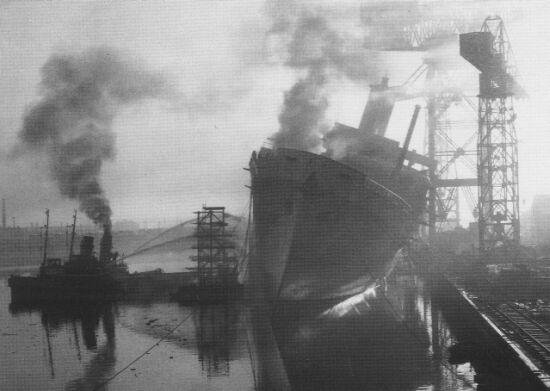
fitting out, on October 28, at 9 pm a fire started in the cork
insulation in the No. 2 hold and it burned for three days. The
ship developed a 20-degree list. As there was a fear of her
capsizing, a hole was cut into the side of her hull to let the
water flow out.
Oronsay
seen on fire and listing to port
From the P&O
archives
In spite of the
mishap, her completion was only delayed by only eight weeks. On
April 29 and 30, 1951, she ran her speed trails on the Clyde
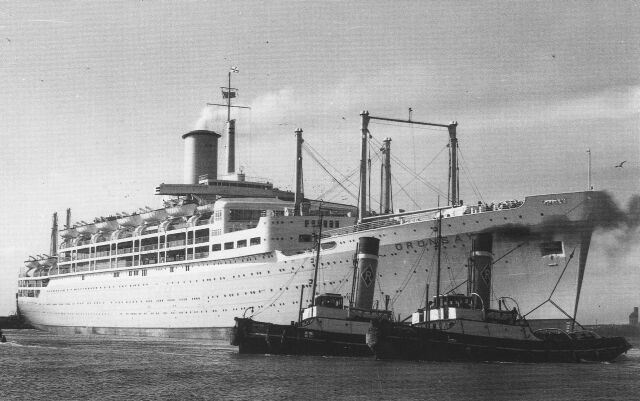
reaching a respectable 23.23 knots. She was officially delivered
to Orient Line at Tilbury on May 3, 1951 and she was made ready
for her maiden voyage to Australia.
RMS Oronsay
being delivered to Orient Line on May 3, 1951
RMS Oronsay set sail
for her maiden voyage to Australia on May 16, under the command
of Captain Shurrock and sailed via the Suez Canal, to Fremantle (Perth),
Adelaide, Melbourne, arriving in Sydney on June 18, 1951
Follow the rest of
her career after her deck by deck as built description.
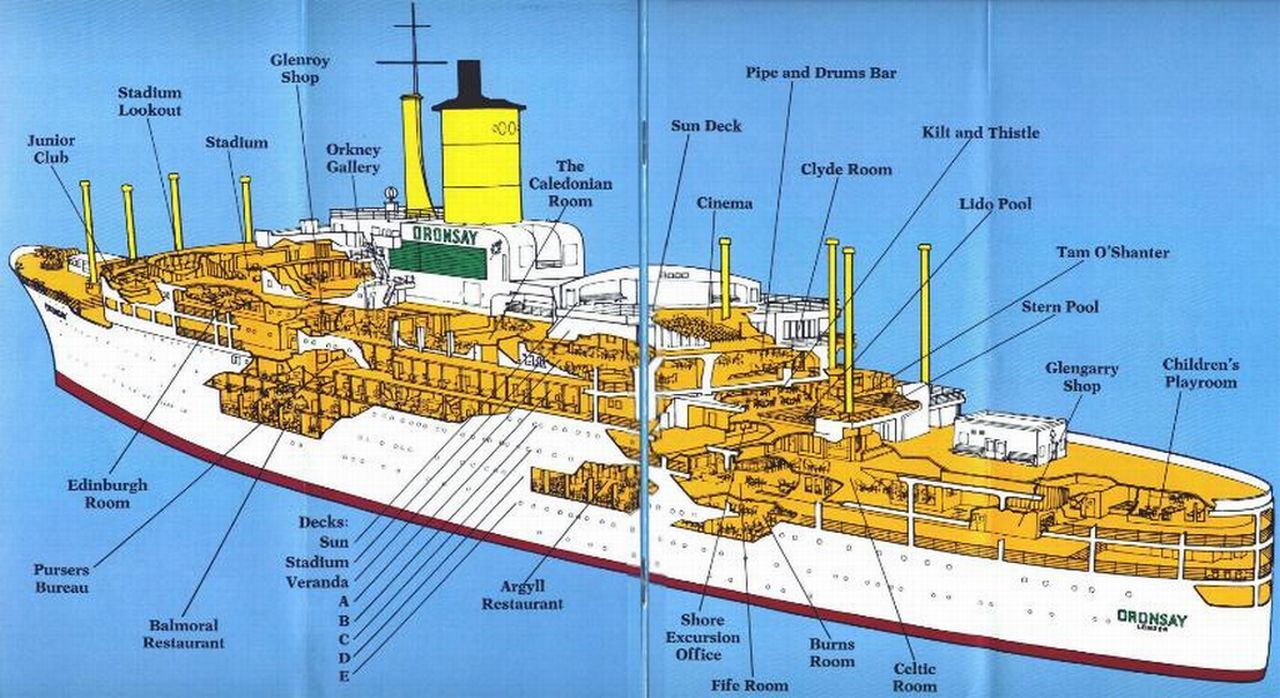
SS Oronsay Deck by Deck Description
Official
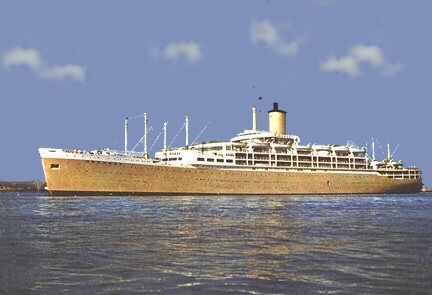
Orient Line Postcard
First Class
Description
of Deck layout starting from forward to aft
First Class
passenger accommodations occupied seven decks forward/amidships.
These were named Bridge, Sun, A, B, C, D, E and F decks. Please
Note; her Two Class Deck Plan is now online. See the links at the
bottom of the page.
Bridge Deck
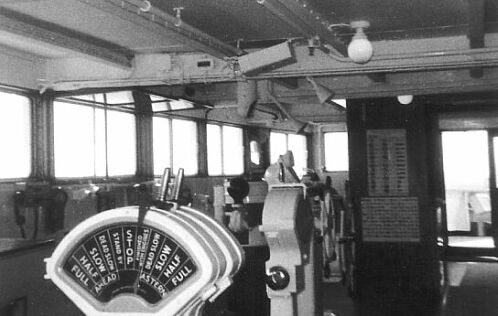
The Bridge
Sun Deck
This was a popular
area for both games and enjoying the sun protected by a screen
located forward. This deck could only be reached by stairs port
and starboard.
A Deck
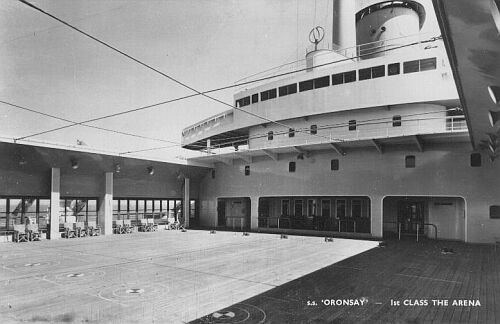
The Arena
Forward was the
popular fully enclosed “Arena” Lookout, which was
surrounded by floor to ceiling windows. This was followed by the
Arena, then the Lobby and Library. Amidships was taken up by the
spacious Games deck. Located aft was a lounge and as well as the
Grill Restaurant, overlooking the pool down on A deck.
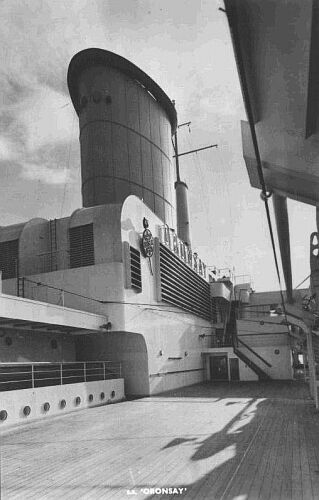
Games Deck
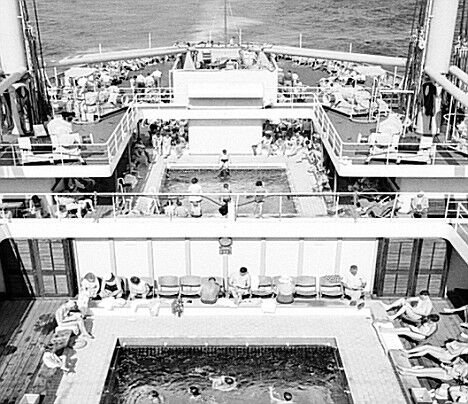
The aft
decks with the First and Tourist Class Pools in view
B deck
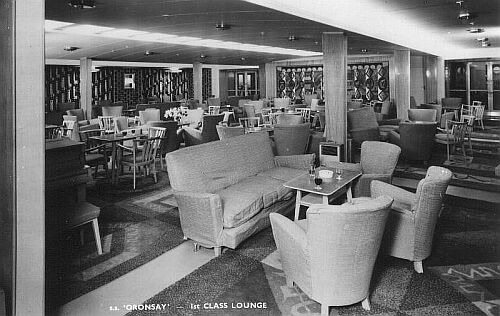
The Main
Lounge
This deck had one of
the two walk around promenades. Far forward was the
Children’s Playroom and play deck, followed by the forward
Lobby and the Main Lounge. Next the Main Lobby and side
Galleries, with the Verandah Bar aft.
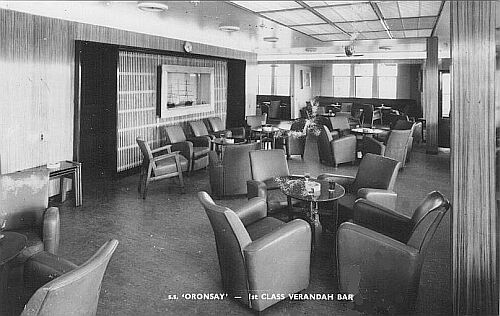
Verandah
Cafe
C Deck
The forward section
was taken up by cabins, the Shop, Hairdressing Salon, with the
Tavern and pool far aft. There was also a full walk around
promenade deck.
D Deck
This deck, except
for the Pursers Office was dedicated to cabins and suites, the
most famous of these being The Flat. Other cabins were one and
two berth cabins, most with private facilities.
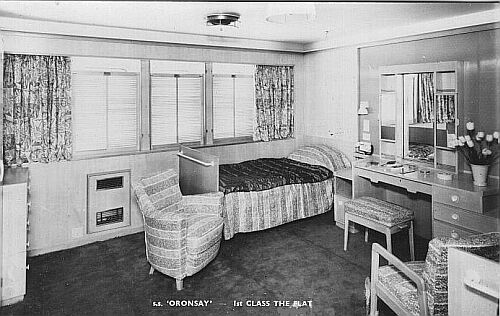
The ships
finest accommodation was known as “The Flat” - being
the deluxe Suite
The Flat
had two bedrooms, a large Lounge and bathroom, a separate WC,
suitable for visitors, even a pantry!
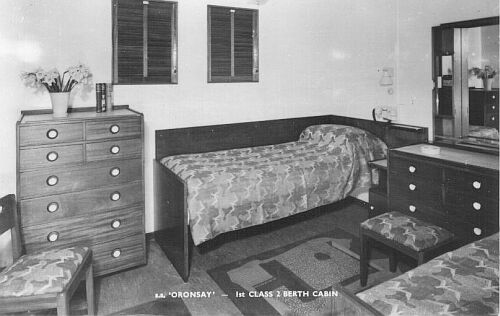
A twin
bedded cabin with two windows
E Deck
This deck was fully
occupied by cabins, and the Main (First Class) entrance Foyer and
the Doctor’s Surgery.
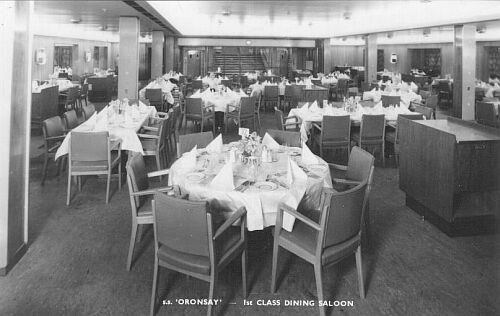
Dining Room
F Deck
Forward section was
occupied by cabins followed by the Main Dinning Saloon, a
separate Children’s Dinning Room (port) and a small
Auxiliary Dinning Room (starboard).
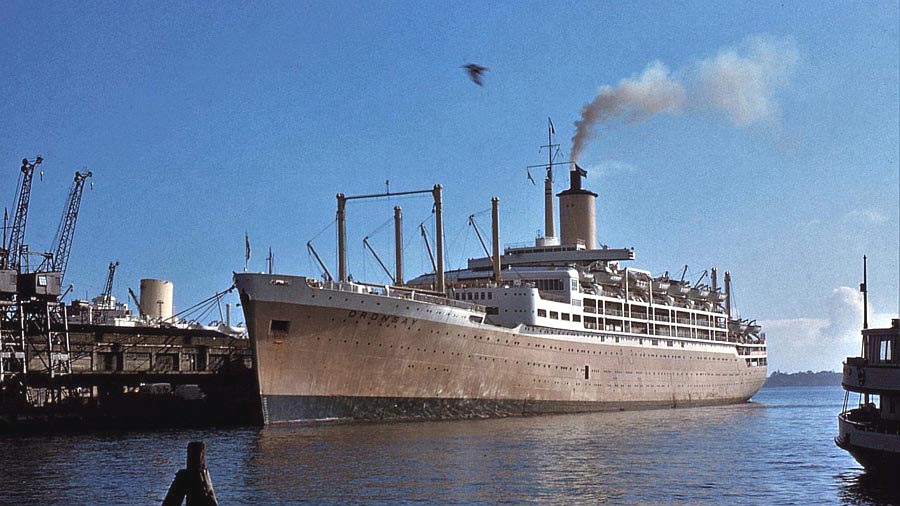
RMS Oronsay
seen at Princess Wharf Auckland New Zealand in August 1958
Photograph
was kindly provided by Geoff Eastwood, but was taken by his Father
Mr. Roger Eastwood
Tourist Class
A
Deck
With First Class
occupying the forward section of the ship, Tourist was located
aft, sharing a number of decks A to E decks. This deck contained
the pool, changing room with showers, sun bathing deck and sports
facilities.
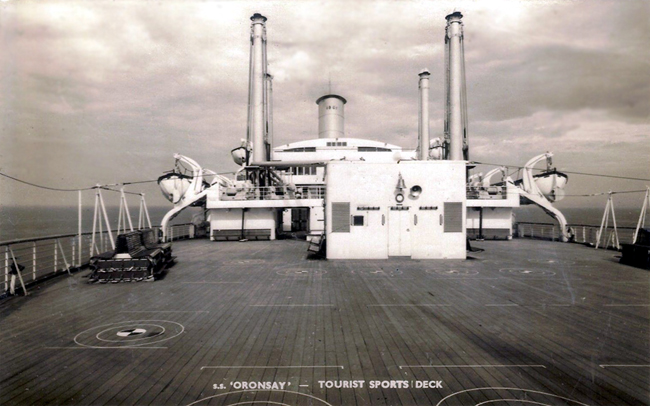
Games Deck
aft
B
Deck
Forward was occupied
with two and four berth cabins, a few with private facilities.
These were followed the main stairwell, and a fully covered
spacious screened Verandah deck with the Upper Promenade on
either side. A Bar located forward on the starboard side. Aft was
the Children’s Play Room and deck.
C Deck
Forward started with
the Pursers office, Surgery, Lobby and Main stairwell. This was
followed by the Main Lounge and Bar as well as the shop aft. On
both sides were the lower Promenade decks.
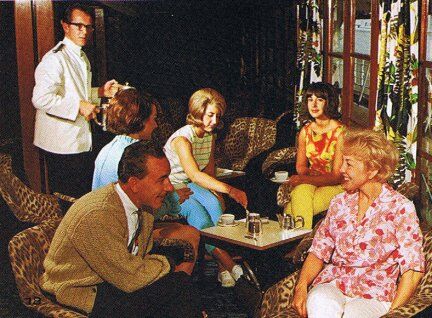
Main
Tourist Class Lounge and Ballroom
D Deck
Aft of the Galley,
was the Tourist Class Dinning Room, followed by the Lobby and a
very large Library. Aft of this were further cabins, most being
two berths, with some having four berths. None had private
facilities.
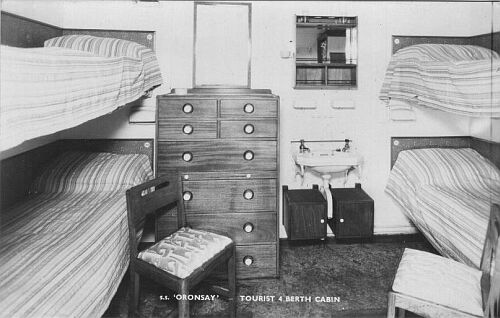
Inside
twin/three or four-berth cabin
E & F
Decks
These two decks were fully occupied by cabins.
Most of these were four berths; however there were some two and
six berth cabins. None had private facilities.
Please Note: As you will have seen, I have no
photos/postcards of the Tourist Class public rooms. If you have
some, I would greatly appreciate some!
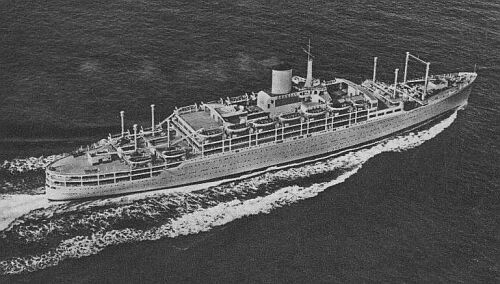
SS Oronsay
at full speed
Speciation’s as
Built
Built by:…………..Vickers
Armstrong shipyard at Barrow-in-Furness
Call Sign:……….GCNB
Tonnage:………….27,632
GRT (gross registered tons) – 28,136 GRT in 1970
Length:…………….708ft
– 216m
Beam:………………93.5ft
– 28.5m
Draught:………….31ft
- 9.4 m
Propulsion:……..Parsons
marine steam geared turbines - 42,500 SHP
Screws:……………two
Service speed:…22
knots.
Passengers:……..668
First - 883 Tourist Class - 1,400 One Class in 1972
Crew:……………….622
Air-conditioning:Fitted
in 1959
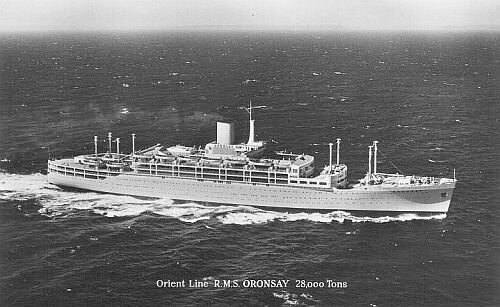
RMS Oronsay
and early Orient Line postcard
RMS Oronsay Fine Career
Oronsay operated the
UK to Australasia service sailing via the Suez Canal. However, on
February 14, 1954 for on January 1, 1954, she would become the
first Orient Line liner to cross the Pacific sailing to San
Francisco via Auckland, Suva, Honolulu, and Vancouver. After
returning to Sydney, she made two further Pacific crossings. In
1960 she transited the Panama Canal completing her first round
the world voyage.
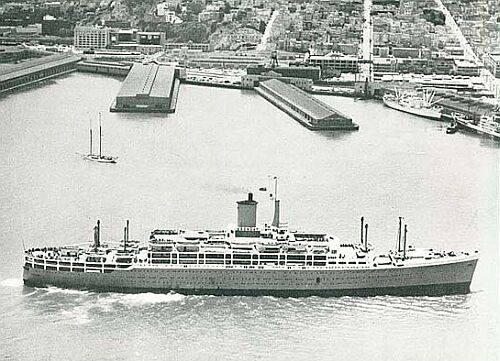
In San
Francisco Harbour
On May 2, 1960,
P&O (Peninsular Orient Line) absorbed Orient Line however
Oronsay retained her traditional Orient Line corn coloured hull
for another four years, until 1964, when in April the hull was
finally painted white and she was the first of the Orient Line
ships to change livery. She departed Southampton gleaming white
on April 18, 1964.
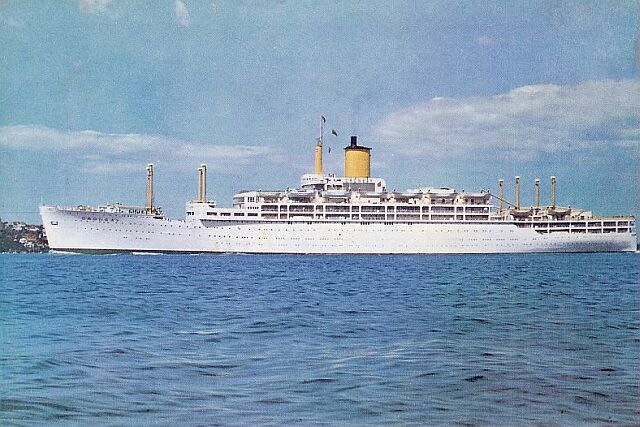
P&O
Postcard of a gleaming white SS Oronsay
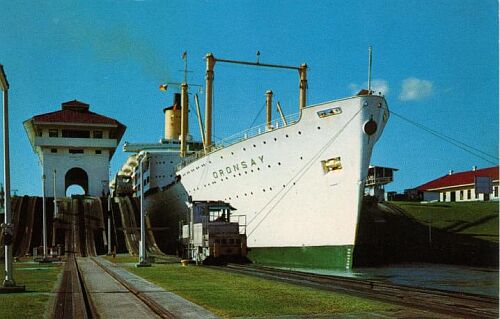
Postcard of
her transiting the Panama Canal after her hull was painted white
in1964
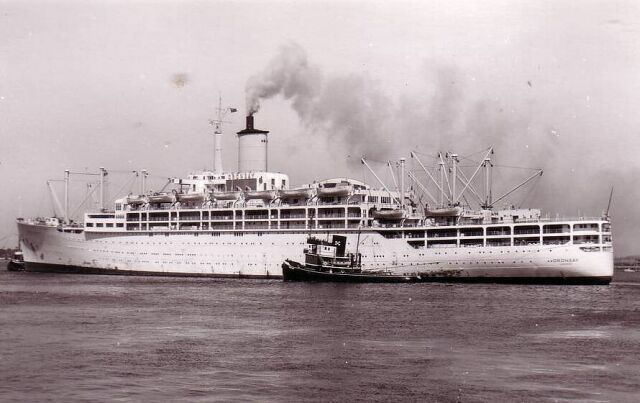
Above
and below: Two fine stern views of the SS Oronsay
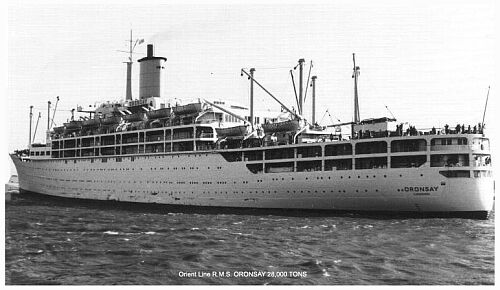
SS Orcades
as seen on an Orient Line postcard
On January 14, 1970
Oronsay arrived in Vancouver but somehow it was said that there
was Typhoid onboard, which meant that the health authorities had
the ship quarantined and anchored out in the harbour. She
remained there until February 4 when she was cleared and was free
to depart. The outbreak was traced down to sewerage pipes that
had been wrongly installed during a recent refit. She continued
operating both Line Voyages and cruises; however from 1973 she
spent most of her time as a cruise ship.
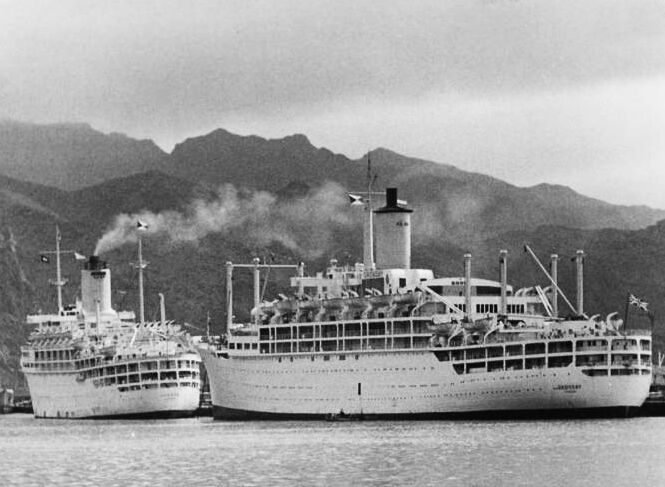
Oronsay and
P&O liner Chusan meet up in Tenerife in the 1970’s
*Photographer
unknown – Please read special photo note at bottom of page
In 1972 Oronsay was
converted into a One-Class Liner, like most of the fleet, now
capable of accommodating 1,400 passengers and she becomes
reasonable success, although it was short lived. There is one
event that many passengers on one voyage will remember is in
March/April 1973 when Rock star David Bowie sailed on the Oronsay
from San Francisco to Yokohama. During the voyage he gave an
impromptu solo acoustic performance for the passengers and crew.
The ship arrived in Yokohama on April 5 to great media fanfare.
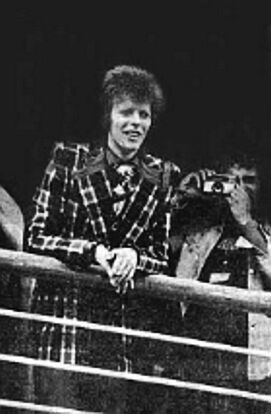
David Bowie
out on deck upon arrival at Yokohama
*Photographer
unknown – Please read special photo note at bottom of page
However, she was
mostly based in Australia and by 1974 it had become obvious that
passenger numbers was in a severe decline with either superior
ships on the horizon, including the SS Oriana as well as the
foreign invasion such as Chandris Lines, Lloyd Triestino, Sitmar
Lines, Flotta Lauro and TSS Fedor Shalyapin of “Celebrity
Club Cruises’ operated by the author” as well as other
Soviet ships operated by CTC, which offered cruises at more
favourable fares.
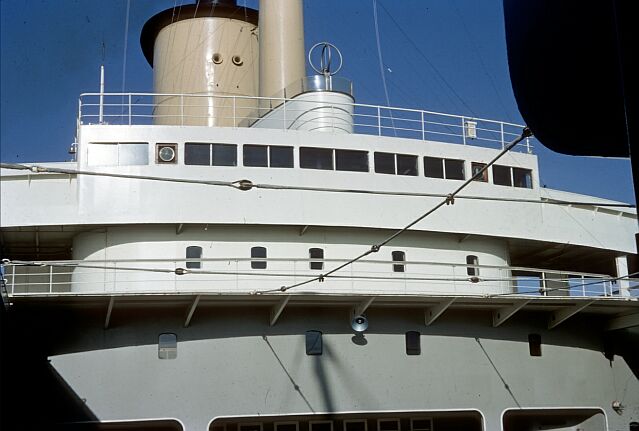
Looking up
to the Bridge from the forward Sports Arena
Photograph by Pam
Franklin – provided by Stephen Moore
Thus, P&O
decided to sell Oronsay and sold her to Nan Feng Steel Enterprise
Company of Kaohsiung, Taiwan. She departed Southampton for Australia
on August 4, 1975 under the command of Captain Jack Lefevre,
sailing to Sydney via Hamilton (Bermuda), Port Everglades, Nassau,
Cristobal, Balboa, Acapulco, San Francisco, Honolulu, Suva and Auckland,
arriving in Sydney on September 15.
Then on September 16
she departed Sydney with some 700 passengers for her final one
way Fly/Cruise to Hong Kong, sailing via Brisbane and Manila,
arriving in Hong Kong on September 28. Her passengers had a
farewell party and left her feeling very sad for she was a fine
ship and many had sailed on her many times, but as soon as they
disembarked, workers came onboard to remove all that had not been
sold (destore) to the breakers and the ship was left looking much
like a lonely and an empty shell.
On October 7, 1975
SS Oronsay arrived in Kaohsiung Taiwan and on the 9th the
transfer papers were officially completed, and she was soon
broken up.
This fine liner that
became known as a ship with a Scottish heritage had called in
total at some 150 ports and had completed 64 world (line) voyages
and 37 cruises and that in her 25 years of operation. But with
her disposal, the sad fact was, that in a little over three years
P&O had disposed of six fine liners; these being the Iberia,
Orcades, Chusan, Orsova, Himalaya, and the now the Oronsay. That
left P&O with just three ships for the Australian trade, the Arcadia,
Oriana, and Canberra.
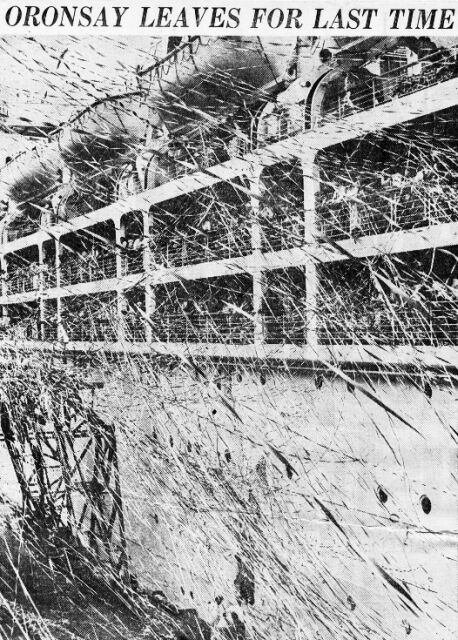
Oronsay
seen on September 16 1975, departing Sydney for her final cruise
to Asia and then to the breakers yard in Taiwan
From the Sydney
Telegraph published the next day - 17 September – provided
by Stan Evans
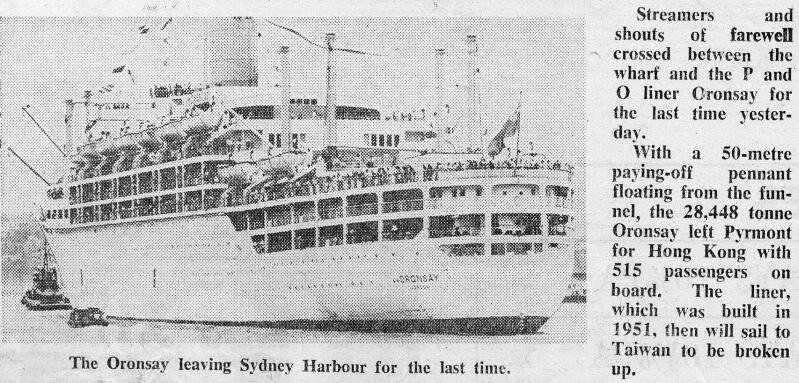
Sydney
Telegraph article and photograph – published on September 17
Provided by Stan
Evans
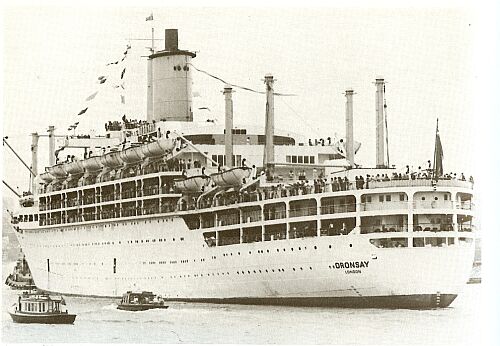
Oronsay
seen departing Sydney for the very last time, bound for Hong Kong
and then Kaohsiung Taiwan
Photographs and Oronsay Memorabilia
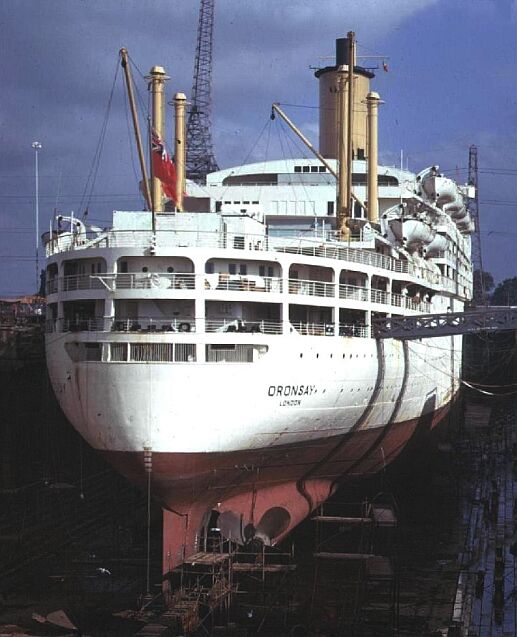
Oronsay
seen in her final dry-dock in Sydney
Photograph
sent in by Peter Thurlow, but believed to be taken by
Chris-Benham
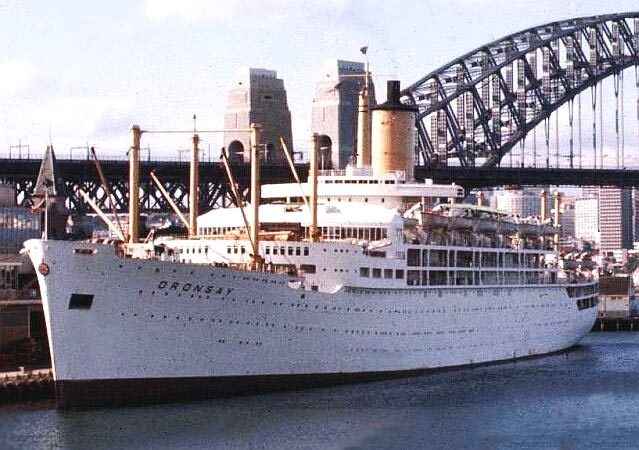
A
wonderful memory of the Oronsay berthed at Circular Quay Sydney
in her latter days
SS Oronsay Memorabilia
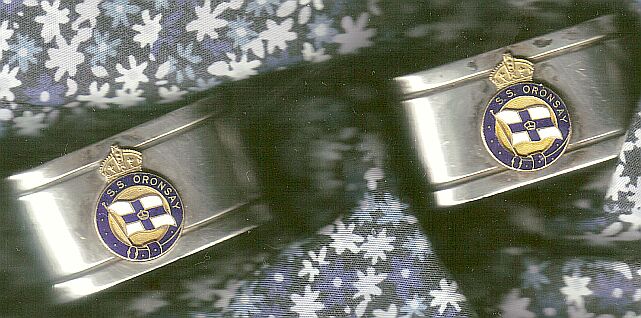
A fine pair
of First Class Silver Napkin Rings
Part of the
author’s memorabilia collection
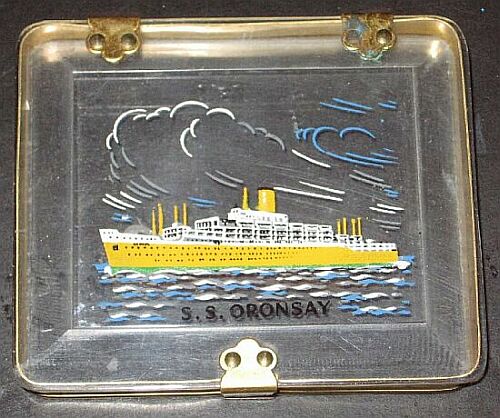
Above
& below: This is a decorative Oronsay cigarette box
Part of the
author’s memorabilia collection
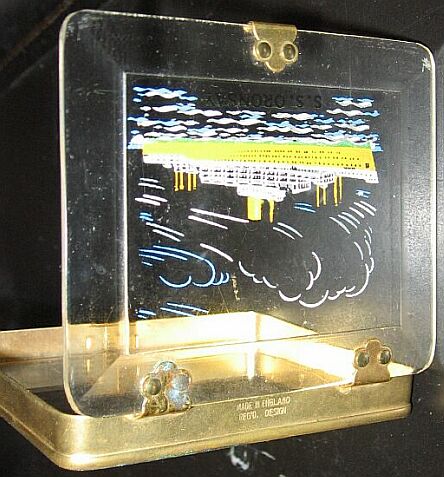
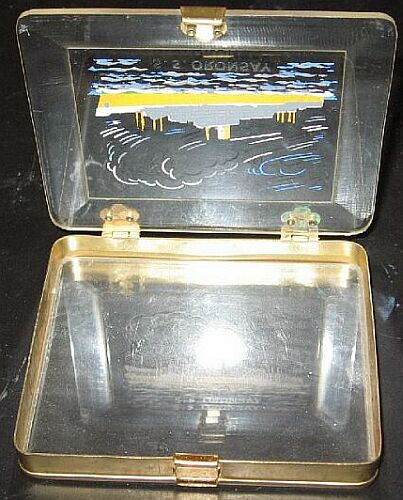
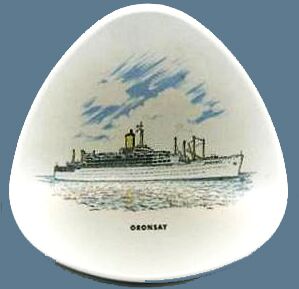
A typical
souvenir dish of the ship
Part of the
author’s memorabilia collection
the author
has a complete set of Orient Line & P&O dishes
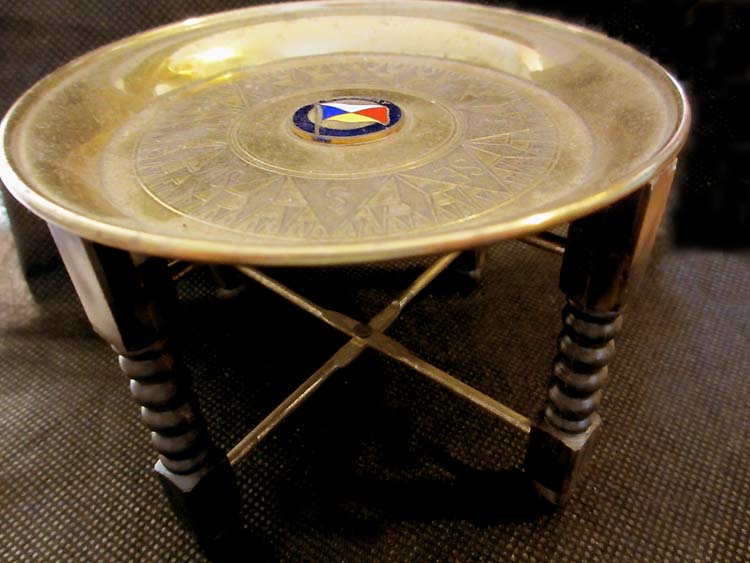
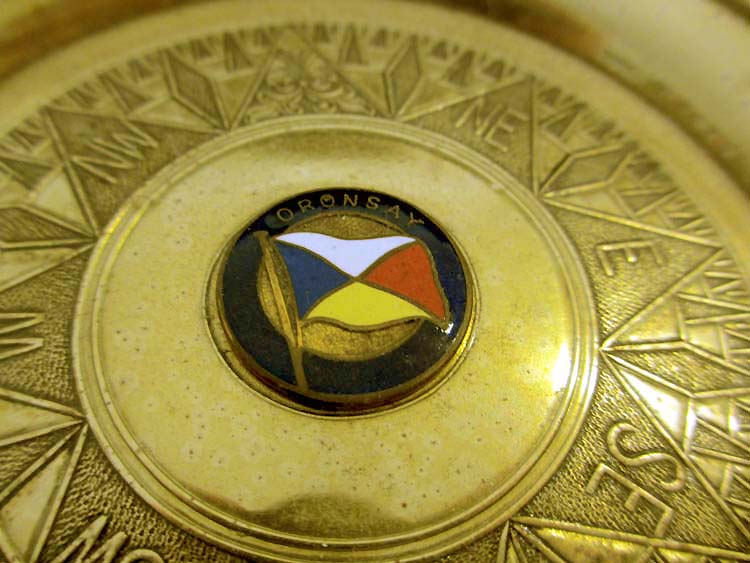
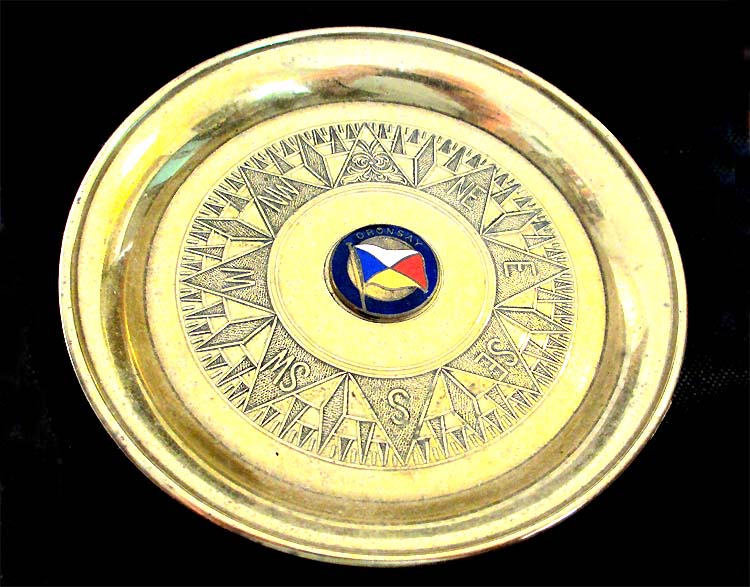
Above
& below: An Oronsay miniature Arab style table, a
souvenir from the mid sixties
Part of the
author’s memorabilia collection
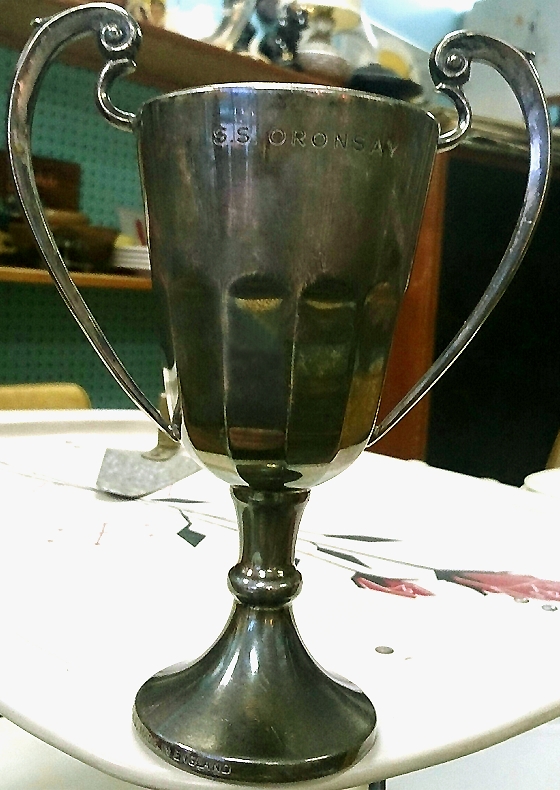
A
beautifully English made silver (EPNS) 7” tall Oronsay
sports Trophy from between 1964 to 1970
Photograph provided
and trophy owned by Steve Tingle
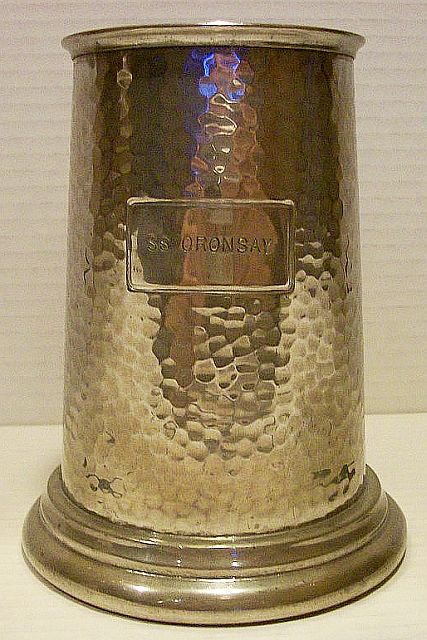
A
delightful SS Oronsay pewter tankard is stamped on the bottom -
"Pewter" and was "Made in Sheffield, England."
Owned and provided
by George Boys
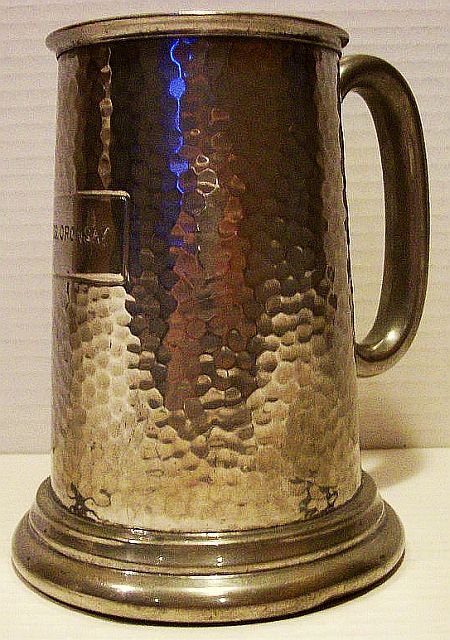
A side view
of the tankard
Owned and provided
by George Boys
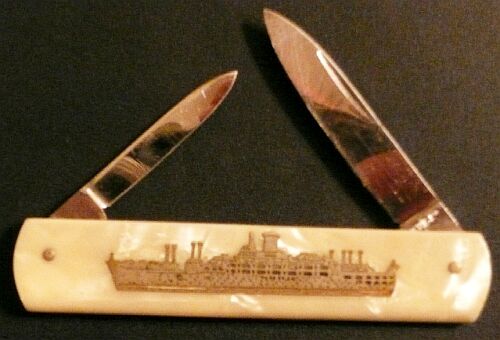
Above
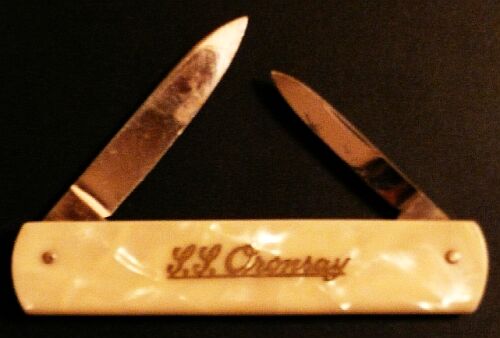
and below: An attractive “pearlite” handle
souvenir folding SS Oronsay knife
Provided by
Ralph-Dellor
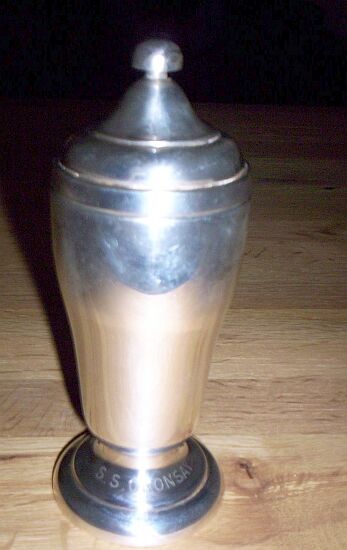
A silver SS
Oronsay cream jar
Provided by Jan
Paulussen
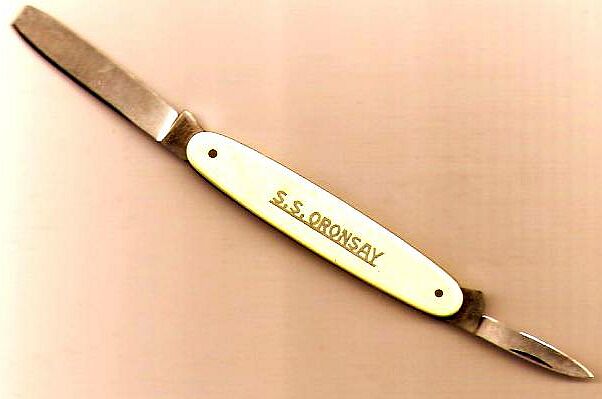
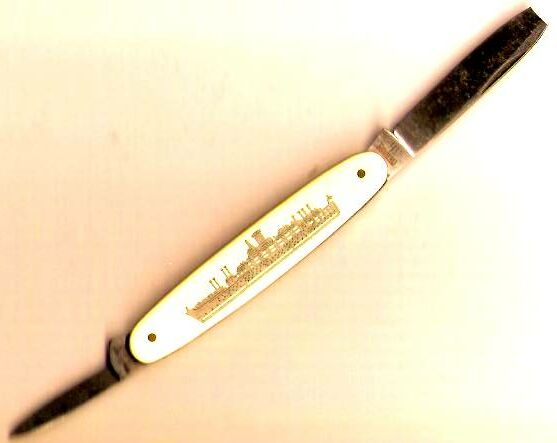
Above
and below: A stainless souvenir steel SS Oronsay folding
knife
Provided by Peter
Harris
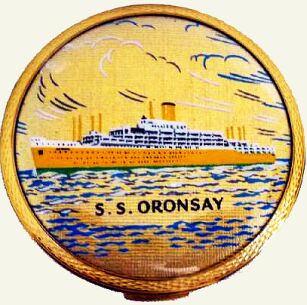
A SS
Oronsay powder compact from the mid 1950’s
From the
author’s memorabilia collection
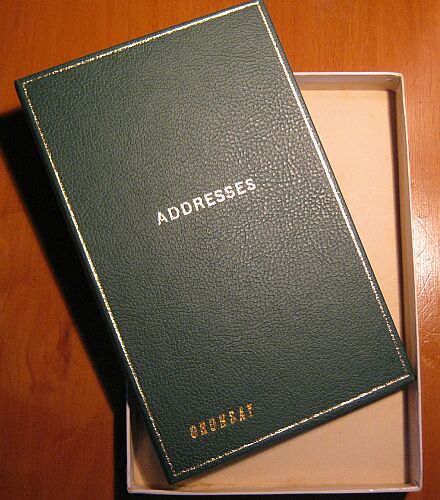
Here is an
SS Oronsay Address Book in original condition, which was obtained
in 1969
Owned and provided
by Vince Lowden
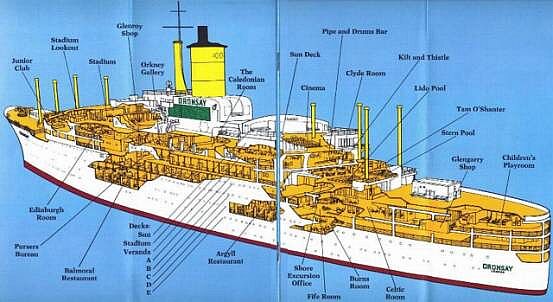
Upon
boarding this fold-up of the SS Oronsay’s new One-Class
layout was given to passengers
Click on the image
for an enlargement
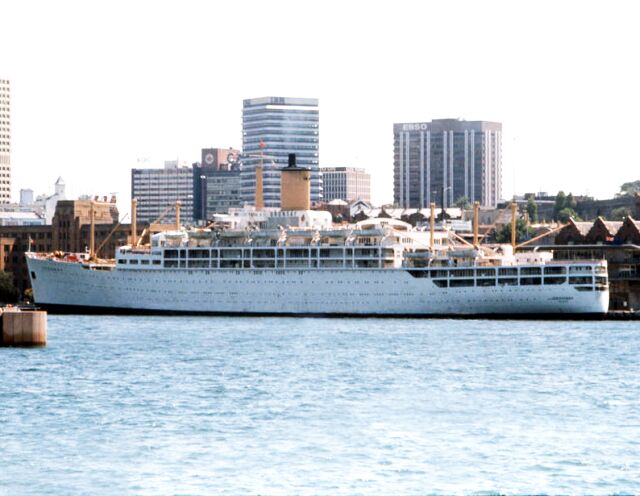
SS Oronsay
seen in Sydney in the early 70’s
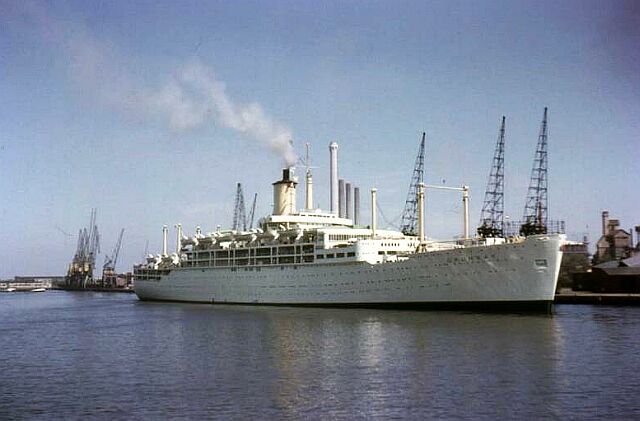
SS Oronsay
seen in Southampton for the very last time
*Photographer
unknown – Please read special photo note at bottom of page
****************************
INDEX:
Part
One:
SS
Oronsay: This
Page covers RMS Oronsay’s complete history - This Page.
SS Oronsay:
Page Two contains this fine ships complete Deck Plan!
Part
Two:…………… Rick Danley sails on SS
Oronsay’s World Voyage in 1962.
Page
One:
Across America / San Francisco to Hong Kong.
Page
Two:
Manila to Port Said.
Page
Three: Port
Said to London & Epilogue – RMS Queen Mary Trans
Atlantic crossing
Page
Four:
Voyage memorabilia, menus and other items – further items to
come online soon!
Watch
the following Pathe films:
www.britishpathe.com/record.php?id=74942
This
film shows SS ORONSAY during her very early days!
www.britishpathe.com/record.php?id=74947
This
is the continuation of the above film
I
highly recommend this superb Book …
“Orient Line
– A Fleet History”
It
is available for £23.50 plus p&p from “Ships in
Focus”
Email:
sales@shipsinfocus.co.uk
****************************
Also Visit our Features on the
following Orient Lines & P&O Liners
Orient
Lines: RMS Orcades - SS
Oronsay - SS
Oriana - RMS
Orion
P&O:
RMS
Strathaird - SS
Iberia - SS
Canberra
“Blue
Water Liners sailing to the distant shores.
I watched them come, I watched them go and I watched them
die.”
ENTER
OUR … ssMaritime Main
INDEX
Where you will
discover well over 700 Classic Passenger & Passenger-Cargo
Liners!
ssMaritime.com
& ssMaritime.net
Where
the ships of the past make history & the story of the 1914
built MV Doulos
If
requesting Passenger or Crew Lists or Sailing Schedules, I am
sorry your email will be Deleted!
I
receive hundreds of requests and I simply do not have any lists
or schedules available.
Please
Note: ssmaritime and associated sites are 100% non-commercial and
the author does not seek funding or favours and never have and
never will.
Photographs
on ssmaritime and associate pages are either by the author or
from the author’s private collection. In addition there are
some images and photographs that have been provided by Shipping
Companies or private photographers or collectors. Credit is given
to all contributors, however, there are some photographs provided
to me without details regarding the photographer or owner
concerned. Therefore, I hereby invite if owners of these images
would be so kind to make them-selves known to me; my email
address can be only be found at www.ssmaritime.com in order that due credit
may be given.
ssMaritime
is owned & © Copyright by Reuben Goossens - All Rights
Reserved